🤔 Why Do 90% of First-Time Board Game Creators Lose Money After a Successful Kickstarter?
You hit your funding goal, backers are thrilled, and the factory gave you a great per-unit printing quote. You think you’ve won. Then reality hits. 😵😵
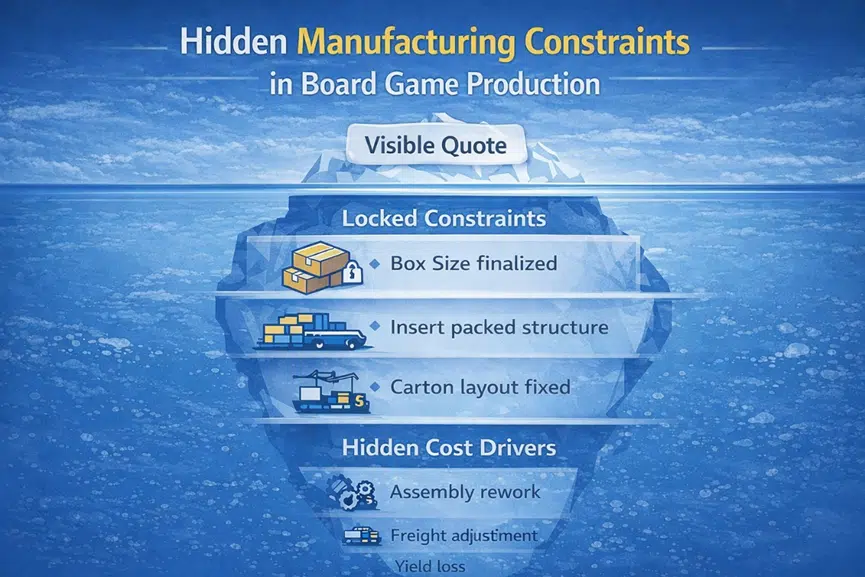
When the final bills for ocean freight, customs clearances, and local fulfillment arrive, your profit margins completely vanish. Why? Because you budgeted based on Factory Price, not True Landed Cost.
As a board game designer, Landed Cost is the financial footprint of every design decision you make. The thickness of your cards, the size of your box, and the type of insert aren’t just aesthetic choices—they are logistics variables that dictate your final bill.
What “Landed Cost” Actually Means to a Creator
In board game manufacturing, Landed Cost is the total expense required to move your finished game from our factory floor in Dongguan directly into your backers’ hands or fulfillment warehouses (like Quartermaster Logistics or Gamesquest).
Many first-time creators pit Factory A against Factory B based solely on the per-unit printing price. But Factory Price is only about 40% to 60% of your actual budget. True landed cost includes:
If you ignore these, your Kickstarter campaign isn’t just risking a lower margin—it’s risking bankruptcy before rewards even ship.
The Landed Cost Formula (Translated for Game Designers)
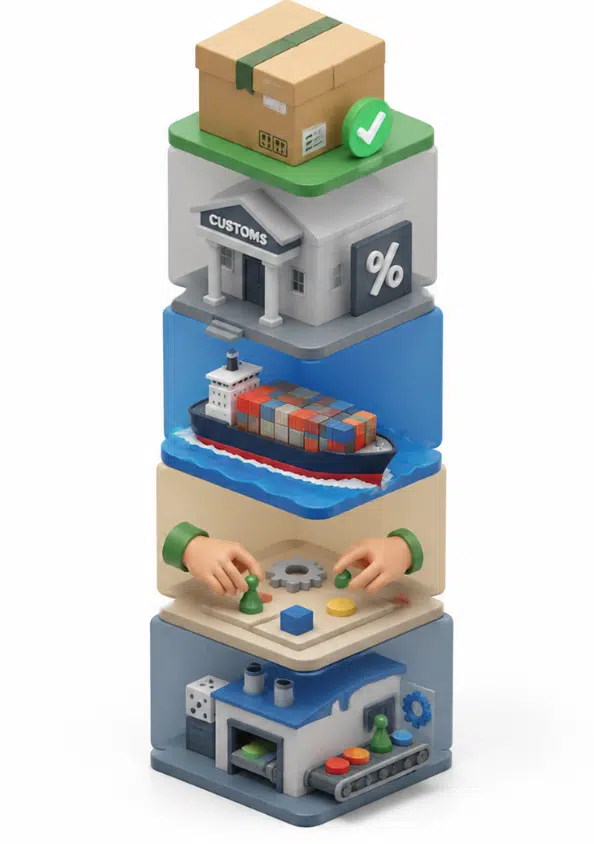
Landed Cost = Manufacturing Cost + Assembly & Packing + International Freight + Import Duties & VAT + Destination Fees
Here is what that actually means for your game:
💡 Tip FROM FUNWAY
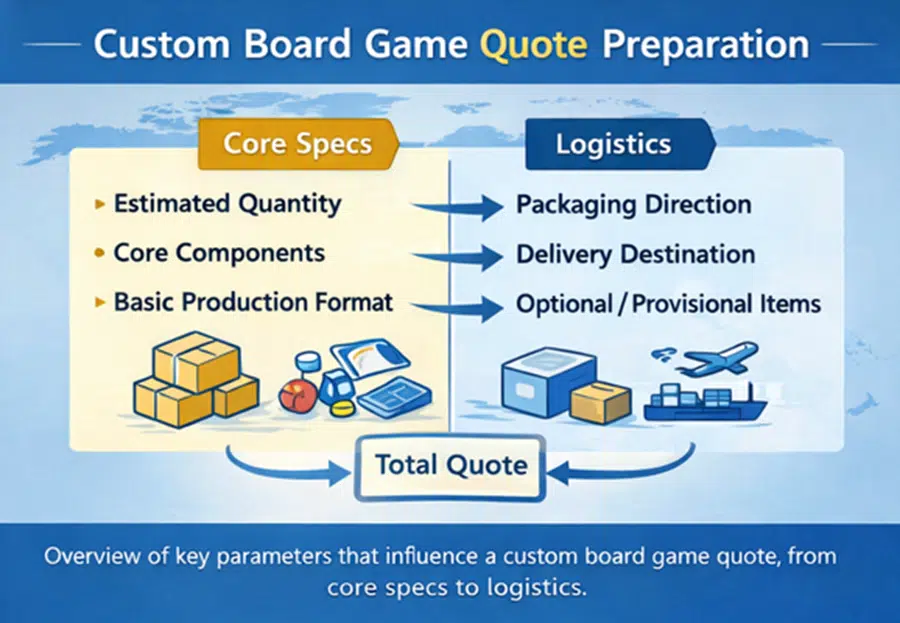
Prepare your specifications before requesting a quote. Without them, you will get either an underestimate that balloons later, or no quote at all. We put together a checklist you can use.
Three Realistic Landed Cost Scenarios
The exact same game specifications will produce vastly different invoices depending on your shipping strategy. Here is how they play out in the real world:
Scenarios | 🚂 Scenario 1: Small-Batch Courier (Express Shipping for Samples or Promos) | ✈️ Scenario 2: Air Freight (The Emergency Rush for Conventions) | 🚢 Scenario 3: Sea Freight (The Standard Bulk Production) |
|---|---|---|---|
When to use | Express couriers care about Box Volume above all else. | You have 200 copies ready, and Essen Spiel or Gen Con starts in two weeks. You need them on booths immediately. | Shipping your main print run of 1,000 to 5,000+ copies to global fulfillment hubs. |
The Reality | Air couriers (like DHL or FedEx) use a strict Volumetric Weight calculation (L * W * H / 5000). | Air freight blends both actual mass and volume, but charges hefty fuel and destination handling surcharges. | Sea freight rewards disciplined packing but ruthlessly penalizes under-filled master cartons. It is calculated by CBM (Cubic Meters). |
The Designer Takeaway | If your prototype insert has 3 cm of empty space just to make the box look “standard size,” you are paying double for that courier shipment. For reviewer runs, shrink the box to the absolute minimum to protect your marketing budget. | If your game is a heavy Eurogame with custom clay poker chips, wooden meeples, or metal coins, air freight will obliterate your retail margins. Keep air freight strictly limited to light card games or high-margin Deluxe Editions. | Do not design your game box in a vacuum. Ask your factory early: “What are the dimensions of the master carton, and how many boxes fit on a standard shipping pallet?” A half-empty master carton means you are paying thousands of dollars to ship factory air across the ocean. |
😱 Are You Paying for Air? (The “Big Box” Tax)

Every designer wants their game to look epic on a retail shelf. It’s tempting to use a massive box to justify a $60 price tag, even if the components only fill 40% of the interior (relying on plastic vacuum inserts to do the heavy lifting).
Here is the marketing truth vs. logistics reality:
If your game box is 20% larger than necessary, you aren’t just paying more for cardboard; you are shrinking the number of games that fit into a shipping container. You are effectively paying a premium to ship air. Work with your manufacturer early to optimize component layouts and shrink your box footprint without compromising the unboxing experience.
Why Volumetric Weight is a Design Outcome, Not a Freight Issue
Many publishers fall into the “Cost-Lock Trap.” They approve their final packaging after the First Article Inspection (FAI), launch their campaign, and only calculate shipping at the very end. By then, the dimensions are locked, and the overruns cannot be engineered away.
Volumetric penalties are almost always caused by decisions made at the design table:
The Logistics Reality: A bigger box means fewer games fit into a container. You are effectively paying a premium to ship air.
Your “Quote-Ready” Specification Checklist
Before you ask a factory for a landed cost estimate, make sure you have these exact parameters ready. Missing details lead to “optimistic quotes” that don’t survive reality:

Download the Board Game Pricing Risk Checklist to audit your budget today.
These inputs map directly to the pricing checkpoints in Manufacturing Cost, Shipping, Taxes, and Total Landed Price Explained. Missing information introduces uncertainty, and uncertainty leads to optimistic estimates that do not survive contact with reality.
How This Article Fits the Pricing System
📝 This article is part of the Custom Board Game Pricing System. For system-level context, see:
🥳 Let’s Optimize Your Box Before You Lock Your Specs
Have you finished your game artwork and settled on a box size, but aren’t sure if those dimensions are a logistical nightmare?
Don’t wait until your Kickstarter campaign ends to find out your shipping budget is short. Send your preliminary specs to FUNWAY. Our team doesn’t just print games—we engineer them. We will run a Landed Cost Feasibility Review on your initial specs to hunt down hidden “air costs” and optimize your packaging before it’s too late.
Get your specifications reviewed before you calculate costs. That is the same thing we tell every creator at Funway.

Author: August Hu
Project Manager at FUNWAY • 19 years in game printing & manufacturing