
Sell Your Art as Puzzles: How Artists Can Turn Artwork into Collectible Puzzle Merchandise
Selling prints is not the same as selling puzzles.
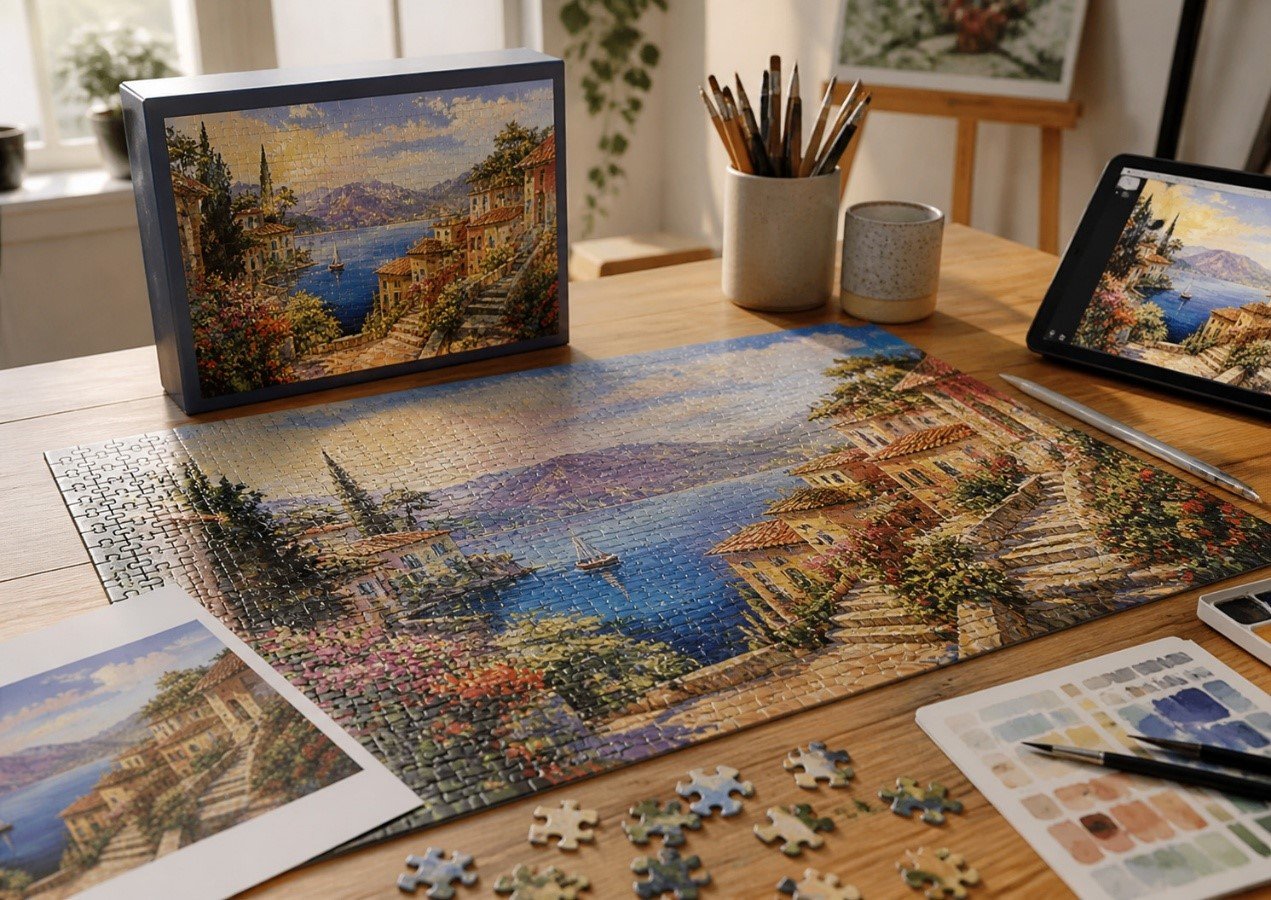
A print is bought, framed, and then it mostly becomes part of the background. A puzzle asks for more from the buyer. It takes table space. It takes time. It gets touched, sorted, rebuilt, photographed, gifted, and sometimes kept as part of a collection.
That is why more artists are looking for ways to sell your art as puzzles instead of only selling posters, cards, stickers, or canvas prints. A puzzle gives fans a slower way to stay with the artwork.
But this is also where many projects go wrong.
Stop treating puzzles like graphic design projects. They are physical inventory. If you wait until the artwork looks ‘nice’ to think about packing density or repeat-order margins, you’ve already lost. A puzzle that looks great on screen but forces an oversized box—or an unsustainable retail price—is a failed SKU before it even hits the press.
Before asking for a quote, ask one harder question:
Will people want to spend two or three evenings inside this image?
If not, it may still be a good print. It may not be a good puzzle.
Why Puzzles Work Better for Some Artists Than Others
The puzzle market has warmed up because puzzles are no longer only treated as children’s products or casual family games. They now sit in museum shops, gift stores, artist drops, bookshops, creator stores, and Kickstarter reward tiers.
That does not mean every artist should make one.
Don’t pick artwork just because it looks good on a screen. For a puzzle to work, it needs ‘discoverable density.’ Cityscapes, intricate maps, or busy character groups give the buyer a reason to slow down. Nobody wants to spend twenty hours staring at a flat blue sky. If the artwork lacks detail, you’re not selling an experience—you’re just selling 1,000 pieces of frustration.
A quick visual-hit image may sell well as a poster but still fail as a puzzle. That is the first uncomfortable point. Strong art and strong puzzle art are not always the same thing.
Most artist merchandise is consumed quickly. Someone buys a sticker, uses it, and moves on. A puzzle creates table-time. The buyer opens the box, sorts pieces, studies small differences, gets stuck, comes back later, and finishes the image slowly.
That is where the value is.
So do not treat puzzles as another print size. Treat them as interactive art merchandise.
Start With the Image People Already Linger On
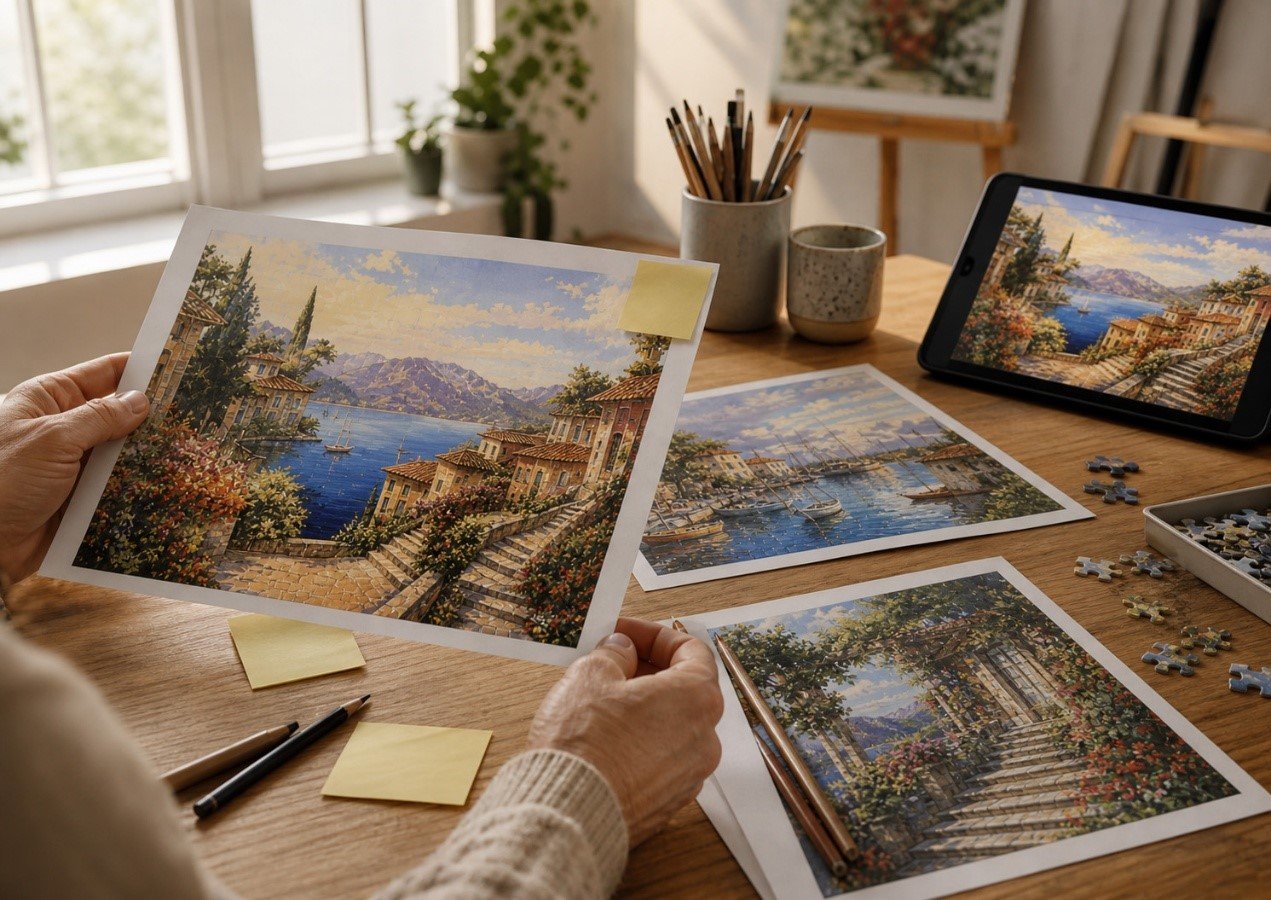
Artists often want to use the piece they personally like most. That is understandable. It is not always the best commercial decision.
It is not always the best commercial decision.
For a first puzzle, start with the image that already has proof of interest.
Look at which artwork gets saved, shared, commented on, or asked about. Which image sells better as a print? Which one do people zoom into online? Which one gets attention at fairs or exhibitions? That informal reaction data matters more than personal preference.
A puzzle asks for more commitment than a print. It costs more, takes more storage space, and requires the buyer to actually spend time with it. If the artwork has no existing pull, the puzzle format will not magically create demand.
A safer first puzzle candidate usually has one or more of these signals:
A weak candidate often looks attractive from a distance but becomes dull when broken into pieces. Large empty skies, plain black backgrounds, soft gradients, and repeated abstract fields can all cause problems.
Minimal art can work, but only if the buyer expectation is right. A design-store audience may appreciate a quiet abstract puzzle. A casual 1000-piece buyer may just feel punished.
The factory can produce the puzzle. It cannot make a weak puzzle image interesting after the artwork is already fixed.
Check the Table-Time Value Before Piece Count
Many artists ask for 1000 pieces first because it sounds premium.
That is usually too early.
The first question should be: does the image have enough table-time value?
A puzzle needs visual information the player can use. Not clutter. Information. Color shifts, small objects, texture changes, linework, figures, plants, windows, symbols, shadows, architecture, borders, and layered background details all help the buyer move through the puzzle.
Review the artwork in a practical order.
First, look at the full image. Does it have a strong overall impression?
Then zoom in. Are there enough local details to help sorting?
Then check the edges. This is where artists often miss the problem. Prints are judged from the center. Puzzles are often started from the border. If the edge is mostly blank sky, empty wall, or flat color, the first step already feels slow.
Then check repeated areas. If 40 flowers, windows, stars, or leaves are almost identical, the puzzle may become annoying instead of interesting.
A useful production-side rule: if more than 20–25% of the image is visually similar, think carefully before choosing a high piece count. The buyer may not call it “poor artwork distribution,” but they will feel the drag.
Good puzzle difficulty does not come from hiding information. It comes from giving enough clues, but not all in the same place.
Choose Piece Count Based on Buyer Type
Piece count is not a status symbol. It is a user-experience decision.
A serious puzzler may enjoy a long 1000-piece build. A fan buying artist merchandise may want something satisfying but not exhausting. A museum visitor may buy it as a gift. A parent may want something approachable. These are different buyers.
For most first-time custom puzzles for artists, 500 pieces is often the safer first SKU. It still feels substantial, photographs well, and works as a gift, but it does not scare off buyers who are fans first and puzzlers second.
300 pieces can work for event merchandise, younger audiences, family gifts, museum shops, or lower-price entry items.
1000 pieces should be reserved for artwork with enough detail and an audience that actually wants longer solving time.
Do not use 1000 pieces as a shortcut to a higher price tag. If the artwork cannot carry that much table-time, the product stops feeling premium and starts feeling tedious.
A better decision sequence is:
Many artist puzzle projects fail because this order gets reversed. The artist wants a premium product, so the project starts with 1000 pieces and a large box. But the actual buyer only wanted a beautiful, approachable merchandise item.
Premium does not always mean more pieces. Sometimes it means the artwork choice is smarter, the box feels worth keeping, and the edition story is controlled.
Adjust the Artwork, But Do Not Kill It
You should not redesign the whole artwork just to make it easier to puzzle. That usually makes the art worse.
But small adjustments can prevent obvious problems.
If the top third of the image is plain sky, consider adding cloud texture, birds, light variation, distant buildings, or anything that naturally belongs in the scene. Do not add random decoration. Add useful visual information that feels native to the artwork.
If the image has repeated flowers, windows, stars, leaves, or tiles, avoid making them identical. Slight changes in direction, color, spacing, or scale help the player sort pieces without making the image look artificial.
Keep signatures, logos, QR codes, and important text away from the final edge. A digital mockup looks exact, but physical cutting has tolerance. For important elements, keep at least 5–8 mm of safety distance from the trim edge. More is safer for small text.
Also be careful with tiny lettering inside the puzzle image. Text often works better on the box, certificate, or insert card. On the puzzle itself, very small type may become weak after printing and cutting.
The aim is not to optimize the artwork to death. The aim is to remove the obvious puzzle risks: dead zones, repeated sameness, edge emptiness, tiny text, and important details placed too close to the border.
Fix those before production. After cutting, they are no longer design problems. They are product problems.
Build the Box Like Artist Merchandise
The box is where a puzzle stops looking like a printed object and starts looking like an artist product.
If the box only shows the image, piece count, and product name, it is doing the minimum. That may be enough for a generic retail puzzle. It is weak for an artist SKU.
For art puzzle merchandise, the box should carry identity. It should tell the buyer who made the artwork, what the image is, and why this edition is worth keeping.
A practical branded box can include:
Keep the artist bio short. A puzzle box is not a gallery essay. Buyers need a fast answer: who made this, what is it, and why does this version exist?
For lower-price retail or event products, a folding carton may be enough. For premium artist merchandise, a rigid box or strong paper-wrapped box usually makes more sense. It gives the product more gift value and makes the box worth keeping.
But a bigger box is not automatically premium. Often it just means wasted carton space, higher freight, and poorer carton efficiency. A box can look impressive in a product photo and still become annoying when shipping in volume.
Side panels matter for shelf display and warehouse picking. The back panel matters for product photos and story. The bottom panel may need barcode, legal marks, manufacturer details, or recycling symbols.
This is not decoration. This is the part that turns puzzle merchandise ideas into something sellable.
Use an Insert Card Instead of Overloading the Box
Many artists try to put the whole story on the back of the box. That usually makes the packaging crowded.
A small insert card often works better.
It can carry the artwork title, artist note, QR code, care note, edition number, or collection link. For signed editions, the insert card can also become the certificate.
This keeps the box clean while still giving the buyer a story to keep.
The insert does not need to be long. One short paragraph is usually enough: where the artwork came from, why this image was selected, or how it fits into the larger collection.
For premium artist puzzles, a simple insert card can do more work than extra decoration on the box. It also gives you a controlled place for signature and numbering, which matters when you start selling limited editions.
Limited Editions Need a Real Packing Plan
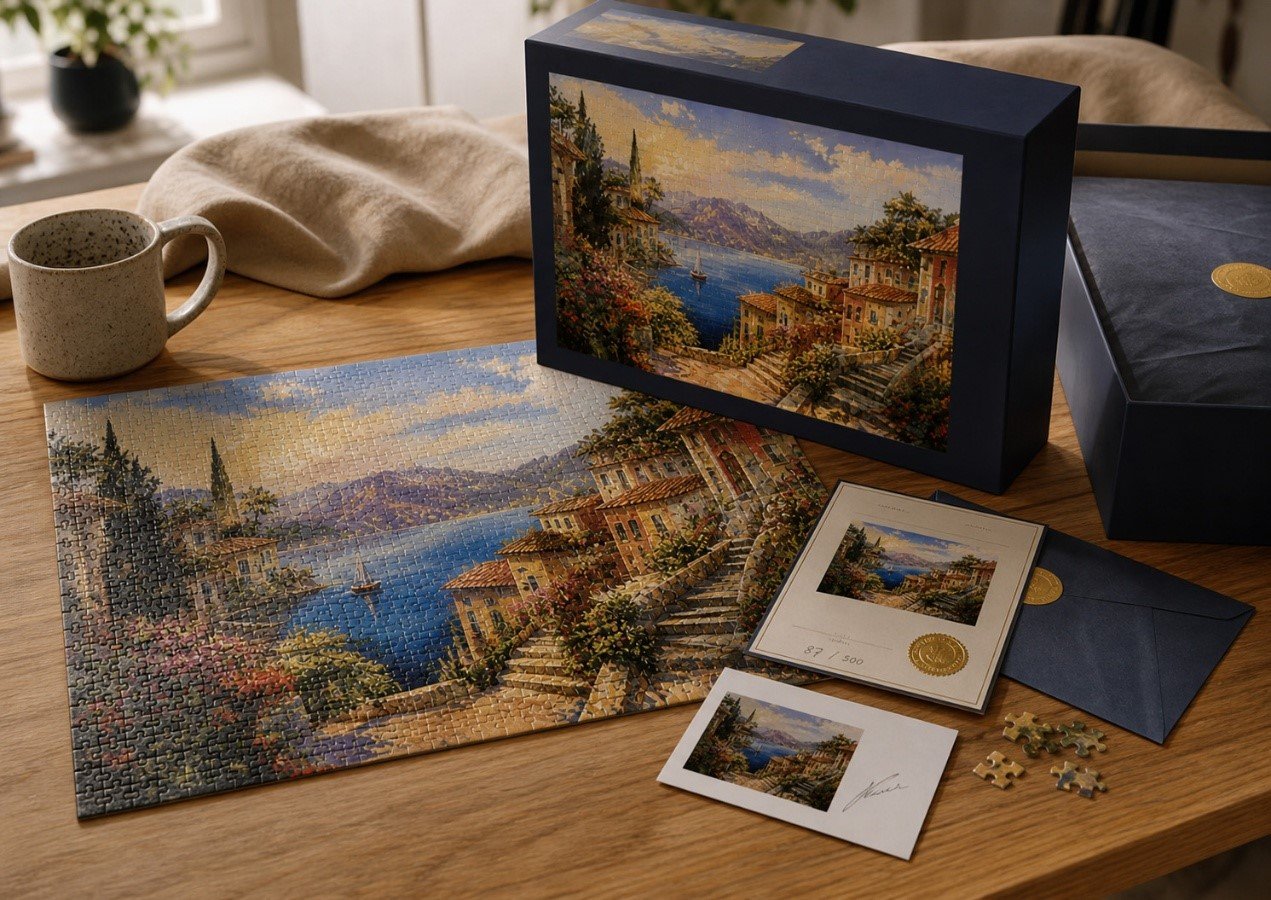
“Limited edition” is easy to print. It is harder to control.
A numbered edition is the clearest format: 1/300, 2/300, 3/300. Buyers understand it immediately.
Signed editions can also work, but the signing method matters. Signing every box sounds romantic until you need to control numbering, avoid surface marks, and keep packing moving. Boxes can scratch, dent, or get mixed.
In most cases, a signed certificate or signed insert card is cleaner. The box stays production-stable. The collectible value sits inside the product where it is easier to control.
Plan these details before packing day:
If numbering is not tracked properly, you do not really have a limited edition. You have printed boxes and a future customer service problem.
A better model is simple:First release: 300 or 500 pcs numbered edition.
Factory Choice Affects Artist Brand Trust
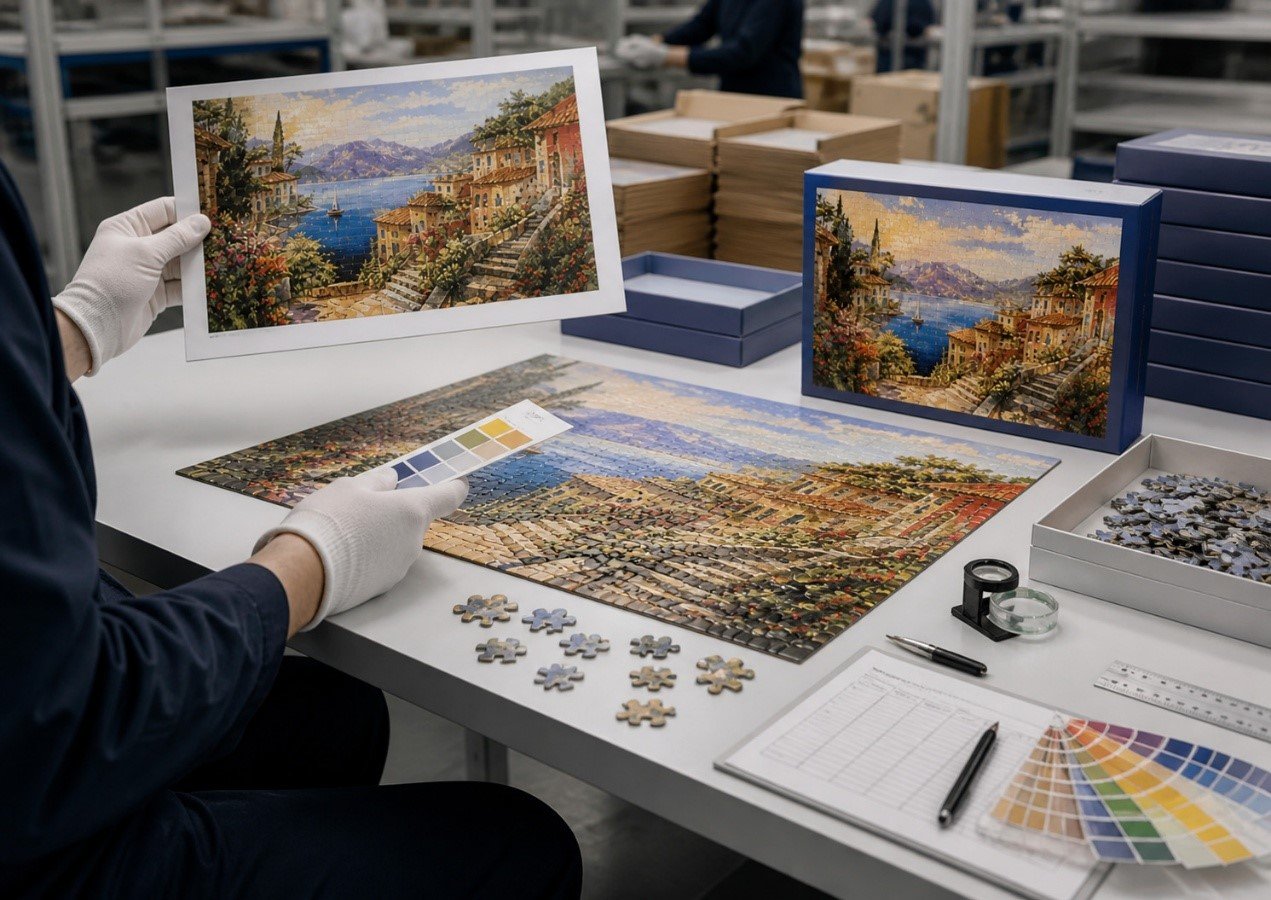
For artist puzzles, production quality becomes part of the artist brand.
If fans already know the artwork, they will notice when the puzzle looks like a weaker version of it. Dull color, muddy shadows, rough edges, weak packaging, or inconsistent repeat orders all reduce trust.
The factory’s job is not just to reproduce the file. It is to keep the artwork from losing value when it becomes a physical product.
For artist puzzle projects, check whether the supplier can handle:
A good supplier is not the one who agrees to everything. It is the one who tells you early when the artwork is too flat for 1000 pieces, when the box size will hurt freight, or when the edition plan will create packing trouble.
The cheapest quote is often the most expensive mistake later. If the color comes back dull, the box feels weak, or the second run does not match the first release, the savings disappear quickly.
For artist brands, repeat buyers matter. Do not damage them with a product that feels cheaper than the artwork promised.
Recommended First Setup for Artist Puzzle Projects
For a first commercial artist puzzle, keep the project tight.
This is not the only possible setup. It is just a safer starting point than launching five designs, three sizes, and custom packaging before you know what the audience will buy.
For an artist with a strong collector base, a 1000-piece signed and numbered edition can work. The buyer is not only buying a puzzle; they are buying a limited object connected to the artwork.
For a broader audience, I would not start there. A 500-piece puzzle is usually easier to sell because it feels complete enough as a gift, but still approachable for people who are fans first and puzzlers second.
For very small personal-gift quantities, factory production is usually the wrong tool. Print-on-demand may be less controlled in color, packaging, and material feel, but for 5–20 pieces, it is often more realistic than forcing a commercial production model.
Print-on-demand (POD) is useful for testing. Factory production is better for branded merchandise, retail sales, consistent packaging, and repeatable quality.
Do not pretend these are the same model.
When Artists Should Not Make a Puzzle Yet
A puzzle is not right for every artist or every artwork.
If the audience has not shown interest in physical merchandise, test demand before committing to inventory.
If the artwork has large empty areas, subtle gradients, or very dark tones, do not force it into a high-piece-count puzzle.
If the design changes every few weeks, puzzle manufacturing may become inefficient. Puzzles work better as planned SKUs, not fast-moving micro-products.
If the budget only stretches to the cheapest board, weak packaging, and no proofing, do not market the result like a collector product. Buyers may not know the manufacturing details, but they can feel when the physical product does not match the online story.
And if the artist only needs a few pieces for gifts, custom factory production may be unnecessary.
So the warning is not ‘do not make puzzles.’ The warning is narrower:
Do not make puzzles just because the format feels fashionable.
Make them when one image already has pull, the artwork can hold table-time, the packaging supports the brand, and the edition plan can be controlled in production.
For artists, the strongest puzzle products are not the ones with the most pieces. They are the ones where artwork, fan demand, packaging, edition logic, and manufacturing reality point in the same direction.