
500 vs 1000 Piece Puzzle: How to Choose the Right Jigsaw Puzzle Difficulty Level
Clients often fixate on the ‘1,000-piece’ mark before auditing the artwork’s actual data density. The result is usually a ‘Dead Zone’—large areas of repetitive sky or shadow that turn a premium hobby into a brute-force grind. They chase the ‘premium’ label without realizing they might be manufacturing a product that is literally unplayable for their target audience.
The number sounds better. It looks more serious. It can also support a higher retail price on paper. But if the image is too flat, the buyer is too casual, or the finished size starts creating table-space problems, that “upgrade” is not always helping the product.
So when you compare a 500 vs 1000 piece puzzle, do not start with “which one sounds more premium.” Start with the real question: Will the customer actually finish it?
That is where jigsaw puzzle difficulty levels should begin. Because piece count does more than change the number on the box. It changes table space, sorting time, frustration level, finished size, packaging, and in the end, whether the puzzle gets completed or left half-built in a corner.
Puzzle Difficulty Is Not Just Piece Count
The number on the box is the easy part. It is also the part buyers rely on too much.
What actually makes a puzzle feel easy or hard is the image. I have seen 1,000-piece puzzles move quite smoothly when the artwork gives the player something to work with — clear color blocks, strong landmarks, obvious objects, clean visual zones. I have also seen 500-piece puzzles drag badly because too much of the image is doing the same thing: dark background, repeated texture, weak contrast, no real sorting clues.
That is the practical difference.
💡 Pro Tip
A puzzle becomes difficult when the player has to guess instead of sort. Flat skies, soft gradients, repeated flowers, repeated windows, black backgrounds, snow fields, ocean surfaces, or abstract textures can all create that problem. Audit your artwork’s solve-rate before the first proof is pulled.
That may be fine if you are designing for experienced puzzlers on purpose. It is a poor decision if the buyer is a casual gift customer and the product ends up feeling like work.
For custom puzzle products, this matters a lot. A serious puzzler may enjoy a slow challenge. A museum shopper may want something beautiful but still approachable. A family buyer usually wants everyone at the table to place pieces, not stare at the same blue area for twenty minutes.
⚠️ Lead Time Risk: So difficulty should be planned early. Fixing a ‘tiring’ image at the physical sample stage is a waste of a proofing cycle. If you aren’t auditing the artwork’s solve-rate before the first proof is pulled, you’re already burning your lead time.
Finished Size: Where 500 and 1000 Pieces Start to Feel Different
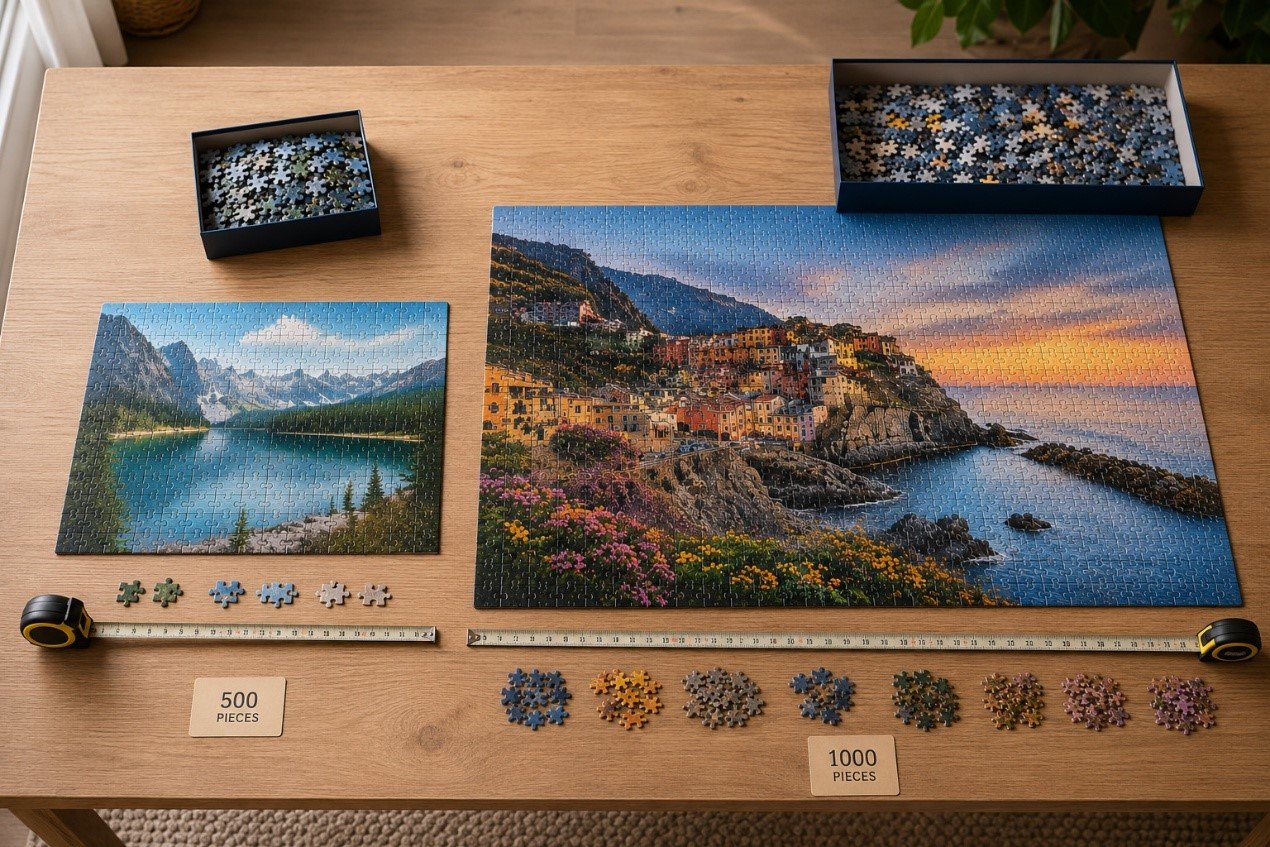
This is where the difference stops being abstract
This is where the difference stops being abstract.
A 500-piece puzzle usually behaves like a normal home product. It can sit on a dining table, coffee table, or puzzle mat without taking over the whole space. There is still room around it for sorting.
A 1,000-piece puzzle starts asking more from the buyer.
More table space.
More room around the edges.
More time before the table can be used for something else.
That is easy to ignore when looking at a product photo, but it becomes obvious once the puzzle is opened. If the customer has to clear the table every night before dinner, the product immediately feels less convenient.
Typical Finished Sizes
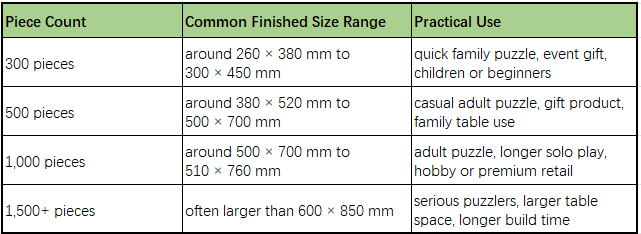
These are working ranges, not fixed global rules. Tooling, piece shape, market style, and box format all affect the final size:
💡 Pro Tip
Finished size does not only affect the player. It affects the box too. A 1,000-piece puzzle may not look much more expensive in material alone, but once the finished size pushes the box bigger, the carton loading changes. That is where the real cost difference often starts.
⚠️ Shipping Margin Alert: Do not compare 500 vs 1000 pieces by unit price alone. Check the finished size, box size, and how many sets actually fit into one export carton. A puzzle can be perfectly playable and still become a bad SKU if the format quietly eats your shipping margin.
500 Pieces: Easier to Finish, Easier to Gift
For many retail or gift-led projects, I would not treat 500 pieces as the “smaller” option. A 500-piece puzzle is often the format people actually finish.
That sounds simple, but it matters. For gift shops, museum stores, travel souvenirs, and family products, completion is part of the value. The buyer should be able to open the box, make visible progress, and finish the puzzle without needing to protect the dining table for three days.
This is why I do not treat 500 pieces as a “small” puzzle. I treat it as a safer retail format. It gives enough build time to feel like a real product, but it does not ask casual buyers to behave like serious hobby puzzlers.
500 Pieces Work Best For
The common mistake is thinking 500 pieces sounds less premium. It does not have to. A 500-piece puzzle with a strong image and proper packaging can sell better than a 1,000-piece puzzle that feels like homework. Many buyers do not want maximum difficulty. They want something they can finish and feel good about finishing.
For gift-led products, that matters. A buyer choosing a puzzle for a parent, friend, tourist, or family evening is usually buying a pleasant activity, not a long-term challenge. For that use, 500 pieces is not a downgrade. It is often the more sellable product.
1,000 Pieces: Better for Serious Puzzlers, Worse for Casual Buyers
A 1,000-piece puzzle earns its place when the image and audience can support it. It works for adult hobby puzzlers, detailed maps, illustrated worlds, city scenes, landscapes with many visual zones, and premium retail products where the buyer expects several sessions of solving.
A 1,000-piece puzzle makes weak image planning show up fast. If the artwork has too much repeated sky, water, foliage, brick, window, or dark background, the extra pieces do not create a better product. They create more places for the buyer to get stuck.
That is the part many buyers miss when they compare piece count on a quote sheet. The number looks stronger, but the actual playing experience may get worse.
Use 1,000 pieces when the image has enough visual zones and the buyer wants a longer build. Do not use it just because the number looks more serious.
A 1,000-piece puzzle can look stronger on a quotation sheet. It may also look better on a product page. But if your customer base is broad, casual, or gift-led, starting there can be over-positioning.
Some Puzzles Are Hard for the Wrong Reason
A difficult puzzle can be a good product. A boring difficult puzzle usually is not. There is a difference between a puzzle that challenges the player and a puzzle that simply gives them nothing useful to work with.
Some puzzlers enjoy a serious challenge. They may want monochrome areas, repeated patterns, or a very slow build. That is fine if the product is sold honestly as a difficult puzzle.
⚠️ The Frustration Trap: The problem is when a normal gift puzzle accidentally becomes one of the hardest puzzles to solve. That usually happens for boring reasons: too much sky, too much ocean, too many similar windows, too many repeated flowers, too much black background, or a gradient where the pieces give almost no clue. The buyer may still finish it once. But they will not buy the next one for a friend.
If the difficulty is intentional, label it that way. If it is accidental, fix the image or reduce the piece count.
This is where product planning matters more than marketing language. “Challenging” can be a good selling point. “Frustrating by accident” is not.
Beginner Strategy: Start With the Border, But Do Not Stop There
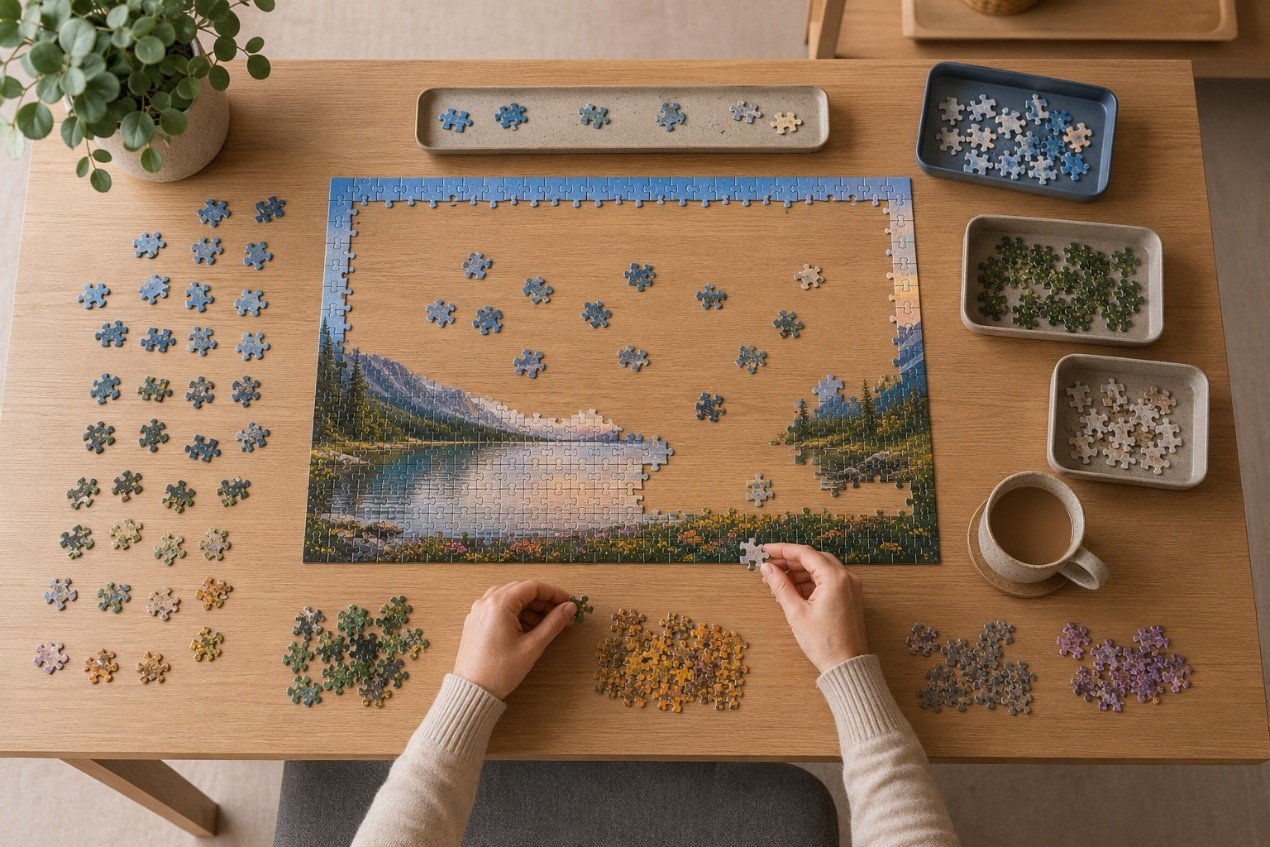
For beginners, “border first” is still useful advice. It just should not be the whole strategy.
The border gives the puzzle a frame. It shows the real finished size and stops the build from becoming a pile of unrelated pieces. For 500 pieces, this is usually manageable. For 1,000 pieces, the border stage takes longer, especially when the edge artwork is repetitive.
That is why edge design matters. Four sides of similar blue sky may look clean in a print, but it gives a beginner very little to work with.
A Better Beginner Sequence
💡 Pro Tip
This matters for product planning, not only for players. If a beginner can sort by border, color, buildings, faces, plants, or text, the puzzle starts well. If every pile looks the same after ten minutes, the product is probably too hard for that buyer group. For family, museum, tourist, or first-time puzzle products, the first ten minutes matter more than many brands expect.That is when the buyer decides whether the puzzle feels inviting or exhausting.
A bad first ten minutes can shape the whole product experience.
Solo Puzzle vs Family Puzzle: Piece Count Should Change
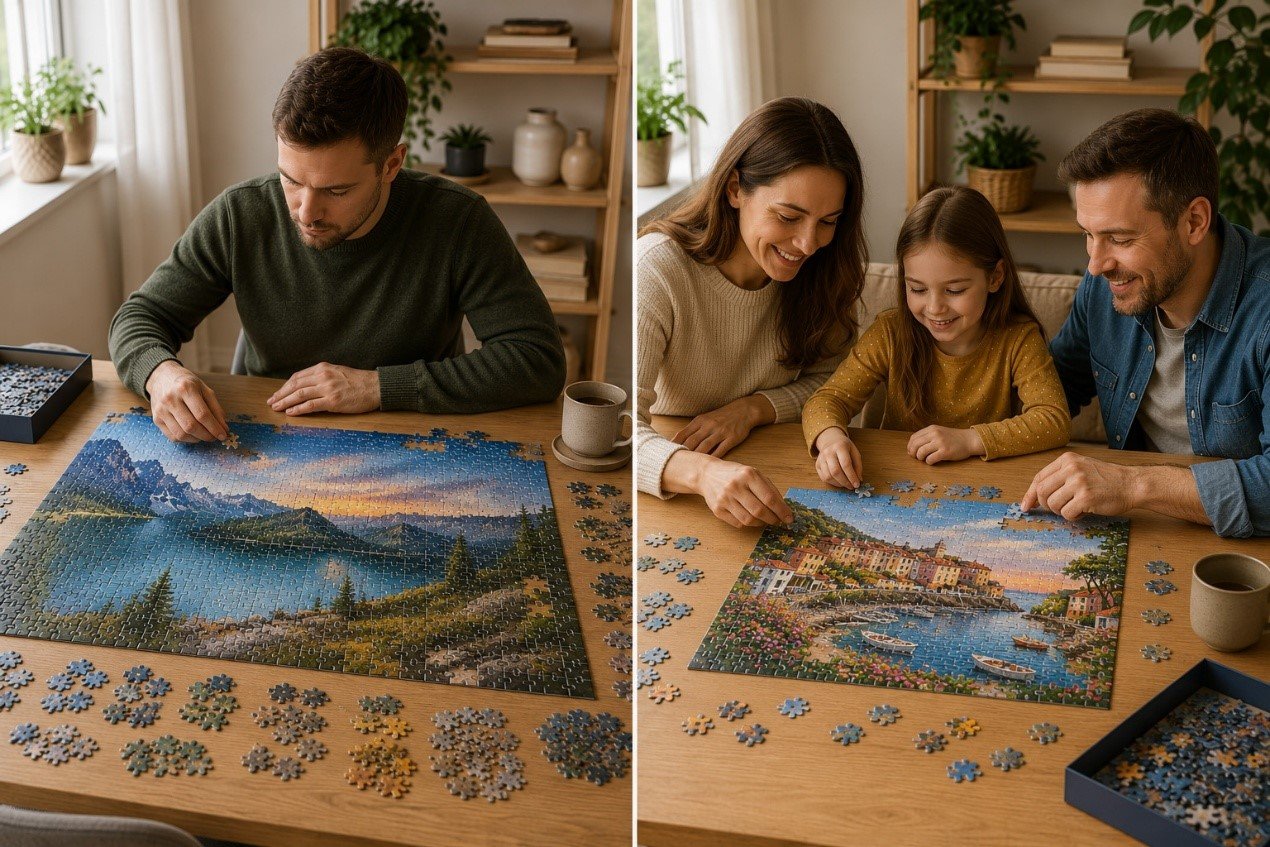
One person solving alone and four people around a family table are not the same use case.
A solo puzzler can accept slow progress. That is part of the hobby. They may sort pieces today, build one section tomorrow, and leave the puzzle on a mat for a week. For that buyer, 1,000 pieces can work well if the image has enough detail and the finished size fits their space.
A family table works differently. When several people sit down together, the puzzle needs to produce progress quickly. Children need pieces they can place. Adults need the activity to keep moving. If everyone spends ten minutes staring at the same blue or black area, the room goes quiet for the wrong reason.
That is why I would not make 1,000 pieces the default for family or event use. It can work for puzzle-loving families, but it is a risky first choice for a broad audience.
💡 Pro Tip
For mixed-age buyers, 500 pieces is usually the easier product to recommend. There is enough work for several people to share, but not so much that the puzzle takes over the table or loses the younger players halfway through. For solo hobby use, 1,000 pieces can absolutely make sense — but only if the artwork supports it.
In some projects, the cleanest answer is not choosing one or the other. It is making two SKUs from the same artwork: a 500-piece version for general retail and a 1,000-piece version for serious puzzlers.
That is often a better product decision than forcing one version to serve everyone.
Match Difficulty to the Product, Not Just the Piece Count
If you are building a puzzle line, do not let the piece count do all the positioning work.
A 300-piece or 500-piece puzzle can be your easy family product. That does not make it low-end. A successful SKU needs clear ‘visual data’ to help the player navigate the image. If the art lacks distinct zones for easy sorting, you aren’t selling a hobby — you’re selling a frustration.
For standard adult products, the goal is to hit that sweet spot: enough detail to feel satisfying, without the repetitive patterns that force a player into mindless guessing. Once you introduce large dead zones or zero-contrast areas, you’ve moved out of the gift market and into ‘expert-only’ territory. Know the difference, or your buyers will.
Expert Formats: Sell Them Honestly
Expert formats are a different category: monochrome puzzles, gradient puzzles, double-sided puzzles, no-border puzzles, or images built around heavy repetition. Those products can be great for the right customer. They are terrible for the wrong one.
⚠️ Labeling Matters: Do not package an expert puzzle like an easy gift puzzle and let the buyer discover the difficulty after opening the box. This is why difficulty labeling is not just a nice extra. It keeps the wrong buyer from choosing the wrong puzzle.
What We Recommend Before Quoting a Custom Puzzle
Before asking a factory for a custom jigsaw puzzle quote, do not send only the artwork and a piece count. That is enough for the factory to calculate something, but not enough to judge whether the product direction is right.
A Useful Inquiry Should Include
A Better Inquiry Sounds Like This
“We need a family-friendly 500-piece puzzle for museum retail. It should be easy enough for mixed-age buyers, fit a normal table comfortably, and use a box that still works as a gift item.”
That gives the manufacturer something useful to work with. Not just a number. A product direction.
A Warning, Not a Soft Ending
The real question is not “How many pieces can we sell?” It is: who is going to solve this puzzle, and will the image give them enough clues to keep going?
That is the real logic behind 500 vs 1000 piece puzzle planning.
⚠️ Final Word: The hardest puzzles to solve are not always the best products. Sometimes they are just puzzles built for the wrong buyer.