Showing 33–48 of 58 results
-

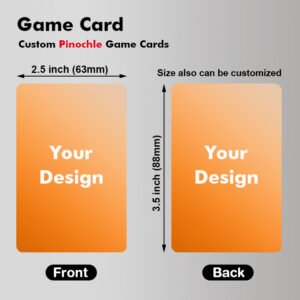
For Pinochle game playing cards, the size usually stays close to the format players are already used to. You can push it bigger or smaller, but that is often where the deck starts to feel a little off in actual play, even if the print itself comes out fine. That problem usually shows up in handling first, not on the press sheet.
So this is normally treated as a known playing format, not a place to make the deck look different just for the sake of it. The card still needs to feel right in hand, stay easy to read, and match the pace players expect from this kind of game.
-
We create Plastic Game Playing Cards. Upload your high-quality image or artwork, and we will precision-print it to fit this layout, ensuring a sharp and professional look. To protect your custom creation, each finished deck is securely shrink-wrapped. For the perfect finish, you can add a premium packaging option like a deluxe tuck case or rigid box, or a tin box to complete your deck.
-
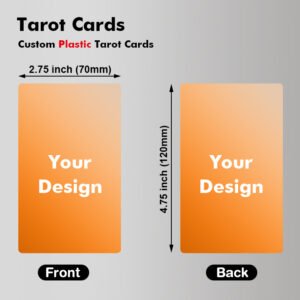
For tarot cards, plastic is usually being chosen for durability first. Tarot decks are picked up, laid out, gathered back into the deck, and kept in use over long periods, so paper wear shows up sooner than many people expect. Once the deck moves to PVC or PET, that part changes. The cards hold up better against moisture, edge wear, and repeated handling, which is why plastic can make sense on tarot when long service life matters more than paper feel.
The larger tarot format usually carries plastic better than smaller cards do, but the deck will not feel or print like a paper tarot deck afterward. That change needs to be understood early, before the artwork and structure are already moving in the wrong direction.
-
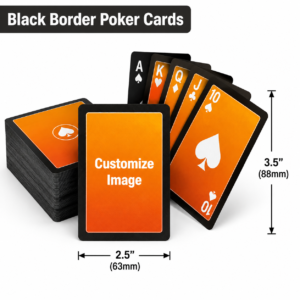
For poker size playing cards, a black border should be treated as a visual decision, not a tolerance-friendly one. In offset production, small cutting drift is normal. Once the edge turns dark, that same drift becomes much easier to notice and is often read as poor centering. The border does not make the deck more accurate. It simply makes normal production variation harder to hide.
That is why black-border poker decks are usually chosen for projects where framing, contrast, and artwork presentation matter more than production forgiveness. They make more sense for collector editions, presentation-led retail decks, and art-driven concepts than for large repeat runs that need a more forgiving layout.
-
For poker size playing cards, lenticular is not something you add onto a normal deck at the end. Once the front changes to a lenticular lens, the card stops behaving like a standard playing card. The structure gets thicker, the surface gets harder, and the deck starts moving away from regular gameplay use.
This approach usually makes sense when the deck is meant to create visual impact rather than support intensive gameplay. If the project still depends on smooth shuffling, compact packaging, or fast readability, lenticular is rarely the first direction we recommend.
-
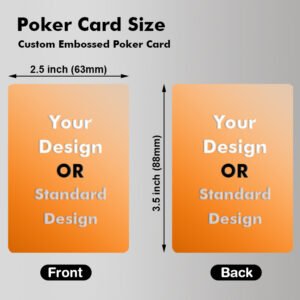
For poker size playing cards, embossing should not be treated as a surface effect that can be dropped in at the end. Once part of the card face is raised, the card no longer feels or behaves like a fully flat print. The change may be small, but it starts affecting both touch and deck handling.
That is why embossing usually works better when it is being used to pick out one visual point, not when the whole card still has to read fast and handle like a normal gameplay deck. For brand-led, promotional, or presentation-focused cards, it can add a clear tactile layer. For decks built around quick reading and repeated play, it usually needs to be kept under control.
-
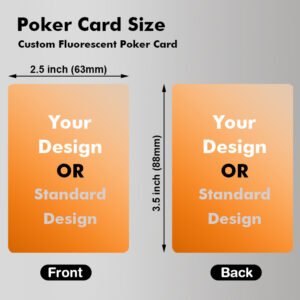
For poker size playing cards, fluorescent printing is not something you add just to make the deck look brighter. The whole point of it shows only under UV or blacklight conditions. Under normal light, the colors often look softer than people expect, so the deck may feel underwhelming if the artwork was not built for that trade-off from the start.
That is why fluorescent poker cards only make sense when the use environment is already clear. In UV-reactive settings, the effect can do its job very well. In normal gameplay or standard retail use, it often adds more production work than real value.
-
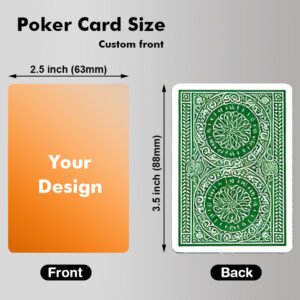
For poker size playing cards, a front-only printing setup is often the more practical choice when the back does not carry unique game information. Many projects start by assuming they need printing on both sides, but once the layout is reviewed properly, that extra complexity often turns out to be unnecessary. A custom front with a standard or uniform back usually gives a cleaner and more controllable result.
The first benefit shows up in production stability. Once front-to-back alignment is removed from the job, the deck becomes much less exposed to normal registration tolerance. That matters more than many clients expect. On double-sided cards, even a small shift can start showing in borders, corner marks, or centered elements. On a front-only structure, those issues simply do not pile up in the same way.
This also makes repeat production easier to hold steady. Color control is usually more predictable, visual consistency across the deck is easier to maintain, and the risk of customer complaints over back alignment is reduced. On larger runs, that kind of simplification is often worth more than it looks at the quoting stage.
-
For poker size playing cards, gilded edges are a presentation decision first. The deck looks richer as soon as the edge goes on, but it also stops feeling like a plain poker deck. The edge gets slicker, and after some real handling the pack starts showing that difference in a way a fresh sample often does not. That is where gilding stops being just a visual upgrade.
That is why gilded edges usually sit more naturally on premium retail decks, collector releases, gift products, and brand-led editions where the finish is part of what the customer is paying for. They become a more careful decision when the deck is still expected to be shuffled hard and handled like a normal playing deck.
-
For poker size playing cards, gold foil is not something to add casually after the artwork is finished. Once foil goes onto the card face, that part of the layout stops behaving like normal print. It catches light differently, feels different in hand, and starts pulling attention faster than the rest of the design. On the right element, that works. Push it too far, and it starts creating problems instead of value.
That is why gold foil usually works better on logos, titles, suit symbols, and other areas that are meant to be picked up first. On decks that still need to read fast and play like normal poker cards, the foil usually has to stay selective. Too much reflection across the face can make the deck feel more decorative, but less usable.
-
For poker size playing cards, a holographic finish is not just a visual enhancement. Once the surface changes to holographic film, the job is no longer being built like a standard paper card. The artwork will not read the same way either.. Once holographic film replaces standard paper surfaces, the project moves from conventional offset printing into a different manufacturing path with its own cost structure and design constraints.
Holographic poker cards are not standard cards with an extra effect added on top. Once holographic film is used, the artwork has to be treated differently from the beginning. Color will not read the same way, small details get harder to control, and some layouts that look fine on screen start breaking once the sample is made.
-
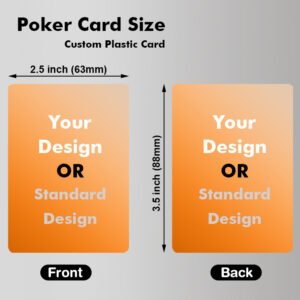
For poker size playing cards, plastic should not be treated as paper cards with extra durability added on top. Once the deck goes to PVC or PET, it no longer feels like a normal paper poker deck. The hand feel changes first. Then the shuffle starts feeling different too. Even the printed face will not read exactly the way it does on paper.
Plastic works better when the deck is expected to stay in use around moisture, repeated handling, or rougher conditions. It lasts well, but anyone expecting normal paper-card feel will notice the difference very quickly once the deck is actually in hand.
-
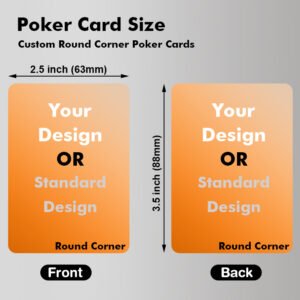
For poker size playing cards, round corners are not there to make the deck look softer. They are there because the deck holds up better once people actually start using it.
With square corners, wear tends to start at the tip. Once that point gets hit often enough during shuffling, sorting, or just pushing cards around the table, the corner starts looking old faster than the rest of the card. Round corners break that pattern. They spread the stress out, so the deck wears more evenly and stays cleaner for longer.
That is why round corner is still the safer format for most gameplay-driven decks. If the cards are meant to be opened, shuffled, handled, and reused, this is usually where the practical decision lands. If the whole project is being pushed by a sharper visual style, that is a different discussion.
-
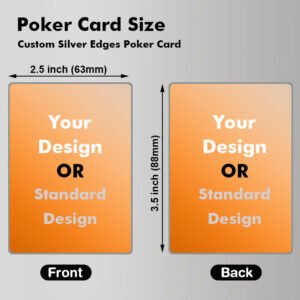
Silver edging improves the presentation quickly, but the deck does not feel the same afterward. The edge feels slicker, and the deck starts showing that difference once it is actually handled. You may not notice much on first touch, but after shuffling and packing, it no longer feels quite the same as a standard poker deck. A box fit that looked fine on the flat deck may also need to be checked again after sampling.
That is usually not a problem on premium retail, commemorative, or gift-led decks, where the finish is part of what the customer is paying for. It becomes a more careful decision when the deck is still expected to shuffle hard and handle like a normal poker deck. In those cases, silver edges are no longer just a visual upgrade. They start affecting how the deck feels in actual use.
-
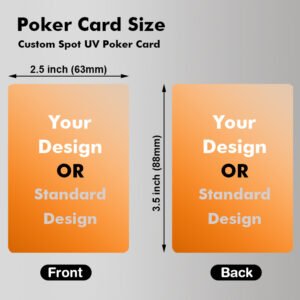
For poker size playing cards, Spot UV should not be treated as a finish that can be dropped onto the artwork at the very end. Once part of the card face turns glossy, that area starts catching light differently from the rest of the design. It becomes more noticeable immediately, which is why Spot UV can help the right element stand out very fast — and can also start causing trouble just as fast if it is pushed into the wrong place.
That is why Spot UV usually works best on logos, suit marks, titles, and other controlled elements that are supposed to pull attention first. On poker decks that still need to read quickly and handle like normal playing cards, the gloss area usually has to stay selective. Once too much of the face starts reflecting light, the finish stops helping the layout and starts competing with it.
-
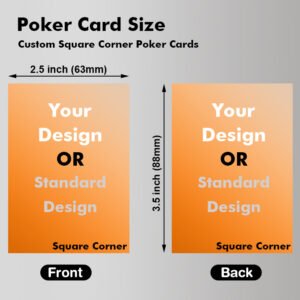
For poker size playing cards, square corners are usually chosen for visual reasons rather than functional ones. quare corners are mostly a visual decision. They give the deck a cleaner and more angular look, which can suit modern artwork and branding-led projects. But compared with round corners, the sharp points are less forgiving in use and start showing wear sooner.
In real production and gameplay environments, the four sharp points become natural wear concentrations. Edge chipping, minor layer separation, and increased friction during shuffling are more likely to occur over time. The card is not actually weaker, but square corners do age faster in use. Once the deck goes into regular shuffling, the sharp points are usually the first place where wear starts to show. If the deck is mainly about visual presentation and not built for heavy handling, square corners can still make sense.