Showing 17–32 of 58 results
-

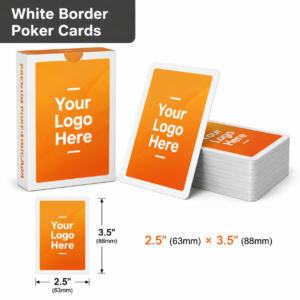
White border poker cards are standard 2.5″ × 3.5″ poker-size playing cards with a clean white margin around both the face and back. That border does two things: it hides the normal ±0.25 mm cutting drift so your design still looks centered if the cut’s a hair off, and it covers up minor edge wear from shuffling. Casinos and heavy-use decks stick with white borders for exactly that reason.
At FUNWAY, every white-border deck is customizable. Upload your own designs for the card faces, backs, and tuck box. Rather not design from scratch? Pick from our finishes — linen, smooth, or glossy — and choose a core that fits (white, black, blue, gray, or go coreless). Want to take it further? Foil stamping, embossing, UV coating, you name it. For packaging we’ve got tin boxes, drawer boxes, flip magnet boxes, mailer boxes — basically whatever you’ve got in mind.
Pricing depends on how many decks you’re ordering, plus your core, finish, and packaging choices.
Simple custom prints start at 300 decks MOQ; at 1,000+ the per-deck cost comes down quite a bit. Send us your specs and we’ll get you an exact quote plus a free digital proof.
-
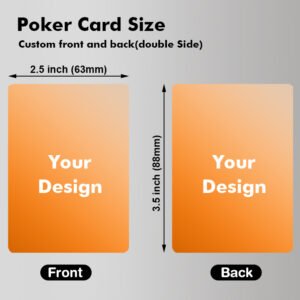
For poker size playing cards, double-sided printing should not be treated as the automatic choice. The first question is whether the deck really needs information on both faces. In some projects, it does. In others, printing on both sides only adds more control points without giving the gameplay anything back. That decision needs to be settled early, before the artwork and production file are already moving in the wrong direction.
Once both sides are carrying print, the job becomes less forgiving. Front-to-back alignment starts showing much faster, and opacity control matters more than many clients expect, especially on decks with centered layouts, border-sensitive faces, or backs that need to stay visually stable. At that point, the issue is no longer just whether the print is clean. It is whether the two sides still hold together properly once the card is in hand.
-
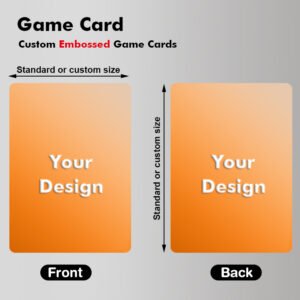
For custom game playing cards, embossing should not be treated as a decorative finish that can be added after the layout is already solved. Game cards usually have a job to do first. They have to show icons, values, symbols, or rules information clearly enough for players to read them quickly in play.Raise part of the card face, and that card will no longer feel the same as the others in the deck. On game cards, that only makes sense when the raised area helps players spot something faster. If it does not, it is just getting in the way.
On a few key cards, embossing can be useful. Spread it too widely, and the deck starts paying for it in readability and handling. On game cards, that trade-off has to be judged against gameplay first, not against visual effect alone.
-
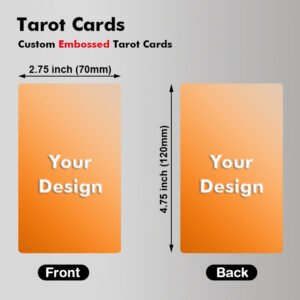
On tarot cards, embossing works best when it is used to give one part of the artwork a stronger physical presence. The larger format gives the raised area enough space to be noticed without making the card face feel crowded. Titles, symbols, and key visual elements usually carry the effect better than artwork that is already too fine or too busy. On this format, embossing is less about decoration by itself and more about giving selected parts of the card more weight once it is in hand.
Tarot cards are also used differently from poker or bridge decks. They are handled repeatedly during readings, laid out on the table, gathered back into the deck, and revisited over time, but they are not normally pushed through heavy shuffling again and again. That makes embossing easier to justify on tarot, as long as it is supporting the artwork rather than getting in its way. When the raised area is kept in the right place, the effect can add tactile depth without making the deck feel awkward in normal use.
-
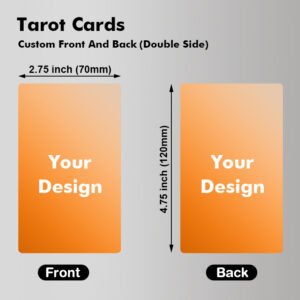
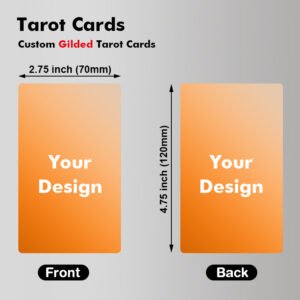
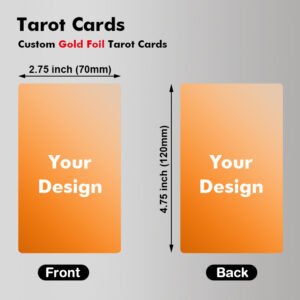
We create classic 2.75×4.75 inch(70×120mm) Front And Back Tarot cards. Simply upload your high-quality image or artwork, and we will precision-print it to fit this layout, ensuring a sharp and professional look. To protect your custom creation, each finished deck is securely shrink-wrapped. For the perfect finish, you can add a premium packaging option like a deluxe tuck case or a rigid box or a tin box to complete your deck.
-
We create classic Front Game Playing Cards. Upload your high-quality image or artwork, and we will precision-print it to fit this layout, ensuring a sharp and professional look. To protect your custom creation, each finished deck is securely shrink-wrapped. For the perfect finish, you can add a premium packaging option like a deluxe tuck case or rigid box, or a tin box to complete your deck.
-
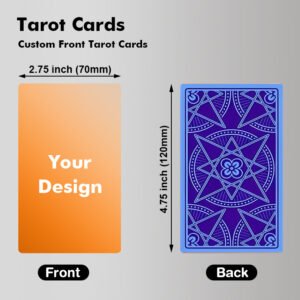
We create classic 2.75×4.75 inch(70×120mm) Front Tarot cards . Simply upload your high-quality image or artwork, and we will precision-print it to fit this layout, ensuring a sharp and professional look. To protect your custom creation, each finished deck is securely shrink-wrapped. For the perfect finish, you can add a premium packaging option like a deluxe tuck case or a rigid box or a tin box to complete your deck.
-
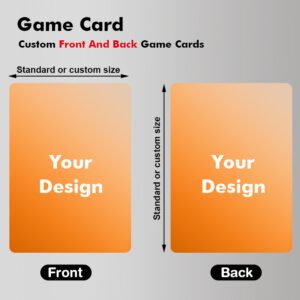
We create classic Double Side Game Playing Cards. Upload your high-quality image or artwork, and we will precision-print it to fit this layout, ensuring a sharp and professional look. To protect your custom creation, each finished deck is securely shrink-wrapped. For the perfect finish, you can add a premium packaging option like a deluxe tuck case or rigid box, or a tin box to complete your deck.
-
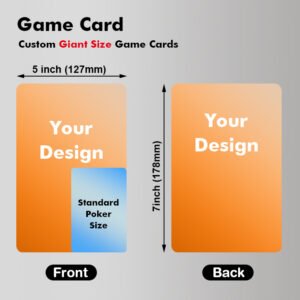
Giant size game playing cards are usually where people underestimate what “just making it bigger” really changes. The artwork may scale up easily, but the trouble starts right after that. Deck thickness builds fast, the box gets bulky, packing becomes inefficient, and shipping volume rises much earlier than most customers expect.
This format only really works when the large size is the whole point of the product. Classroom use, party games, live demonstrations, and display-led gameplay are typical examples. In those projects, the large format is there for a reason: people need to read the cards from farther away, or the oversized look is part of how the game is presented. If the deck still needs to handle like ordinary playing cards, this size usually becomes a headache very quickly.
-
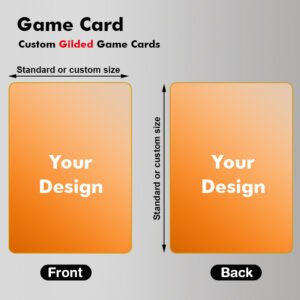
We create Gilded Game Playing Cards. Upload your high-quality image or artwork, and we will precision-print it to fit this layout, ensuring a sharp and professional look. To protect your custom creation, each finished deck is securely wrapped in shrink wrap. For the perfect finish, you can add a premium packaging option like a deluxe tuck case or rigid box, or a tin box to complete your deck.
-
For tarot cards, gilded edges are usually a presentation decision, not a handling one. The larger format carries the gold edge more naturally, and once the deck is stacked and boxed, the finish becomes part of the product immediately. That is easier to justify here than it is on poker or bridge cards, because tarot decks are handled repeatedly in use but are not normally pushed through hard shuffling again and again. The gold edge usually stays part of the experience instead of turning into a handling problem too quickly.
That is one reason gilding is easier to carry on collector decks, gift editions, spiritual products, and other tarot projects where the deck is meant to feel special as soon as it is opened. When the product is being built around atmosphere, symbolism, and presentation, the gold edge often supports that direction very directly.
-
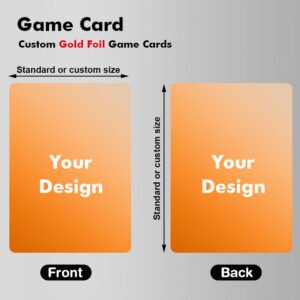
We create Gold Foil Game Card. Upload your high-quality image or artwork, and we will precision-print it to fit this layout, ensuring a sharp and professional look. To protect your custom creation, each finished deck is securely shrink-wrapped. For the perfect finish, you can add a premium packaging option like a deluxe tuck case or rigid box, or a tin box to complete your deck.
-
On tarot cards, gold foil usually makes the most sense when it is helping the artwork carry more presence. The larger format gives foil enough room to work, so titles, celestial elements, borders, and key symbols can catch light without making the whole face feel crowded. On tarot, that kind of emphasis usually carries better than it does on smaller card formats, because the artwork already has more room to build atmosphere from the start.
Tarot decks are also used differently from poker or bridge cards. They are handled repeatedly during readings, laid out on the table, gathered back into the deck, and revisited over time, but they are not normally pushed through hard shuffling again and again. That makes gold foil easier to carry here, especially when it is supporting the artwork instead of pulling attention away from it. On collector decks, spiritual products, gift editions, and other tarot projects meant to feel special from the moment they are opened, foil usually feels much more at home.
-
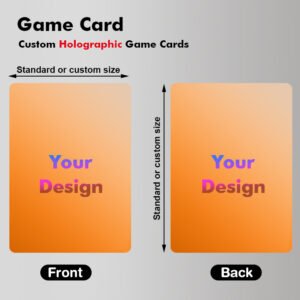
For game playing cards, holographic is rarely a neutral choice. Once it is added, it starts affecting readability, information hierarchy, and sometimes even gameplay comfort.
That is why we do not usually treat holographic as a simple finishing upgrade on game cards. If the deck carries icons, small effect text, resource values, or hidden-information logic, the reflective surface can create more problems than the visual effect is worth. It only starts making sense when the deck is meant to sell on visual impact first and gameplay density second.
-
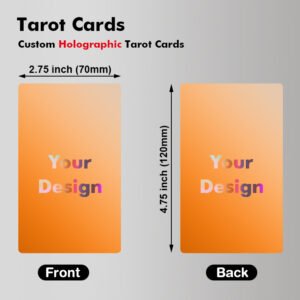
For tarot cards, holographic is usually a visual decision, not a practical one. Once the card gets larger and the artwork starts relying on dark fields, gradients, and symbolic detail, the reflective surface stops feeling like a simple added effect. It starts changing how the whole deck reads after printing.
That can work very well for collector or display-led tarot projects. It works much less well when the deck still needs calm readability during regular readings. Holographic does not automatically make a tarot deck feel more premium. On the wrong artwork, it just makes the surface louder.
-
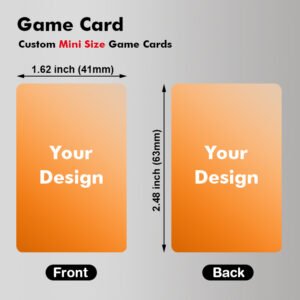
Mini size game playing cards are usually chosen because the game needs to stay compact. That part is true. But once the card gets smaller, the job does not simply become a reduced version of a standard deck. The layout gets tighter, cutting tolerance starts showing faster, and anything that was already close to the limit on a normal card usually becomes a problem here first.
This format works best when the card face is kept simple on purpose. Short text, clear icons, and a clean information structure are usually fine. But if the design is still trying to carry the same amount of content as a regular-size card, mini size starts becoming difficult very quickly, no matter how efficient it looks in the box.