
Custom Wooden Game Pieces: Meeple Manufacturing Decisions Most Designers Make Too Late
Most board game creators start thinking about custom wooden game pieces after the artwork is almost finished.
That is usually too late.
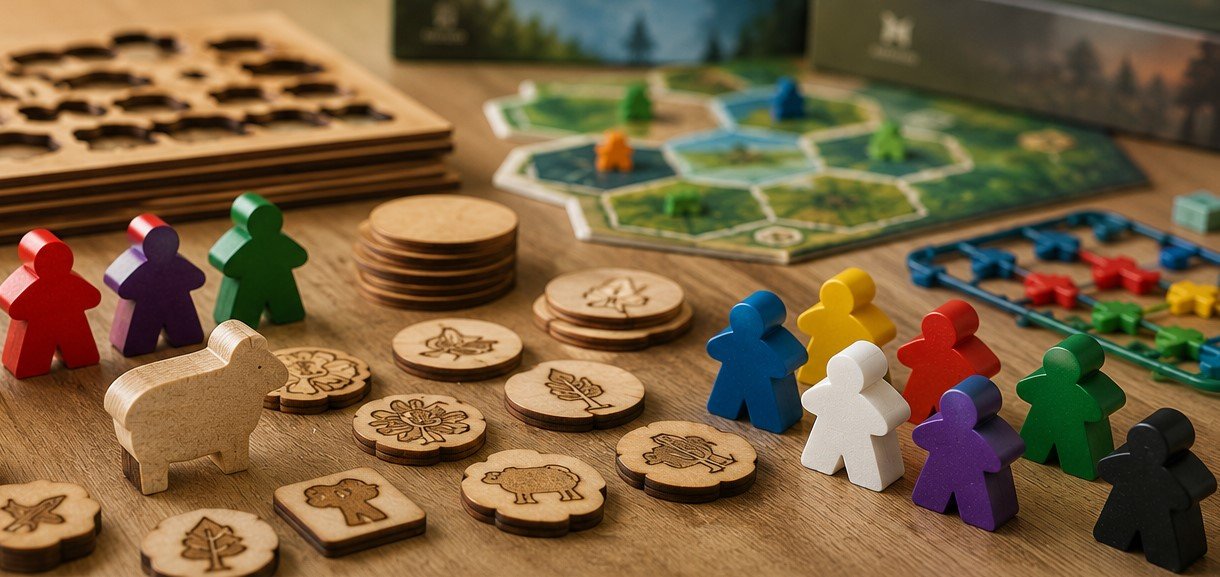
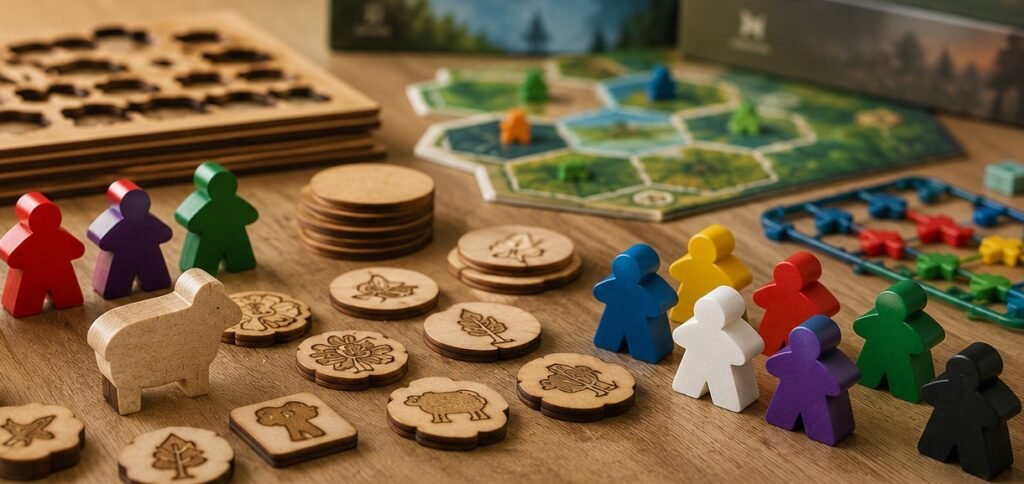
For cards or punchboards, artwork can still be adjusted before printing. For meeples, the shape, size, thickness, material, coloring method, printing method, and tray height start locking the cost much earlier. A meeple is not just a small character marker. From a factory side, it is a shaped component with several risk points: cutting, sanding, moisture control, paint absorption, printing position, base stability, tray fit, and packing abrasion.
This is why meeple manufacturing should not start with:
How much does one custom meeple cost?
A better starting question is:
What is the simplest piece that still supports the gameplay, survives production, and does not create a finish-risk point?
That sounds less exciting, but it is how real board game manufacturing works.
For laser cut wood games, flat wooden tokens and sheet wood components can be practical. But laser cutting is not the default answer for every wooden component. A flat laser-cut wooden resource token and a thick standing custom animal meeple are not the same production problem.
Different material.
Different process.
Different cost model.
Different sample expectation.
Start With The Decision Sequence, Not With The Shape
Designers often start from the character silhouette. From a manufacturing perspective, that is backwards.
The usual decision sequence should be:
Cost control usually fails at step 2 or step 3, not at the final quotation stage.
A designer may reduce the number of pieces but keep a tall, narrow, irregular meeple shape. That does not always save money. A tall narrow piece may need thicker material, stronger base width, more sanding, more careful coloring, or a taller tray cavity. The component count is lower, but the production constraint becomes worse.
This is the first design-stage constraint:
⚠️ Design Constraint: Do not treat wooden meeples like printed punchboard tokens with more personality. They are physical parts, not flat artwork.
If the shape only works in a front-view render, it is not ready for production review.
Common Meeple Sizes: Do Not Choose Height Alone
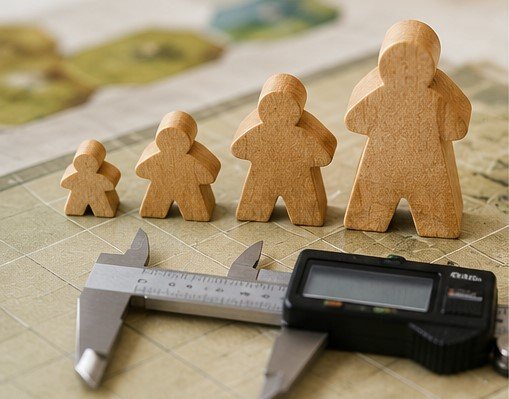
Meeple size is usually discussed by height, but height alone is not enough for production approval.
For most custom wooden game pieces, we divide the size direction into three working zones.
12–15 mm Height: Compact, But Not Detail-Friendly
12–15 mm height works for compact games, dense boards, or projects with many small markers.
This range can save board space and box space, but it is not suitable for detailed character shapes. Small arms, thin ears, horns, tails, weapons, or tiny internal cutouts can burn, weaken, or disappear during production.
If the game needs many small wooden markers, keep the shape simple.
A 13 mm wooden piece with ears, face printing, clothing lines, and a faction symbol may look nice on screen. In production, it can become a QC argument.
16–20 mm Height: The Normal Starting Range
16–20 mm height is the normal range we check first for standard board game meeples.
This is usually the safest starting range for most player markers, worker meeples, faction pieces, and simple animal shapes. Because it is large enough for players to pick up comfortably and still small enough to pack efficiently.
This range usually gives a better balance between handling feel, board space, tray fit, carton efficiency, production stability, and decoration possibility.
Not perfect.
Just safer.
If this size range cannot carry your character identity, the problem may not be the meeple size. The problem may be that the design is asking too much from a small wooden component.
20 mm+ Height: Feature Pieces, Not Default Pieces
20 mm+ height is better for feature pieces, bosses, special role markers, or high-visibility player pieces.
The advantage is clear visibility. The problem is that larger meeples quickly start consuming board space, tray height, and carton efficiency.
If your game has only a few special pieces, this can work. If the game has dozens of wooden parts, 20 mm+ pieces can make the whole box less efficient very quickly.
Do not increase every meeple size just because the character looks better in the render. Once the piece gets taller, the tray depth, box height, and carton loading may all change.
For an initial quote, we usually start with a controlled structure: 16–20 mm height, 8–10 mm thickness, simple outline, one solid color per player or faction, and no narrow internal cutouts. If printing is required, start with one clear mark rather than a full character design. Small eyes, icons, or faction symbols only work when the printed area can tolerate normal positioning movement.
Material Choice: Solid Wood, Plywood, Plastic, And The MDF Boundary
Material should not be picked from appearance alone.
A wooden piece can warp if moisture is not controlled. Plastic can look clean but still show gate marks or sink marks if the mold design is weak. Plywood is useful for flat laser-cut parts, but it should not be confused with a solid standing meeple. MDF has a place in board game manufacturing, but not usually in small handled player pieces.
The cleaner material boundary is this:
Start from solid wood for standing meeples.
Use plywood for flat laser-cut parts.
Use plastic when the shape is complex and volume supports tooling.
Keep MDF out of small handled meeples.
That is the practical starting point.
Solid Wood: The Default For Classic Standing Meeples
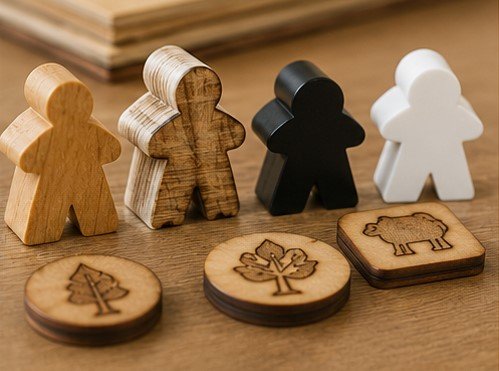
For classic standing meeples, animal pieces, worker markers, and simple shaped wooden components, we normally start from solid wood, not MDF.
The reason is simple: small feet, arms, ears, horns, and narrow bases need real edge strength. MDF can work in flat boards, base boards, or box structures, but it is a poor starting point for small handled pieces.
Solid wood is usually the safer route for classic worker meeples, animal markers, farming-game pieces, and simple faction pieces. If the design needs sculpted detail, rounded 3D surfaces, or very repeatable molded color, plastic should be reviewed instead of forcing the part into wood.
But solid wood is not perfect.
It may absorb stain or paint slightly differently between batches. Small printed details may not look as crisp as they do on plastic or paper. If your brand requires perfectly identical color across every component, wood makes that promise risky.
This is not a defect.
It is the material behavior.
Plywood: Better For Laser-Cut Flat Components
Plywood is common in laser cut wood games, especially for flat tokens, flat standees, discs, resource shapes, puzzle boards, rule boards, map boards, and prototype-style components.
It is better when the part is flat, thin, and not expected to look like a rounded or sculpted wooden meeple. Plywood gives stable sheet thickness and works well with laser cutting.
But plywood has visible layer lines on the edge. Some clients like this. Some clients call it unfinished.
Both reactions are common.
If your game has a handmade, indie, puzzle, escape-room, educational, or prototype-style product language, plywood can work well. If the retail box needs a polished family strategy game feeling, raw laser-cut plywood may look too prototype-like unless the finishing is controlled carefully.
The practical boundary:
⚠️ Material Boundary: Use plywood when the component is flat and laser-cut logic makes sense. Do not use plywood as a shortcut for every standing meeple.
Plastic: Better For Complex Shapes, But Only When The Volume Supports It
Plastic meeples or plastic player pieces are better when the project needs complex silhouettes, very repeatable colors, stronger dimensional consistency, or frequent handling.
Injection-molded plastic can produce shapes that wood cannot handle well: rounded bodies, deeper side profiles, narrow curves, and more consistent repeated parts. Plastic is also stronger when exact color consistency matters more than natural material feeling.
If the shape needs more 3D detail, the color must stay consistent across batches, or the game has high production volume, using plastic is usually the better choice.
But plastic has its own budget lock-in.
A custom plastic meeple normally requires injection mold tooling. That mold cost only makes sense when the final shape is confirmed and the order quantity can support it. For early prototypes, Kickstarter preview copies, or small-batch production, plastic may be the wrong cost model even if the final product might later use plastic.
Our practical recommendation:
💡 Pro Tip
Use plastic when shape complexity and repeatability matter more than natural material feeling. Use wood when tactile warmth, eco-positioning, and lower tooling pressure matter more.
Do not choose plastic too early if the character shape is still changing.
Mold changes are expensive.
Why MDF Is Not A Normal Choice For Standing Meeples
MDF has a place in board game manufacturing, but it is not a normal choice for standing meeples, animal pieces, or small shaped wooden player markers.
The reason is not just appearance.
MDF is made from fine wood fibers. It does not have the same grain strength and edge toughness as solid wood. When it is used for small pieces with narrow waists, small feet, sharp corners, ears, horns, or irregular silhouettes, the risk of chipping, edge collapse, and breakage becomes much higher.
MDF is more realistic for large flat base boards, game board substrates, storage box structures, children’s flat puzzle boards, low-cost flat educational components, or large structural parts that are not handled repeatedly as small player pieces.
It is not recommended for standard standing meeples, animal-shaped wooden pieces, thin legs, ears, antlers, tails, weapons, or premium high-touch wooden components.
So when a customer asks for "wooden meeples," we do not normally start from MDF.
For standing meeples, start from solid wood.
For flat laser-cut components, review plywood.
For complex 3D repeatable pieces, review plastic.
For MDF, keep it in the flat-board or structural discussion.
Decoration And Coloring: Choose Base Color Before Surface Detail
The decoration method should be chosen after the size, material, and shape are clear.
Choosing decoration first is risky. A full-color design may look easy on screen, but if the wooden part is small, curved, rough, or irregular, the printing method may become unstable.
For custom wooden game pieces, we separate the decision into two layers:
First lock the base color: staining or painting.
Then check surface detail: screen printing, heat transfer, UV printing, engraving, or no extra detail.
Trying to decide everything at once usually leads to over-designed meeples.
A small 16 mm meeple with custom shape, faction color, eyes, clothing lines, logo, and two-sided detail is not one decoration decision.
It is several production risks stacked onto one wooden part.
Staining
Staining is not used to create a perfectly solid player color. It is used when the customer accepts that the wood surface will still show through the color.
That can make the piece feel less coated and more like a wooden component. But it also means color control is weaker than painting. A light stain can look uneven from piece to piece. A darker stain hides more variation, but it may also make the player colors less bright and less separated on the board.
Use staining when the natural wood character matters more than exact color control.
Do not ask staining to behave like plastic color matching.
It will not.
Painting
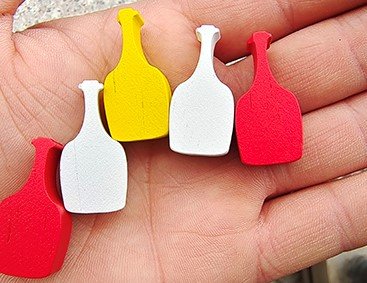
Painting gives stronger solid color and better visual consistency. It is usually better when player colors must be clearly separated, such as red, blue, yellow, green, black, or white faction pieces.
But painting also has a limit.
If the coating is too thick, edges may chip, small details may feel covered, and the piece may lose its natural wood touch. A heavily painted wooden meeple can start to feel more like a coated object than a wooden component.
Use painting when player color clarity matters more than visible wood grain.
This is usually the safer route for standard colored meeples.
Screen Printing
Screen printing is usually the more stable choice for simple graphics: eyes, icons, symbols, simple facial features, faction marks, letters, or one-color markings.
It works best when the printed area is simple, the surface is reasonably flat, the artwork has limited colors, and the customer accepts minor positioning tolerance.
Screen printing is not magic.
On small meeples, registration tolerance matters. A small shift can look obvious if the artwork is only 3–4 mm wide. And the customer may feel the expression changed although a face printed 0.5 mm too high may still pass production.
Our engineering judgment:
⚠️ Screen Printing Limit: Use screen printing when the design can survive small movement. If the artwork only looks correct when perfectly centered, the design is too fragile for small wooden meeple production.
Heat Transfer
Heat transfer is better when the artwork has more colors, gradients, or a more graphic appearance. It can be useful for flat wooden tokens or larger wooden pieces.
But heat transfer has its own risk.
On very small or uneven shapes, the film may not sit perfectly. Edges, curves, and tight corners can create bonding or alignment issues. It may also feel less natural than direct printing, depending on the finish.
For larger flat wooden components, heat transfer can be practical. For tiny custom meeples with irregular sides, it needs review.
Our factory-side recommendation:
💡 Pro Tip
For classic meeples, keep decoration simple and use screen printing where possible. For larger flat wooden tokens, heat transfer becomes more realistic.
Do not use heat transfer to rescue an over-detailed meeple design.
UV Printing
UV printing can be useful when the artwork requires more color detail than screen printing, especially on flat wooden tokens, rule boards, puzzle boards, map boards, and larger flat components.
It is not our first recommendation for tiny standing meeples.
UV printing works better on flat, controlled wooden surfaces. On raw or dark wood, light colors may look weak or dirty instead of matching the artwork file.
If a white base is needed under the color print, the process is no longer a simple one-pass print. It adds alignment control, adhesion checking, and another sample point before mass production.
Use UV printing for flat wooden components when color detail matters.
Do not use UV printing as the default decoration method for small 3D meeples.
For standard meeples, simple color plus limited screen printing is still usually the safer production route.
Laser Cut Wood Games: Good For Flat Wood, Not For Every Meeple
For laser cut wood games, the first misunderstanding is not the burnt edge.
The first misunderstanding is where laser cutting should be used.
Laser cutting is mainly used for thinner sheet wood, often around 3 mm or below, and for flat components such as wooden tokens, puzzle boards, rule boards, map boards, prototype panels, and other flat wooden game parts.
It is much less suitable for thick standing meeples, character-shaped wooden figures, or irregular 3D game pieces.
The reason is simple: laser cutting is a 2D cutting process. It can cut the outline from a flat sheet, but it does not create a rounded side profile, carved body shape, or sculpted 3D surface. If the part is thick, the cutting speed becomes slower, the cost becomes higher, and the heat-affected area becomes more obvious.
This is why a laser-cut wooden token can be practical, but a thick custom animal meeple is usually a different production discussion.
For thicker standing wooden pieces, the production route is usually profile cutting, CNC shaping, sanding, staining, painting, and sometimes lathe turning for round or bottle-like shapes. Die-cutting is more suitable for thin sheet components, not thick standing meeples.
This distinction matters because many customers use the phrase laser cut wood games when they actually mean "custom wooden pieces."
Those are not always the same thing.
A flat wooden resource token can be laser cut.
A thick custom reindeer meeple with antlers, painted body, and printed detail should not be quoted as if it were only a flat laser-cut part.
Different cost model.
Different finish risk.
Different sampling expectation.
The Burnt Edge Is A Process Result, Not A Surprise Defect
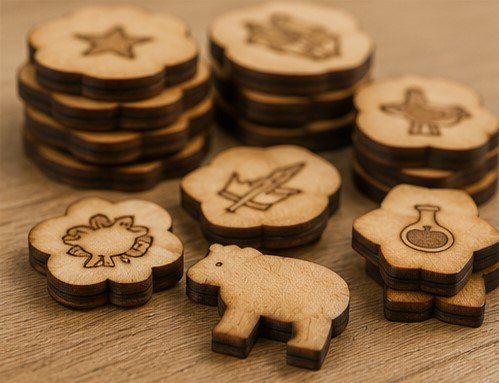
When wood is cut by laser, heat is part of the process. The edge can show a brown or darker burnt line. The darker the material, the thicker the board, or the slower the cutting, the more visible this can become.
Customers sometimes call this a defect after seeing the sample.
From a factory perspective, it should be discussed before sampling.
The burnt edge is not only a color problem. If the dark layer is too heavy, stain can make the edge look even darker, and paint may still leave the edge looking heavier than the face.
For simple flat tokens, this may be acceptable. For a cleaner retail finish, the factory has to slow the laser setting, choose a better sheet, sand the edge, darken the whole piece, or change the production method. The part still looks simple in the drawing, but the finishing work is no longer simple.
Sanding every small piece adds labor. Painting edges adds finish control. Some small internal corners cannot be cleaned perfectly without damaging the shape.
A better decision is:
⚠️ Laser Cutting Decision: Use laser cutting for flat wooden components where the darker edge can be accepted or controlled. Do not use laser cutting as the default answer for thick 3D meeples.
This is one place where factory samples matter more than 3D renders.
A render has no smell, no soot, no edge absorption, no sanding mark.
The real part does.
Why Some Eco Publishers Still Prefer Wooden Components Over Plastic
Wooden components are not automatically "more sustainable" in every possible supply chain. That claim depends on sourcing, coatings, transport, packaging, and certification.
We should not oversell it.
Plastic can be the better engineering choice when the shape is complex, the color must be very consistent, or the production volume supports injection tooling.
But for many eco-positioned board games, wooden pieces still make more sense.
First, wood fits the product language of board games that already use paper, cardboard, greyboard, and FSC-positioned packaging. A wooden meeple in a paper-based game box feels consistent.
Second, wood avoids early tooling lock-in. A custom plastic piece may need mold cost before the game design is fully proven. For prototypes, Kickstarter preview copies, or small production batches, wood gives more flexibility.
Third, wood also gives simple pieces more value in hand. A plain wooden worker or animal marker can still feel intentional if the weight, edge, and finish are controlled. A cheap plastic piece may have cleaner color, but it can make the same game feel more toy-like than planned.
But here is the boundary:
⚠️ Eco Boundary: Do not choose wooden meeples only because “wood sounds eco.” Choose wood when the shape is simple, the finish expectation is realistic, and the game’s product language can accept natural material variation.
Wood is a poor choice when the design needs sculpted detail, sharp 3D facial features, many tiny color zones, exact Pantone-like consistency, thin weapons, or plastic-like edge durability.
For some games, the better eco decision is not "wood instead of plastic."
It is reducing unnecessary component complexity, keeping the box smaller, avoiding oversized inserts, and improving carton efficiency.
That is less marketable.
But it is more real.
What We Need Before Quoting Custom Wooden Game Pieces
When asking for a quotation, do not only send a mood image and ask for a unit price.
For custom wooden pieces, the factory needs enough information to see the production constraint.
Please provide:
This is not paperwork for the sake of paperwork.
It prevents the wrong quote.
A factory can quote a "custom meeple" cheaply if it assumes a simple shape and one color. That quote becomes useless when the final file has thin cutouts, two-sided printing, UV printing, special painting, and multiple faction colors.
The earlier the constraint is visible, the less painful the price correction becomes.
Warning Before You Finalize Meeples
If your meeple design depends on thin details, perfect printing alignment, heavy coating, UV printing on irregular surfaces, MDF used as a standing piece, or a clean pale laser-cut edge, the cost model above will break down.
Wooden components are best when the design accepts material behavior instead of fighting it.
Use custom wooden game pieces when you want tactile value, simple recognizable shapes, eco-aligned product language, and lower tooling pressure.
Use plastic when the shape needs sculpted detail, repeatable molded precision, and enough volume to support mold cost.
Use laser cut wood games logic when the component is flat, the edge character is acceptable, and the project benefits from sheet wood production.
Do not use wooden meeples as a last-minute upgrade after the whole game box, tray, artwork, and budget are already locked.
⚠️ Final Warning: That is when a small game piece becomes a big manufacturing problem.