

Traveling with Board Games: How to Protect Game Boxes in Luggage
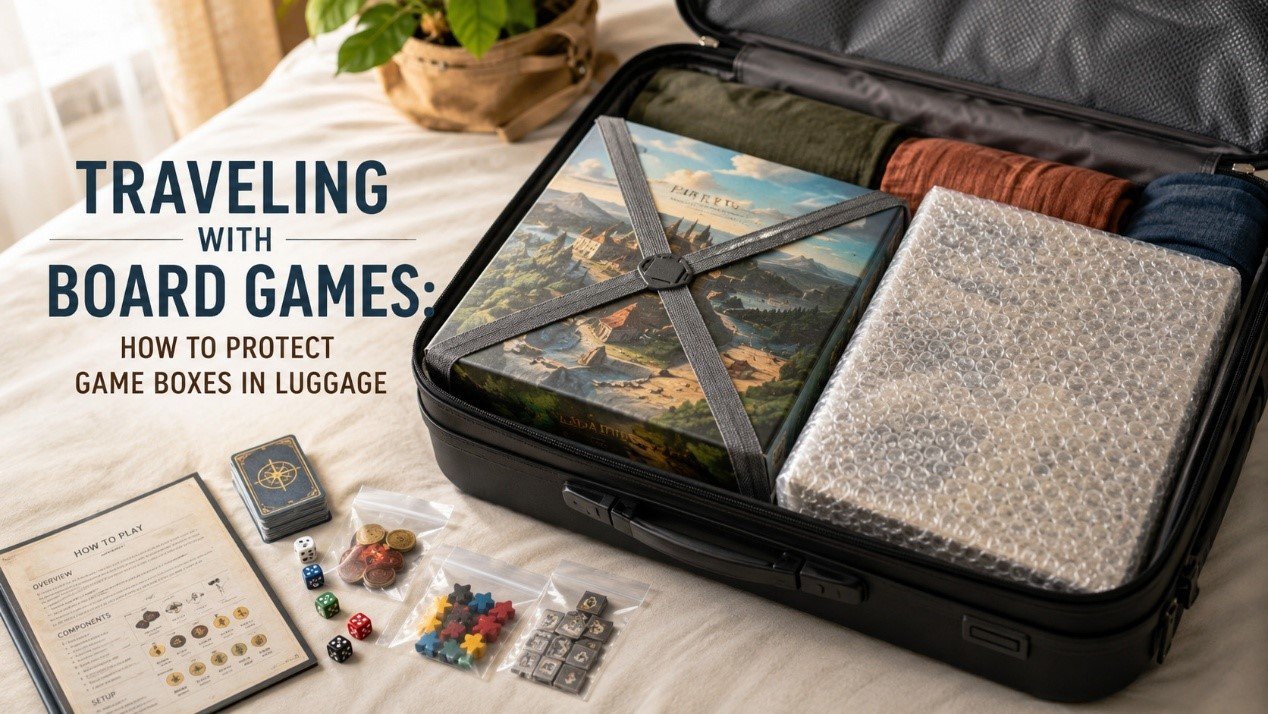
Traveling with board games sounds simple until the suitcase is opened.
The lid has shifted. Cards have escaped the insert. Tokens are under the folded board. One corner of the box is crushed. The box no longer feels like the same product although the game is still playable.
This is very common in our life.
Most board game boxes are designed for retail display, warehouse cartons, and home storage. They are not designed to survive loose movement inside a backpack, suitcase, car trunk, or overhead cabin bag. That difference matters.
A retail board game box expects stable compression from the outside carton. A suitcase gives random pressure from clothes, chargers, shoes, books, and whatever else is packed around it. The box may not break because it is weak. It breaks because the pressure direction is wrong.
So the real question is not only:
“How do I carry this game?”
The better question is:
“Should this game travel in its original box at all?”
This article explains practical ways for Protecting games in luggage, including rubber bands or X-Bands, bubble wrap, and when to switch to Portable game box solutions instead of forcing the original box into a travel bag.
The Original Box Was Not Designed for Travel Pressure
A board game box can look strong on a shelf and still fail inside luggage.
That surprises many players because the box feels rigid in the hand. But a lid and base box is usually built to protect the game during normal storage and carton shipping, not to handle diagonal pressure from a packed suitcase.
The weak points are predictable:
Most travel damage starts from movement, not hitting.
If the box lid opens even a few millimeters inside the bag, components start migrating. Cards slide out. Tokens fall under the insert. Rulebooks curl. Mini cards get trapped at the box wall. After that, the box becomes a small shaker.
This is why Traveling with board games needs a different packing logic from home storage.
At home, the box just needs to sit flat.
In luggage, the box needs to stay closed, resist compression, and stop internal movement.
Those are three different jobs.
First Decision: Keep the Original Box or Repack the Game?
Before using bubble wrap or X-Bands, decide whether the original box deserves to travel.
Some games should stay in their boxes. Some should not.
Keep the original box when:
Repack the game when:
This is where many players make the wrong decision. They protect the box because it is the original box, even when the original box is the worst travel container for that game.
A large square box with a loose insert may look official, but in luggage it can be less safe than a compact zipper pouch with cards and tokens fixed tightly.
For travel, the best container is not always the prettiest one. It is the one that stops movement.
Use Rubber Bands or X-Bands to Stop the Box from Opening
The first layer of protection is simple: keep the lid and base locked together.
This is where rubber bands or X-Bands help.
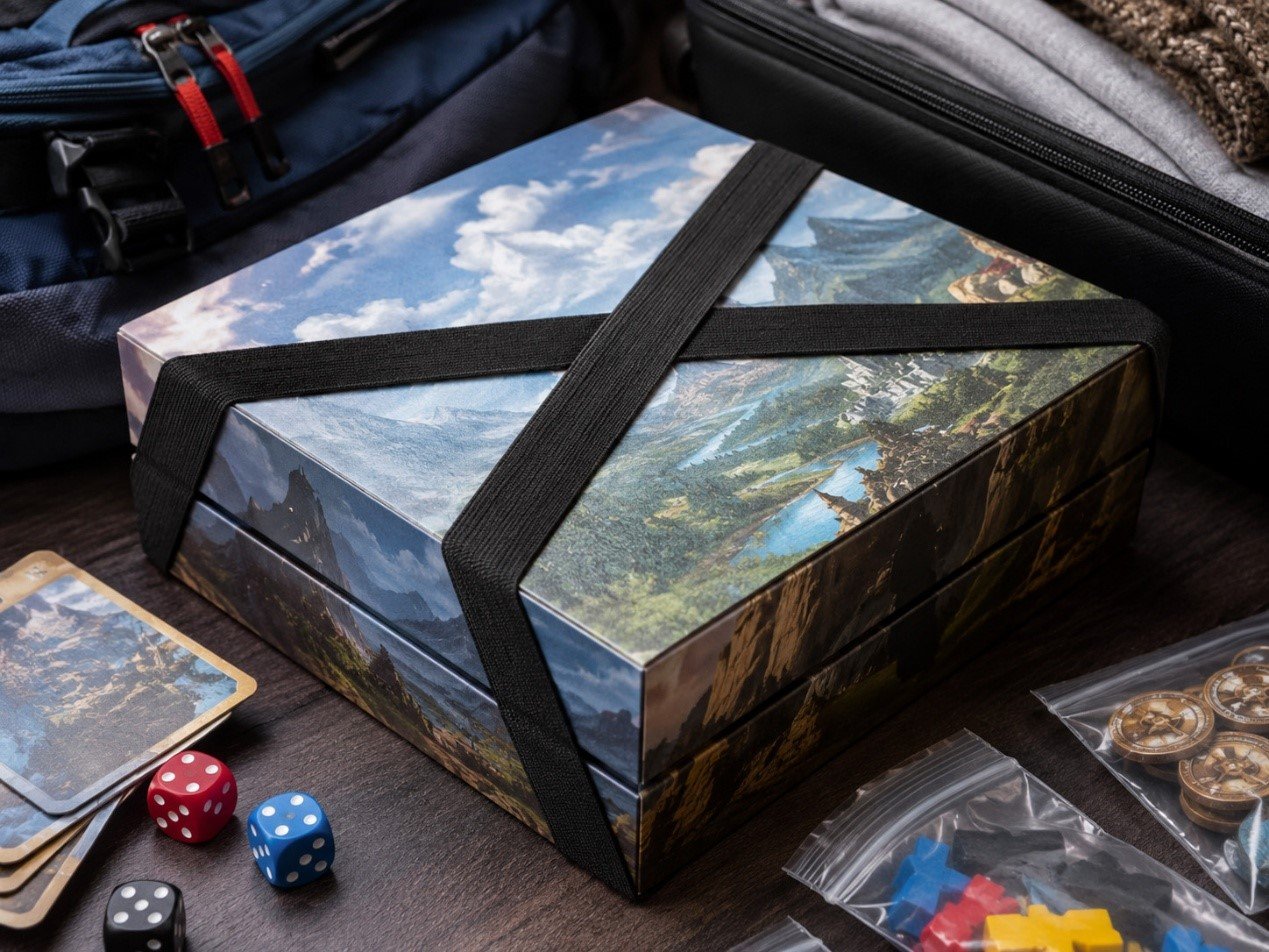
For luggage, one narrow rubber band is usually not enough. It can slide, cut into the box edge, or create pressure marks on the paper wrap.
Use this decision rule:
The band should hold the lid closed, not crush the box.
That distinction matters. A very tight band can dent the side wall, especially on lighter paperboard boxes or boxes with softer edges. It can also leave pressure marks on matte lamination, soft-touch surfaces, or uncoated paper wrap.
💡 Pro Tip
For premium boxes, avoid thin office rubber bands directly on the printed surface. Use wider fabric or silicone-style bands if possible.
⚠️ Warning: Do not use bands as a repair method for a bad box fit. If the lid already slides off too easily or the box is visibly warped, the band is only reducing the risk, not solving it.
For Protecting games in luggage, bands are the first control point. They stop the box from becoming an open tray inside your bag.
X-Bands Do Not Stop Internal Component Movement
A common mistake is thinking that once the box is banded, the game is protected.
Not fully.
X-Bands keep the box closed. They do not stop cards, tokens, dice, and rulebooks from moving inside the box.
If the insert has large open wells, the components can still shift during travel. This is especially common after punchboards are removed. The insert was originally designed around unpunched boards, not loose tokens in bags.
Before travel, open the box and check the internal movement.
Shake the box lightly by hand. If you hear movement, the game needs internal packing.
Not aggressive shaking. Just a small test.
⚠️ Warning: The box should not become a rattle chamber. A closed box with loose components inside can still arrive damaged.
Bubble Wrap Should Protect Corners, Not Just Add Bulk
Bubble wrap can help, but many people use it badly.
They wrap the entire box like a pillow, add too much thickness, then force it into the suitcase. The result is worse compression. The box is padded, but it is also under pressure from every side.
Bubble wrap should be used to protect risk points:
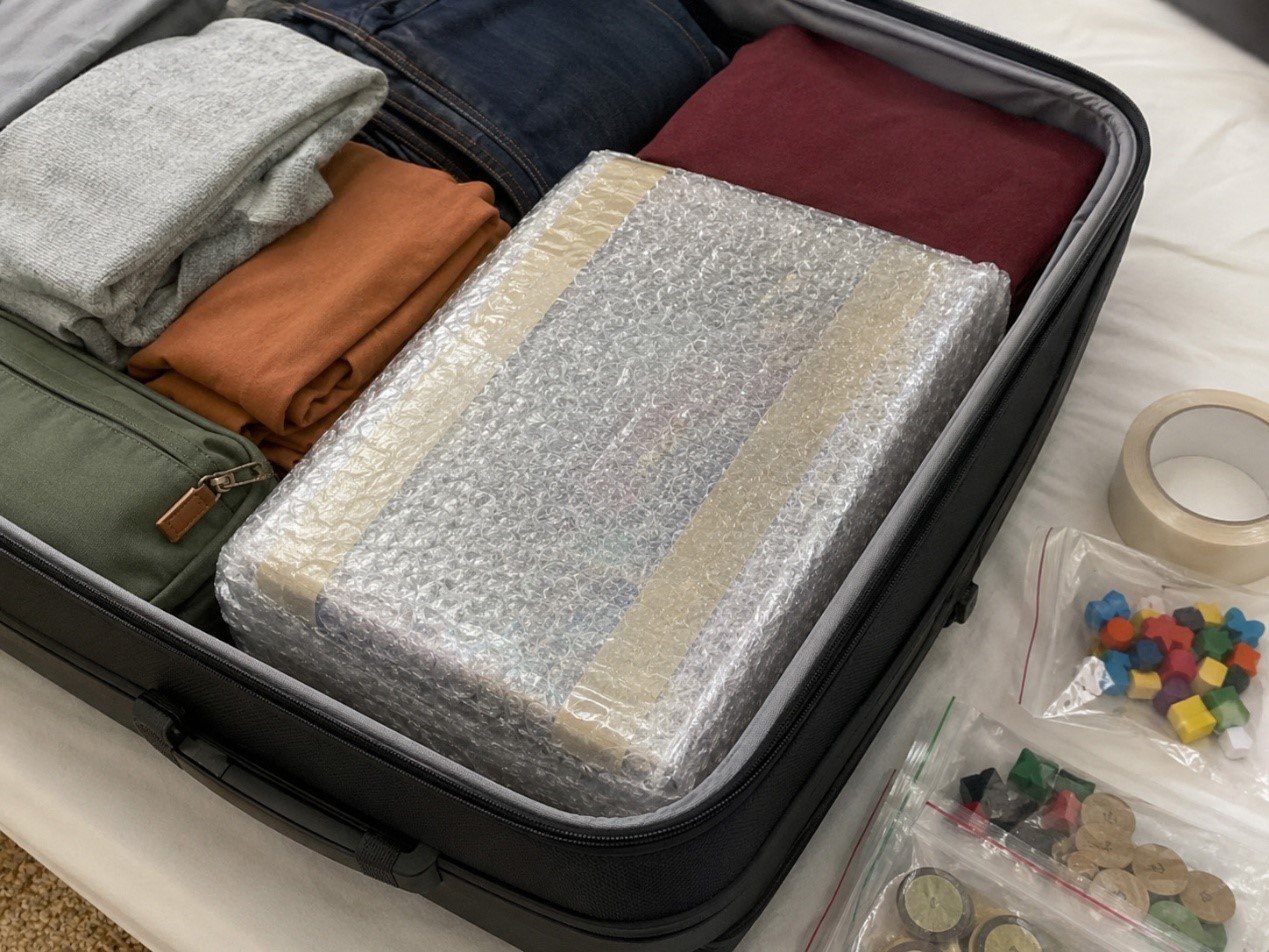
For most board game boxes, one or two layers of small-bubble wrap is enough. Large-bubble wrap can work for bigger boxes, but it creates more volume and may make the luggage fit worse.
💡 Pro Tip
The tape should close the bubble wrap around itself, not stick directly to the game box. Tape on printed paper wrap can lift coating, leave adhesive marks, or damage matte surfaces.
A better method:
Bubble wrap won’t save a box from structural collapse if your suitcase is packed to the brim. It’s meant for scratch resistance, not heavy compression. If you’re already forcing a tight squeeze, adding bulky wrap just raises the internal pressure. Save the box—and your sanity—by unboxing the components, wrapping them in your clothes, and flat-packing the empty shell.
Pack the Box in the Middle of the Luggage, Not at the Edge
The worst place for a board game box is usually the outer edge of the suitcase.
Edges receive pressure first. Corners hit first. The wheel side often takes more vibration and hitting. The handle side can create uneven pressure.
For better travel packing:
The box should be surrounded, not squeezed.
For backpacks, the risk is different. The box may bend because it sits against the back panel or bottom of the bag. A square board game box inside a soft backpack is often a bad idea unless the box is small or protected by clothes.
For car travel, the problem is sliding. Boxes in a trunk can move during turns or braking. X-Bands help, but the box should still be packed so it cannot slam into heavier items.
Travel damage is usually boring. Not dramatic. Just repeated small pressure in the wrong direction.
When Bubble Wrap Is Not Enough
Bubble wrap has limits as well although it is useful.
It is not enough when:
Checked luggage is especially risky. You do not control stacking, dropping, or side pressure. If the game is valuable, rare, or intended for a professional demo, do not trust bubble wrap alone.
For convention samples, prototypes, or review copies, consider a hard outer case or a shipping carton around the game box. It is often cheaper than arriving with a crushed sample although it may sound excessive.
If the game is only for casual vacation play, use a travel pouch and leave the original box at home.
This is the travel version of a manufacturing rule:
Do not overprotect the wrong structure.
Choose the right structure first.
When to Abandon the Original Box
This is the part many players resist.
Sometimes the correct travel decision is to abandon the original box temporarily.
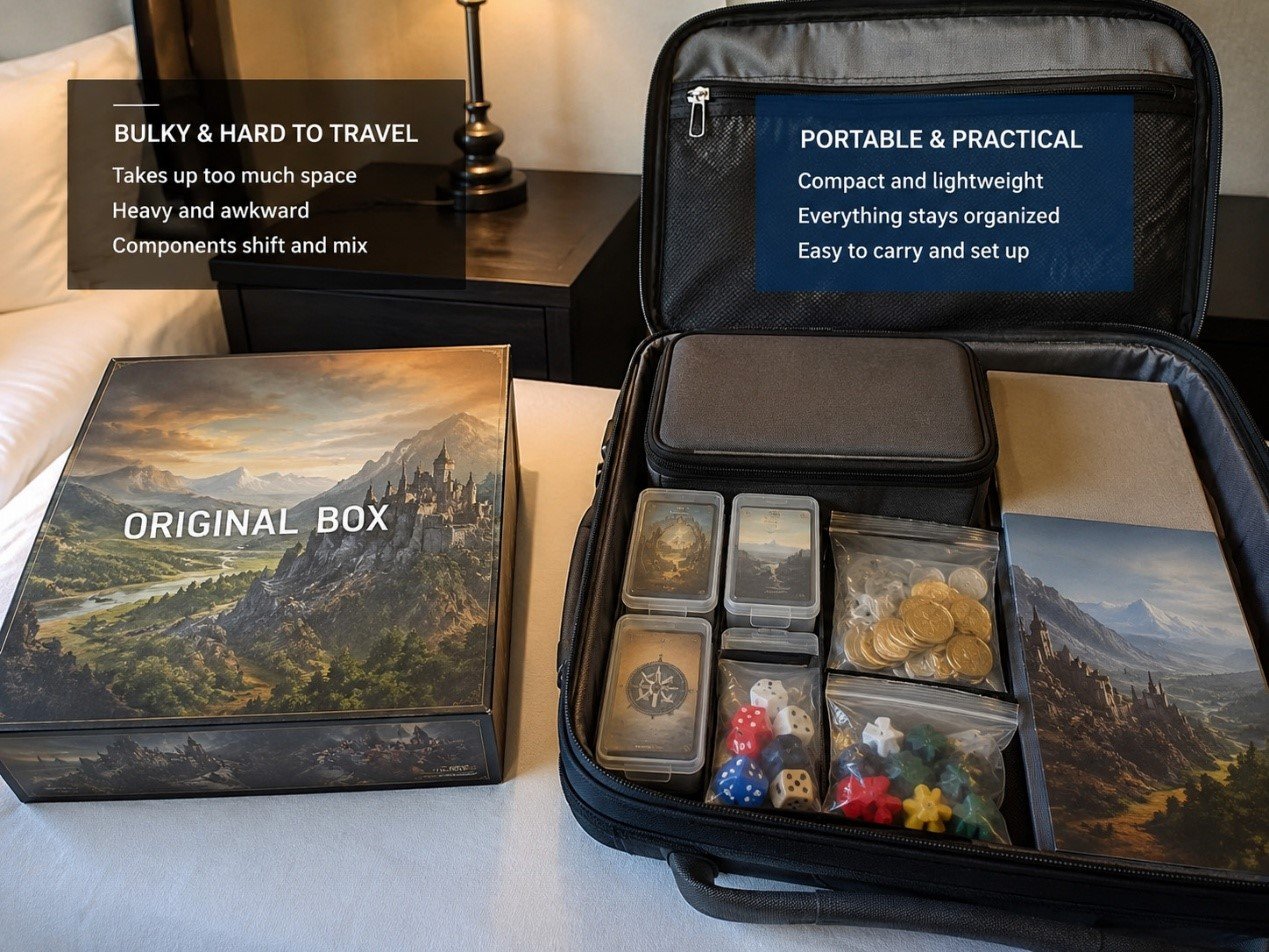
Use Portable game box solutions when the original box has more volume than the components need, or when luggage space is limited.
Good candidates for repacking:
Bad candidates for repacking:
The key question is not:
“Can I fit everything into a pouch?”
The better question is:
“Can I still set up, teach, play, and repack the game without creating confusion?”
A travel pouch that saves space but mixes all components into one bag is not a good solution. It saves luggage volume and creates table chaos.
Practical Portable Game Box Solutions
Portable storage does not need to be fancy. It needs to be controlled.
For card-heavy games, use deck boxes, card cases, or zipped card pouches. Keep each deck separated. Do not just depend on labels if the components look similar although Labeling is helpful.
For tokens, use small zip bags, coin capsules, compartment boxes, or flat organizer pouches. Loose tokens inside one large bag are faster to pack but slower to use.
For rulebooks, decide whether you need the printed book. If the rules are available digitally and you already know the game, leaving the rulebook at home may save space. But for teaching, demos, or convention play, printed rules still help.
For boards, the decision is harder. A mounted board usually forces you to keep a larger footprint. A folded paper map or neoprene mat may travel better in a document sleeve or roll tube, depending on material.
For full games, a small padded tech pouch or travel organizer can work better than the original box. The inside pockets separate decks, tokens, dice, and small boards. But choose one with enough structure. A soft pouch with no internal control just moves the mess from the game box to the travel bag.
The goal is not minimal size.
The goal is controlled size.
That is the difference.
Travel Packing for Designers, Reviewers, and Publishers
If you are carrying games for business, the standard is higher.
A player can accept a dented personal copy. A publisher sample or prototype has to survive judgment before the game is even played.
For designers and publishers traveling to conventions, demos, or retail meetings:
A damaged prototype changes the meeting. The buyer may not say anything, but the product feels less controlled.
For factory samples, this is even more important. A box sample is not only a container. It shows material choice, corner quality, lid fit, insert logic, and presentation value. If the corner is crushed in travel, the sample no longer represents the production quality clearly.
Do not let luggage damage become a fake quality problem.
Design-Stage Advice: Make Travel Easier Before the Box Exists
For publishers, travel protection is not only a player problem. It can be considered during packaging design.
If a game is likely to be taken to conventions, cafés, meetups, schools, family trips, or demo events, the box system should not fight travel from the beginning.
Design-stage choices that help:
This is where Portable game box solutions can become a product idea, not just a player workaround.
Some games deserve two packaging versions: a retail shelf box and a compact travel edition. Not every game needs that. But if portability is part of the product promise, forcing everything into a large retail box may be the wrong packaging direction.
A travel-friendly game should not require players to redesign the storage system after purchase.
Warning, Limitation, and Not Suitable Scenario
X-Bands are useful, but do not expect too much from them.
They solve only one problem: the lid may open in the bag. That is all. They do not protect the box corner when the suitcase is dropped sideways, and they do not stop cards or tokens from moving inside the box. If the insert is loose, the game can still arrive as a mixed pile, just inside a closed box.
Bubble wrap has the same limitation. It works when the wrapped box still has enough space in the luggage. If you have to force the box into the suitcase after wrapping it, the padding is no longer protecting the game. It is adding pressure.
Portable storage is usually the better answer for card-heavy or token-light games, but not for everything. Miniature games, collector boxes, large mounted boards, and publisher samples should be treated differently. Those may need the original box, a hard case, or even a separate shipping carton.
⚠️ Warning: If the game is valuable, rare, or needed for a demo meeting, do not pack it like a weekend filler game. That is how a travel problem becomes a quality problem before anyone even plays it.