

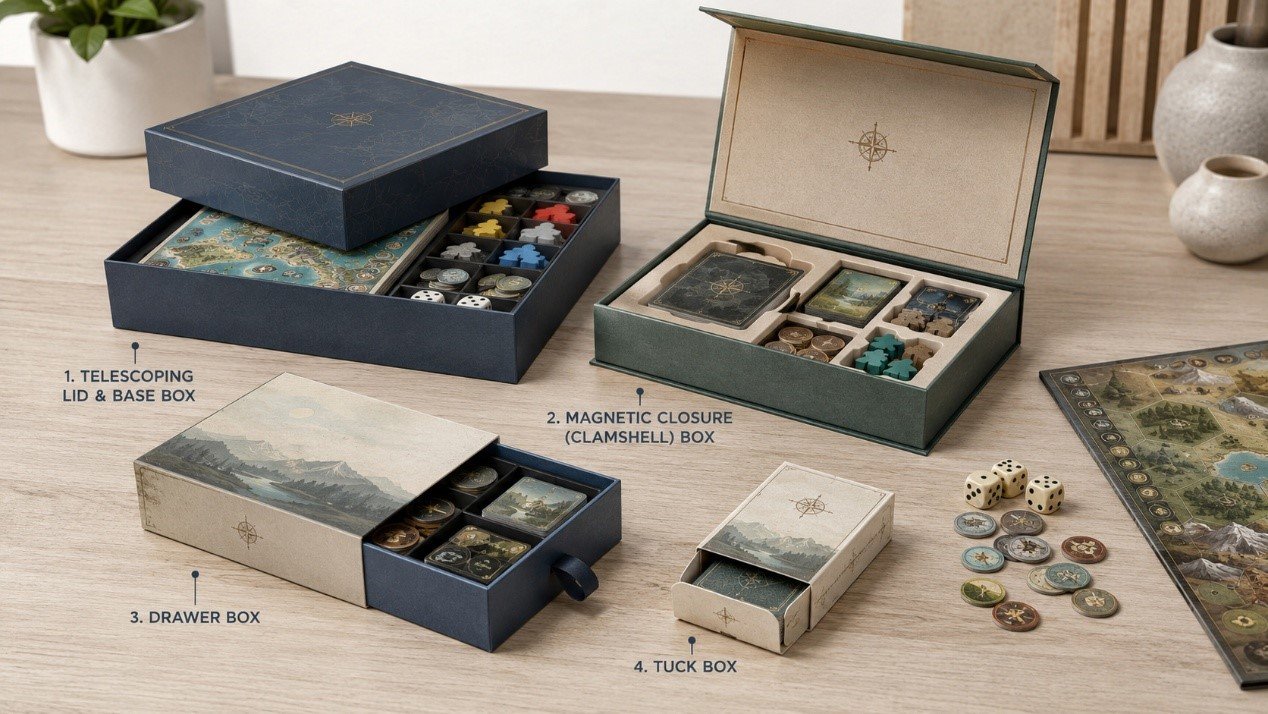
Board Game Box Types: How to Choose the Right Box Structure for Your Game
Most box mistakes start with one harmless sentence:
“We can decide the box later.”
By the time the artwork is finished, the board size is locked, the insert has been imagined, and the campaign render already shows a premium-looking box, the structure is no longer a small packaging choice. Changing it means changing cost, carton loading, component layout, and sometimes the whole product impression.
That is why choosing between a telescoping box, magnetic closure box, drawer box, or tuck box should not start from which one looks better in a mockup.
But this is exactly how many projects begin:
“This magnetic box looks premium.”
“This drawer box feels different.”
“This tuck box is cheaper.”
“This big lid and base box looks like a real board game.”
Those observations are not useless, but they are not enough.
The correct decision starts with the game system: component weight, board size, deck count, insert requirement, retail price, shipping method, and expected player use. A box that looks good in a mockup can become expensive, weak, oversized, or annoying once real components go inside.
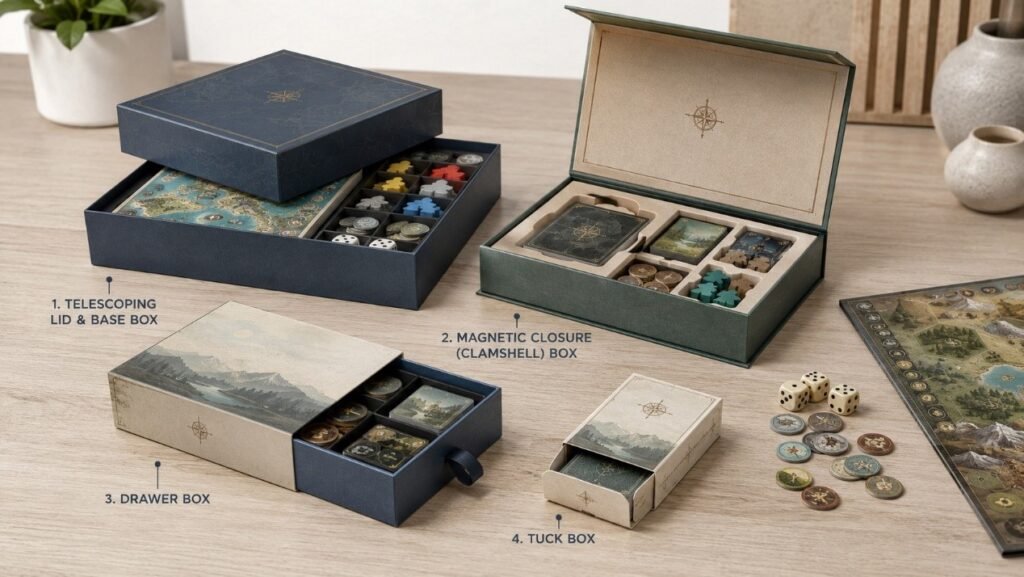
This guide compares the main Board game box types used in tabletop production: Telescoping box, magnetic closure box, drawer box, and tuck box. It also explains how Greyboard thickness affects box strength and when paying for a heavier structure actually makes sense.
Start with the Packing Job, Not the Box Name
Box names can mislead designers.
A “premium” box is not automatically better. A cheap box is not automatically wrong. The box has to do a specific job.
The decision sequence should be:
Most packaging mistakes happen when step 6 comes before step 1.
A publisher wants a premium box before checking whether the components need that structure. Or they choose a low-cost tuck box for a game that has too much internal weight. Both decisions create problems.
The box type should follow the physical game, not the other way around.
Telescoping Box / Lid and Base Box: The Standard Board Game Choice
The Telescoping box, also called a lid and base box, is the most common structure for board games.
It has two separate parts: a bottom tray and a lid that slides over it. This is the familiar structure used for many family games, strategy games, party games, and medium-to-heavy tabletop products.
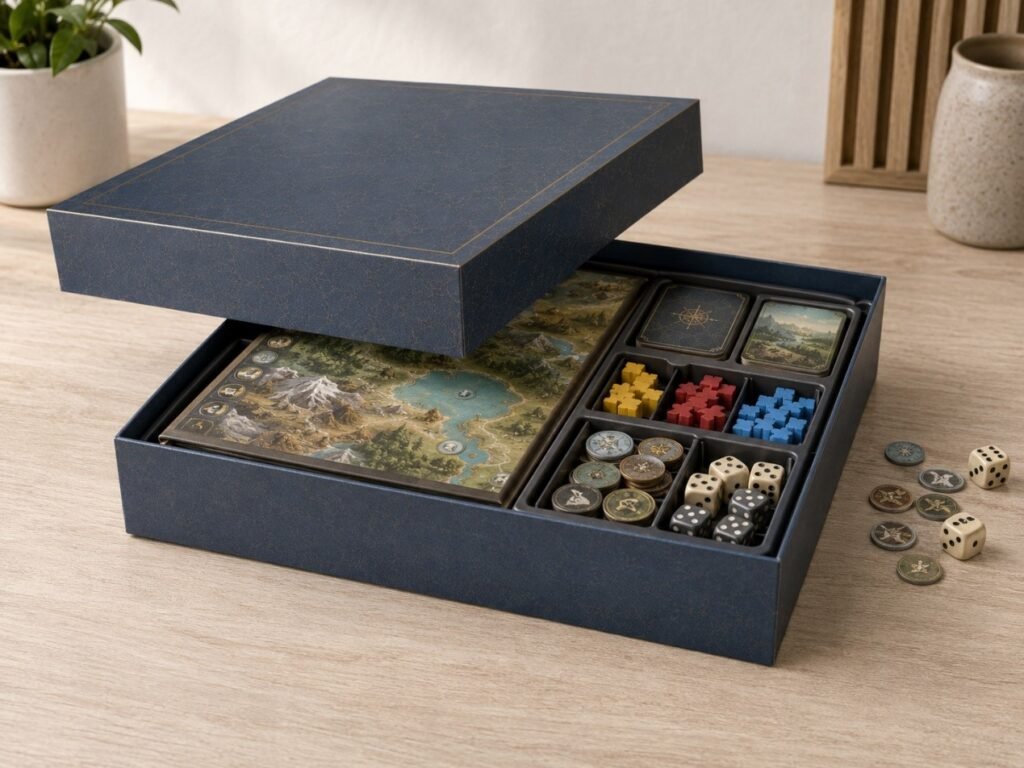
From a manufacturing point of view, this box works because it is simple, stable, and flexible. It can fit cards, boards, punchboards, rulebooks, dice, wooden pieces, plastic pieces, and inserts.
For most board game projects, this is the default starting point.
Not because it is always the most exciting box. It is the default because it solves the most problems with the least structural risk.
Standard Specs for a Telescoping Box
There is no single global “standard” for a board game telescoping box, but there are common production ranges.
For many board games, the box is built with:
For smaller games, 1.2–1.5 mm greyboard would be enough.
For standard board games, 1.5–2.0 mm is the best choice.
For heavier games, 2.0–2.5 mm would be needed.
But thickness alone does not make a box strong. Box height, side wall area, paper wrap, corner forming, insert support, and packed weight all matter.
A shallow box with 1.5 mm greyboard may feel firm.
A tall box with the same board thickness may feel weaker because the side walls have more leverage.
That is why “use thicker greyboard” is not always the correct answer. Sometimes the better answer is to reduce box height, improve the insert, or change how the components are stacked.
For a standard board game, the lid should close smoothly but not feel loose. If the lid is too tight, players struggle to open it. If it is too loose, the box may shift during shipping or travel.
This is not a design detail. It is part of the product feel.
When a Telescoping Box Is the Right Choice
Use a telescoping box when your game has:
This structure gives the game a familiar tabletop presence. Players know how to open it. Retailers understand how to shelve it. Factories know how to produce it consistently.
A telescoping box is also easier to resize than more complex structures. If the component stack changes, the box height can often be adjusted without redesigning the entire packaging concept.
For most first-time board game publishers, this is the safest premium-looking structure.
Not the cheapest.
Not the most luxurious.
But usually the most reliable.
When a Telescoping Box Becomes the Wrong Choice
A telescoping box can still be the wrong choice if the game is too small for it.
If your product is mostly cards and a thin rule leaflet, a large lid and base box may create the “empty box” problem. It looks bigger than the game really is. That can hurt player trust.
It can also increase shipping volume for no real benefit.
A lid and base box is worth using when the contents justify the footprint. If the box is only being used to make a small game look more expensive, the player will notice after opening.
This is where many small card games fail. They borrow the box language of heavier tabletop games, but the component system inside does not support it.
The result is not premium. It is oversized.
Magnetic Closure Box: Premium Feel, Higher Cost, Higher Risk
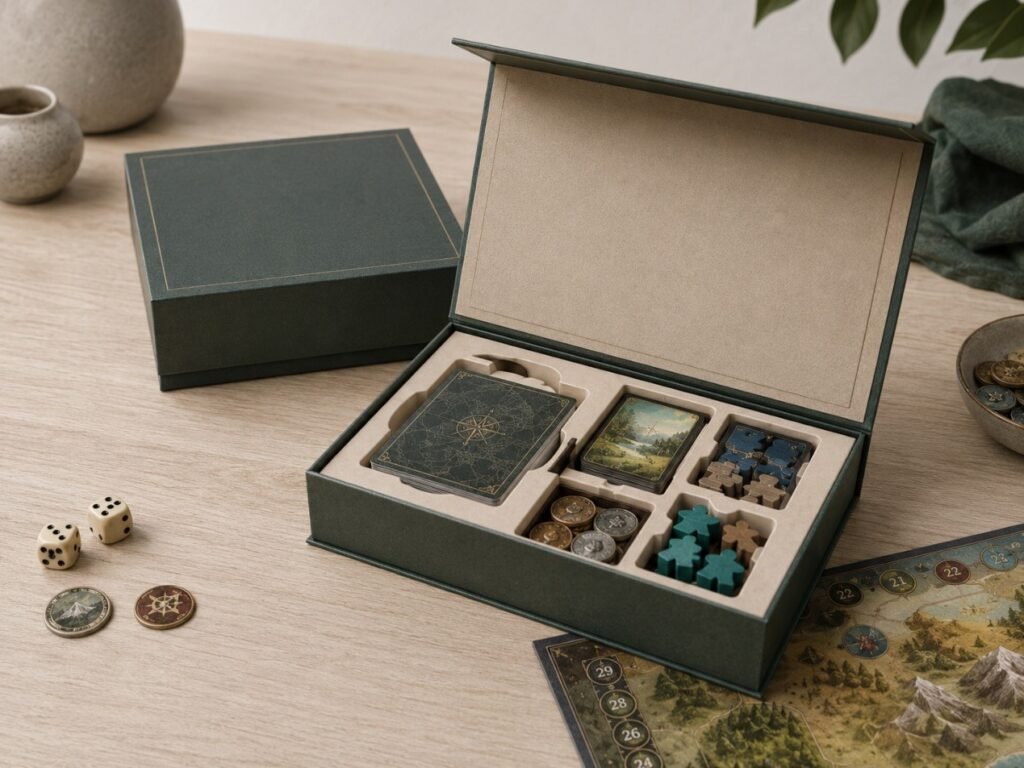
A Magnetic closure box is often used when the publisher wants a more premium unboxing experience.
A magnetic flap isn’t just a closure; it’s an upcharge wrapper. That crisp tactile snap is the easiest way to signal high perceived value before the customer even sees the components. It’s why premium table-top publishers and high-end card brands willingly pay the tooling premium for embedded magnets
The problem is cost and structure.
A magnetic closure box usually requires more material, more assembly work, more accurate positioning, and more quality control than a standard telescoping box. The magnets must align correctly. The flap must close flat. The hinge area must survive repeated opening. The box must not warp after lamination, wrapping, or shipping.
If the box is large, the risk increases.
A small magnetic box for cards can work well. A large magnetic box for a heavy board game needs more careful engineering. If the box is too wide, the flap may not sit perfectly. If the internal weight is high, the structure may feel weaker than expected unless the greyboard and hinge design are upgraded.
This is why magnetic closure should not be selected only because it looks premium in a rendering.
It is a good structure when the product price can support it.
It is a bad structure when the budget is already tight.
When to Use a Magnetic Closure Box
A magnetic closure box makes sense when:
Good examples include premium card games, deluxe editions, small RPG accessory boxes, limited-edition sets, and special campaign rewards.
Because the box is not just a container, it is part of the sales argument for those products.
But if the game is a standard family game, a magnetic box may be overbuilt. Players may not pay enough extra to justify the cost. And the worse thing is that the shipping weight and box volume may increase without improving gameplay or storage.
Premium packaging only works when the market accepts the premium price.
Drawer Box: Good Presentation, Less Forgiving for Heavy Games
A drawer box looks simple from the outside: an outer sleeve and an inner tray.
The problem is that the whole box depends on sliding fit. That fit is easy to underestimate.
For a small card game or accessory set, a drawer box can work well because the tray is short, the packed weight is low, and the opening action feels controlled. The player pulls the tray out, sees the cards or components, and the product feels more deliberate than a normal tuck box.
But once the tray becomes long or heavy, the structure starts to show its limits.
If the sleeve is even slightly too tight, the drawer does not feel premium. It feels stuck. If the sleeve is too loose, it would cause the inner tray slides out too easily and the box feels cheap. Lamination, wrap paper thickness, greyboard thickness, and even humidity can change that sliding feel more than designers expect.
Weight is the other issue. A drawer tray loaded with cards, dice, tokens, or wooden pieces does not always pull straight. It can drag on one side, twist slightly, or scrape the sleeve after repeated use. For a long tray, this becomes more obvious.
That is why I would not use a drawer box as the default structure for a heavy board game. It is better for compact products where the sliding motion is part of the presentation, not where the tray has to carry too much weight.
For this box type, do not approve only from a digital mockup. The sliding feel has to be checked with a physical sample.
When to Use a Drawer Box
Use a drawer box when:
Do not use a drawer box just because it looks different.
A drawer box is a presentation structure, not a universal board game structure.
If the game has a large mounted board, heavy miniatures, or many loose components, a standard telescoping box will usually be safer.
Drawer boxes also need good internal control. If the drawer slides out and loose pieces spill or shift, the nice opening experience disappears quickly.
Tuck Box: Cheap, Efficient, and Easy to Misuse
A tuck box is a folding paperboard box with flaps.
It is common for playing cards, small card games, demo decks, expansion packs, and lightweight print-and-play products. It is usually cheaper than rigid boxes because it does not use mounted greyboard construction.
A tuck box is useful when the product is simple:
For card-only games, a tuck box can be the correct choice. It is efficient, portable, and cost-controlled.
But it should not be used for everything.
A tuck box is weak under repeated opening, side pressure, and heavy internal weight. The flap can wear out. The corners can deform. The side panels can bow if the deck is too thick or if extra components are forced inside.
If the product needs to feel like a full board game, a tuck box usually does not support that promise.
This is the key decision:
Use a tuck box when compact efficiency is the product value. Do not use it when the product needs rigid protection or premium shelf presence.
Greyboard Thickness Is Not the Same Decision for Every Box Type
Many buyers ask for thicker greyboard because they want the box to feel stronger.
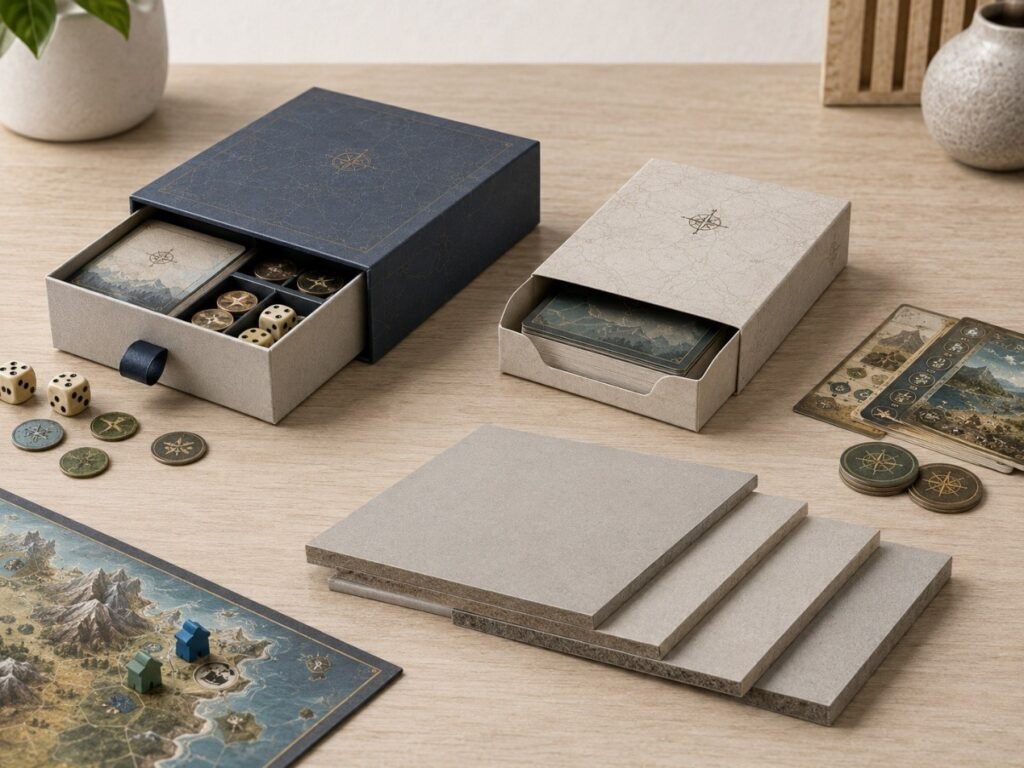
It is not precise enough although that request is understandable.
For a telescoping box, greyboard thickness mostly affects side-wall stiffness, lid feel, and how much weight the box can carry without feeling soft. A standard tabletop game may work well around 1.5–2.0 mm, while heavier games may need 2.0–2.5 mm. But if the box is very tall, thicker board alone may still not solve the problem. Tall walls flex more. The insert and component layout have to help.
For a magnetic closure box, thickness is not only about strength. The hinge area, flap weight, magnet position, and wrapping tension matter. If the board is too thin, the box can feel weak. If the structure is too heavy, the flap may not close as cleanly as expected. This is why magnetic boxes need sampling more than normal lid and base boxes.
For a drawer box, greyboard thickness changes the sliding feel. A slightly thicker tray or sleeve can make the drawer tighter after wrapping and lamination. This is where designers get surprised. The box may look simple, but the fit tolerance is less forgiving than a telescoping box.
For a tuck box, the question is different. Most tuck boxes are folding paperboard, not rigid greyboard construction. Asking for “thicker greyboard” does not apply in the same way. If the game needs real rigidity or heavy component support, a tuck box is probably the wrong structure, not just the wrong material thickness.
So the better question is not “How thick should the greyboard be?”
The better question is:
What box structure is carrying the weight, and where will it fail first?
That failure point may be the side wall, the hinge, the sliding sleeve, the corner, or the insert. Greyboard thickness helps only when it is matched to the box type and the packed component weight.
Carrying Capacity Is Not Only About Greyboard
A box does not carry weight like a shipping carton.
It is not designed to be lifted by one wall or crushed from random angles. It protects components mainly through structure, surface area, and the way it sits inside a master carton.
For a heavy board game, the insert can help or hurt.
A strong insert supports components and reduces movement. A weak insert creates empty cavities and lets parts press against the box wall. If heavy components slide inside the box, even thick greyboard may not prevent corner or side damage.
This is why box strength must be judged as a system:
Box shell + insert + component layout + master carton.
Not greyboard thickness alone.
A heavy miniature game in a poorly designed tray can damage its own box during shipping. A lighter game in a well-supported insert may survive better with less material.
That is not theory. It is how packaging problems usually show up.
The visible box is only one part of the structure.
Cost Comparison: Which Box Type Is Usually More Expensive?
In general, from lower cost to higher cost, the order is often:
This is not an absolute rule since size, material, quantity, finishing, inserts, and labor can change the final cost.
But for most board game projects, the pattern is clear:
Tuck box is cost-efficient.
Telescoping box is the standard rigid solution.
Magnetic closure box is premium and more expensive.
Drawer box sits in the middle but can become costly if the structure is large or tolerance is demanding.
The mistake is choosing a box type before understanding the cost position.
If the game has a low retail price, do not start with a magnetic closure box unless the packaging is part of the business model.
If the game is a high-end collector product, do not force it into a weak tuck box to save a little cost.
If the game is a standard tabletop product, a well-built telescoping box may be more convincing than a poorly executed “premium” structure.
A normal box done properly often beats an expensive box done poorly.
Factory-Side Advice Before Choosing Board Game Box Types
Do not choose the box type from a reference photo alone.
A reference photo can show the direction, but it does not tell the factory where the structure will fail. For box selection, the useful question is not “Can you make this kind of box?” Most factories can.
The better question is:
Will this box type still work after your real components go inside?
For a telescoping box, the factory needs to check the largest folded component, packed height, insert layout, and box wall strength. This structure is forgiving, but it still becomes wasteful if the game is too small for the footprint.
For a magnetic closure box, the key risk is not only cost. The factory has to check hinge strength, flap size, magnet position, box weight, and whether the closure still feels clean after wrapping and loading components.
For a drawer box, the first thing to test is sliding fit. Paper wrap, lamination, greyboard thickness, and tray weight can all change the pull feeling. A drawer box should not be approved from a digital mockup only.
For a tuck box, the factory needs to know whether the product is really light enough for folding paperboard. If the game has heavy tokens, dice, thick card stacks, or a board, the problem is not just material thickness. It may be the wrong box type.
So before choosing the structure, send the factory the information that affects the failure point:
A factory can recommend the box type quickly if these details are clear.
But if you only send a photo and say “make something like this,” the factory can copy the appearance without knowing whether the structure is right for your game.
That is how packaging mistakes start: the box looks correct before anything inside it has been tested.
Warning, Limitation, and Not Suitable Scenario
A telescoping box is the safest default for many board games, but it is not automatically the best choice for small card games.
A magnetic closure box can create a premium opening experience, but it becomes a mistake if the game price cannot support the extra material, labor, sampling, and shipping cost.
A drawer box can look elegant, but it is not friendly to heavy components or poor fit tolerance.
A tuck box is efficient, but it should not be forced to carry the promise of a full tabletop game.