
Custom Jigsaw Puzzle Manufacturing: Quality Standards for 1000-Piece Puzzles
In custom jigsaw puzzle manufacturing, 1000-piece quality usually fails before printing becomes the obvious problem. Buyers often start with piece count, box size, and artwork. That is not how puzzle quality gets locked. A 1000-piece puzzle becomes difficult when the board system is unstable, the fit window is too narrow, the cut logic is lazy, or the dust level tells you the converting process was never really under control.
That is why jigsaw puzzle material quality has to be decided before anyone gets excited about finish options. A flashy print is the easy part. The real test is the board density and the die-cut. If the pieces do not snap together or the edges start peeling after ten minutes, the art is irrelevant. The whole set just feels like a manufacturing mistake.
A proper 1,000-piece puzzle should separate cleanly, stay low in dust, and lock with a firm, natural snap instead of a forced fit. What sounds simple on paper is usually one of the harder controls to hold on the production floor. It usually is not simple.
Custom Jigsaw Puzzle Manufacturer for Bulk & Wholesale Orders
Material Choice First: Why ESKA Blueboard Is the Default Starting Point for Premium 1000-Piece Puzzles
The real argument in jigsaw puzzle material quality is not thickness by itself. It is dimensional stability, die-cut response, and whether the board still behaves predictably once the puzzle leaves the factory.
That is why, on adult retail projects, we usually start the conversation with ESKA Blueboard, not with the cheapest board that can survive a quotation sheet. ESKA’s puzzle-grade board is specifically developed for the jigsaw industry, is available in both blue and grey, and is positioned around the things that actually matter in puzzle converting: easy die cutting, minimum pressure, consistent caliper and sizes, and lay-flat performance. Its official technical sheet also defines die-cut size tolerance and moisture-content targets instead of leaving those as vague shop-floor assumptions.
For example, ESKA’s published puzzle specification lists die-cut size tolerance at ±0.2 mm, and for the 1.75 mm grade, both its puzzle grey and puzzle blue versions are published with MD dynamic stiffness of 1175 mNm. The same technical sheet also sets separate moisture-content targets for the two lines. Those details do not automatically make every puzzle premium, but they do tell you the processing window is defined before production starts. That matters. At this scale, board stability is the whole game. If the sheet moves under the die, you lose that satisfying snap and the pieces just do not lock properly. It is the difference between a high-end feel and a loose mess.
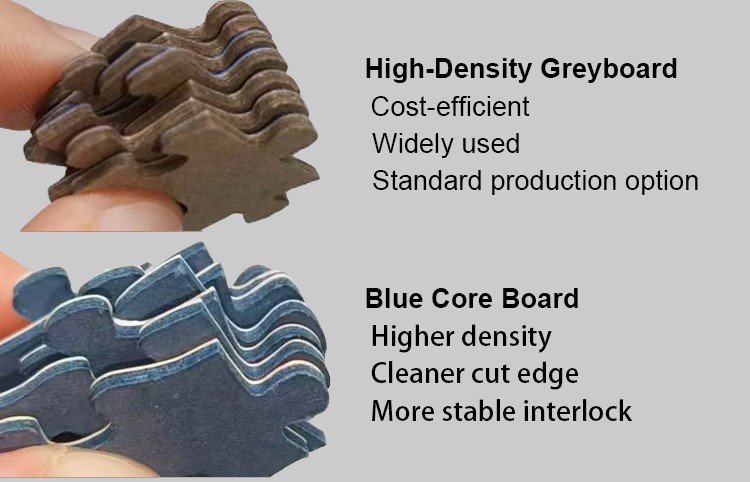
This is where blueboard vs greyboard puzzles should be discussed more honestly. Greyboard is not wrong. It is often acceptable for low-cost promotional puzzles, entry-level children’s products, and short-life campaign items. But if the product is supposed to feel premium in hand, we do not like starting from bargain greyboard and then pretending the rest of the production system will magically compensate for it. It usually will not. On adult 1000-piece jobs, that shortcut tends to show up later as softer edge feel, less stable interlock, more visible board fatigue, or a general impression that the puzzle feels cheaper than the artwork promised.
Why “Thicker” Is the Wrong Question in Jigsaw Puzzle Material Quality
Buyers still ask for “2 mm board” as if that alone defines quality. It does not.
Two puzzle boards can look close on a quote sheet and still behave very differently in the pressroom and in the customer’s hands. What matters is not just caliper. It is whether the board cuts cleanly, whether the layers stay stable under die pressure, whether the neck zones crush too easily, and whether repeated use starts whitening the edges earlier than it should.
ESKA’s own product positioning leans into exactly those manufacturing realities: a 3-layer solid board structure, ample glue between layers, easy die cutting under minimum pressure, and consistent caliper and size control. That is the kind of language that matters more for puzzles than marketing words like “premium” or “luxury,” because it speaks directly to converting behavior.
If the project is low-price, fast-turn, or clearly disposable from a retail point of view, then no, not every 1000-piece puzzle needs ESKA Blueboard. But if the product claims to be premium and the user is expected to keep it, rebuild it, gift it, or review it online, then board choice is not the place to fake savings.
So the practical decision is this: if the puzzle is genuinely positioned as an adult retail product, start from the better board system first and downgrade only if the budget forces it. Doing that in reverse is how projects get trapped in budget lock-in.
The Snap Factor: A Good Puzzle Should Click Into Place, Not Fight the User
A lot of factories still misunderstand the Snap Factor. They think tighter is better. That is wrong for a 1000-piece puzzle.
A premium fit should feel controlled, not aggressive. The piece should settle with a clean click, not with brute force. If the interlock is too loose, assembled sections drift when the user tries to move them. If it is too tight, you start seeing whitening, crushed necks, damaged tabs, or user frustration after repeated assembly. Neither outcome is premium.
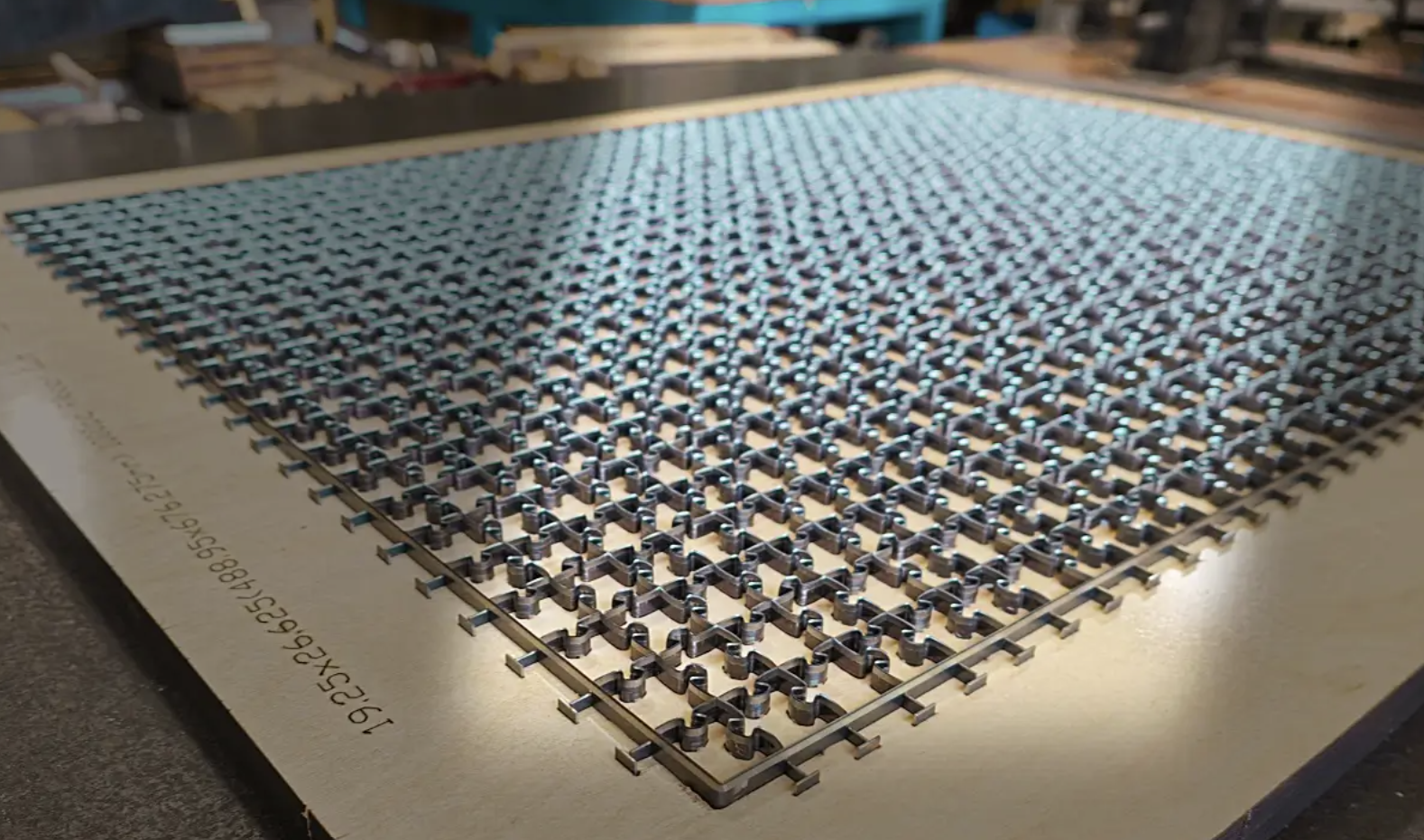
This is why the “click test” should never be judged from one perfect pair of sample pieces. The useful test is broader: center area, edge area, awkward shapes, repeated assembly, and whether the fit remains consistent instead of alternating between tight and slack. In production terms, that consistency is not created by one magic die line. It comes from the board system, die pressure, rule condition, and how intelligently the puzzle die-cut patterns were designed in the first place.
Snap Fit Depends on the Whole Board-and-Die System
💡 Factory Insight
Our factory-side view is blunt here: a puzzle that feels impressively tight on the first build can still be a bad puzzle. For adult 1000-piece products, over-tight interlock is often just deferred customer complaint.
Puzzle Dust Is Not a Cleaning Problem. It Is a Converting Problem.
Puzzle dust is one of the easiest defects to underestimate because it looks cosmetic. It is not.
When a customer opens the box and sees dust, what they are really seeing is a clue about the converting line. Too much dust usually means something upstream was unstable: the board condition, the die condition, the cut pressure, the stripping path, or the overall discipline of the process. Blowing the pieces harder at the end is not a serious fix.
This is another reason better board systems matter. ESKA’s puzzle-grade materials are positioned around minimum-pressure die cutting, lay-flat stability, and consistent caliper and size control. Those are not just pleasant specification words. In practice, they support cleaner cutting and a more predictable die response. That does not guarantee low dust by itself, but it gives the factory a better starting point than an inconsistent board that needs to be bullied through the die. That is a manufacturing inference, but it is a useful one.
Why Puzzle Dust Usually Starts Earlier Than Packing
⚠️ Warning: The mistake many buyers make is treating dust as a packaging issue. That is wrong. By the time the puzzle reaches packing, the important decisions have already been made. If a supplier cannot explain dust control as part of die cutting and converting discipline, the problem is usually structural, not cosmetic.
Random Cut vs. Ribbon Cut: Choose the Difficulty Model First
Most discussions about random cut vs. ribbon cut start at the wrong end. The right first question is not “Which cut looks more premium?” It is “What solving experience is this product supposed to create?”
A ribbon cut follows a clean, predictable grid. It is the layout most players are used to. For family puzzles or budget-friendly sets, you are not looking for surprises. You want a layout that is easy to build and even easier to manufacture.
Random cut is less uniform. The pieces break away from the row-and-column rhythm, and the puzzle gains more shape variety and, frankly, more character. That usually creates a stronger solving experience for adult puzzlers, especially on detailed artwork where you do not want the user progressing mainly by grid logic. But random cut is only better when the artwork and die planning can support it. On repetitive skies, soft gradients, tiled textures, or poorly controlled geometry, random cut can create more wrong placements, not more enjoyment.
The Real Decision Rule for Random Cut vs. Ribbon Cut
So here is the decision rule we actually use:
Puzzle Die-Cut Patterns Matter More Than Most Buyers Expect
The phrase puzzle die-cut patterns sounds technical, but the consequence is very simple: piece geometry changes how the customer thinks while solving.
Good die-cut patterns guide difficulty without making the structure feel repetitive. Bad ones create false challenge, repeated shapes, weak necks, or too many pieces that look correct until the user notices they are not. That is why cut planning should be tied to artwork type, target audience, and price level, not chosen as an isolated style preference.
This is also where low-cost quoting tends to go wrong. Buyers ask for 1000 pieces, random cut, premium board, perfect snap, low dust, and a low retail target, but those requirements were never aligned. The usual correction is not a miracle factory. It is fixing the decision sequence.
The Usual Decision Sequence Is Backwards — Here Is the Better One
Most puzzle inquiries arrive with artwork first, box finish second, and material questions last. That is backwards from a manufacturing standpoint.
The Better Decision Sequence
Lock the finished puzzle size → Lock the board system → Decide ribbon-cut or random-cut → Test fit consistency → Evaluate dust → Finalize box and packing
That order matters because cost control usually fails at step two, not step five. Once the wrong board or wrong cut logic is quietly accepted, the project enters budget lock-in and every later correction looks expensive.
What We Recommend Before Quoting a Premium 1000-Piece Puzzle
For a serious adult retail puzzle, the minimum useful inquiry information is not just “1000 pieces.” It is:
Those are not paperwork details. They are the points that decide whether custom jigsaw puzzle manufacturing will stay stable or start drifting into rework.
A Warning, Not a Summary
If your project has frequent artwork changes, scattered SKUs, and small volume per version, this whole quality model becomes harder to defend. Not because the standards stop mattering, but because the production rhythm changes. At that point, version control and die planning may become more important than upgrading the board again.
There is another limit that should be said clearly: even premium board does not cancel out bad storage logic. ESKA’s puzzle material is engineered around lay-flat performance, moisture targets, and controlled size tolerances, but it is still a paper-based board system. If the product will live in humid supply chains without meaningful barrier packaging, you should not sell it as if material choice alone solved everything.
And one final boundary: not every 1000-piece puzzle deserves to be built like a collector product. If the job is truly cost-led, admit that early. Premium language cannot rescue a low-spec puzzle once the user starts handling the pieces.
⚠️ Warning: The correction you need is not a miracle factory. It is fixing the decision sequence before the quote is even sent.