

How to Choose the Best Card Stock for Card Games (GSM, Core, and Finish)
Most teams searching for the best card stock for card games are actually trying to solve a different problem:
They want a material that feels right — without realizing that the wrong choice will lock in cost, packaging, and shipping constraints.
In real production, material selection is not a surface decision. It controls:
It shows up later as a budget problem that cannot be reversed easily.
So the wrong decision here does not show up as a “quality issue.”
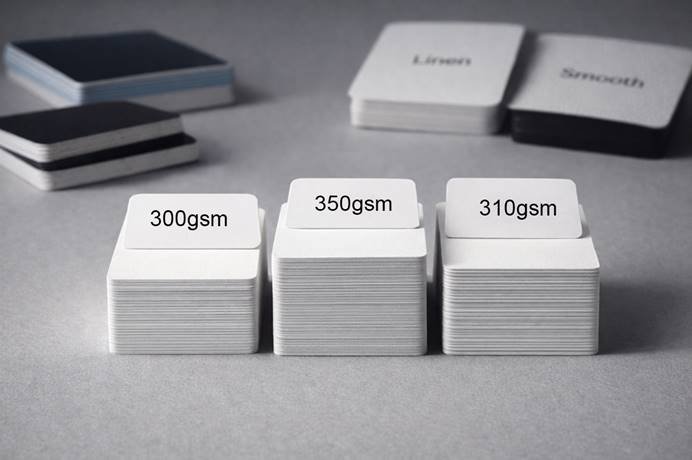 Best card stock for card games guide showing gsm thickness comparison
Start Here: A Stable Default That Avoids Most Problems
If your specifications are not fully defined yet, start with:
This combination works because it avoids three failure points:
Once you move away from this baseline, you are usually solving one issue while creating another.

Custom Playing Cards
The Real Decision Sequence (Most Projects Get This Backwards)
⚠️ Wrong Starting Point: Design teams usually start from “premium feel.” That is the wrong starting point.
The actual manufacturing sequence is:
If you start from Step 3 or Step 5, you usually end up redesigning packaging later.
Playing Card GSM Guide: Why 300gsm Works and 350gsm Feels “Premium”
Most playing card gsm guide content compares thickness.
That is not where the real decision is.
If you need a deeper explanation of how GSM affects stack height and packing constraints, see our detailed breakdown of playing card gsm guide in production.
Why 300gsm Keeps Showing Up
300gsm is not “standard” by definition.
It is where problems are still manageable.
At this level:
Factories keep using it because it is stable under production conditions.
What 350gsm Actually Changes
350gsm gives a stronger first impression, but introduces constraints:
The issue is not thickness itself.
It is how thickness accumulates across the full deck.
Where 350gsm Becomes a Bad Choice
350gsm usually fails when:
In these cases, it does not feel premium. It creates packing and cost problems.
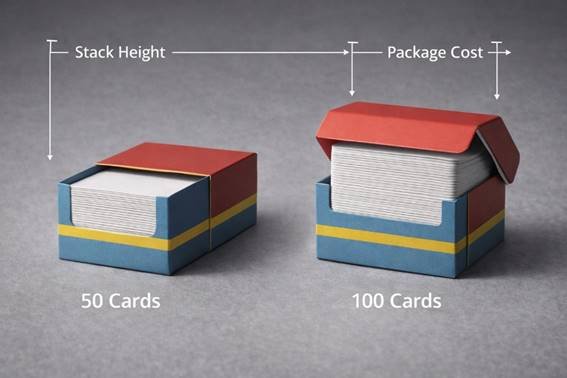 Card stack height affecting box size and carton efficiency 50 cards vs 100 cards comparison
Blue Core vs Black Core Cards: This Is Not a Preference
The discussion around blue core vs black core cards is often treated as optional.
In production, it is not.
If you want to understand how light transmission actually happens inside the paper structure, see our detailed breakdown of blue core vs black core cards.
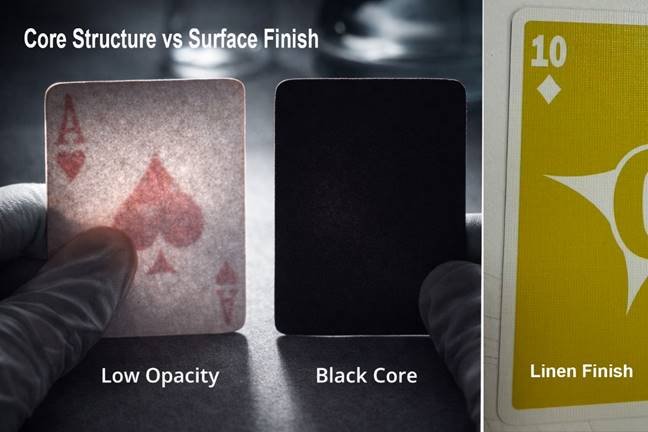
What Actually Causes See-Through
Light passes through paper because of:
Increasing GSM does not solve this reliably.
Why Black Core Exists
Black core introduces a layer that absorbs light instead of letting it pass through.
This is not a visual improvement. It is a structural fix.
When Blue Core Becomes a Problem
Blue core is not acceptable when:
In these cases, choosing blue core is not saving cost.
It is introducing gameplay risk.
Linen Finish vs Smooth Finish: This Is About Air, Not Texture
Most comparisons of linen finish vs smooth finish focus on how cards feel.
That is misleading.
The mechanical difference between linen embossing and coating is explained in more detail in our analysis of linen finish vs smooth finish.
What Linen Finish Actually Does
Linen embossing creates micro gaps between cards.
This changes:
Result:
What Smooth Finish Does
Smooth + matte varnish creates full surface contact.
This leads to:
Where the Wrong Decision Happens
Switching from linen to smooth to reduce cost seems minor.
In practice:
This is usually discovered only after sampling.
Durability: Why Thickness Is Not the Main Factor
Durability is often misunderstood.
Cards do not fail in the middle.
They fail at the edges.
Real Failure Points
What Actually Controls Durability
Not just GSM.
💡 Pro Tip
A poorly processed 350gsm deck can wear faster than a well-produced 300gsm linen deck.
Where Quotations Usually Go Wrong
Quotation problems rarely start with price.
They start with missing specifications:
At that point, suppliers are not quoting the same product.
They are quoting different assumptions.
Before You Send an RFQ
At minimum, define:
Without these, the quotation cannot be compared or used for decision-making.
Warning (Not a Conclusion)
⚠️ Warning: If your project still involves frequent design changes or multiple SKU variations, locking card stock too early will create rework. Material decisions only hold when card count is stable and packaging structure is defined. Otherwise, you will be forced to adjust everything again.