


Digital Proofing vs. Physical MPC: What Is a Mass Production Copy in Board Game Manufacturing?

Digital proofing checks the file. A physical MPC checks the product. In board game manufacturing, that difference matters more than many first-time buyers expect, because a clean layout on screen does not prove the packed game will still work once real materials, real thickness, and real fit enter the process.
If you are preparing a game for mass production, one of the first practical questions is whether digital proofing is enough, or whether you also need a physical sample before production starts.
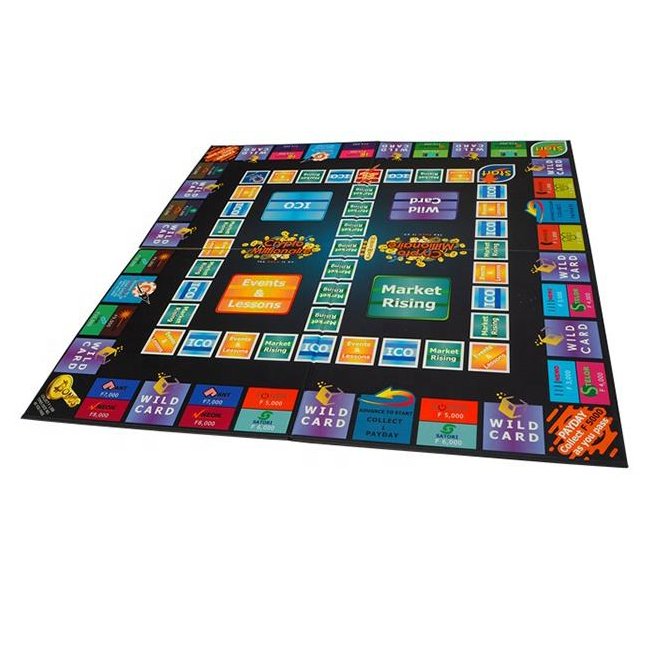
Custom Game Boards
A lot of general articles answer this too loosely. They say both are useful. That is true, but it does not help you decide. In real board game manufacturing, the better question is not whether both methods have value.
The better question is: what failure are you trying to prevent?
If the main risk is text, layout, artwork placement, or file-side mistakes, digital proofing usually comes first. If the real risk is fit, tolerance, packing sequence, insert behavior, or component interaction, then a physical MPC becomes much more important.
That is the key distinction. Digital proofing and physical MPC are not two versions of the same approval step. They solve different problems.
What Digital Proofing Actually Checks
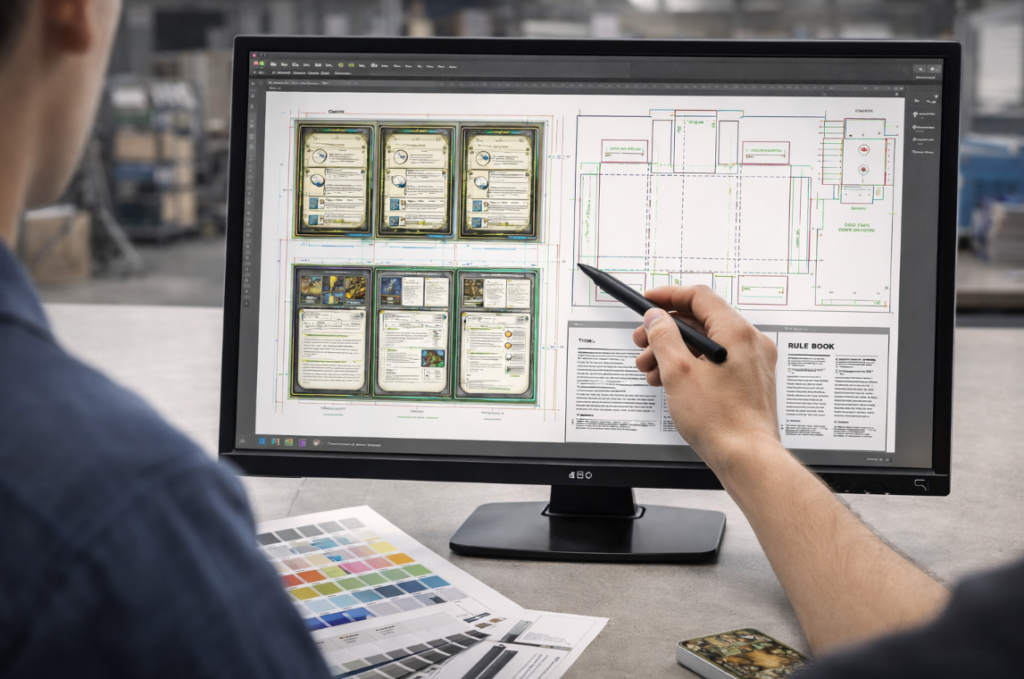
A digital proof is mainly a file-control step.
It is useful for confirming that the right artwork is in the right place, the text is correct, the layout is aligned properly, and obvious technical problems are caught before production. If your game is relatively simple, that may be enough.
But this is where many buyers overestimate what digital proofing really confirms.
What it cannot tell you is whether the real product will still behave well once it is assembled as an object.
It cannot show you whether two decks plus a folded board now make the insert cavity too tight. It cannot show you whether wrapped board thickness slightly changes the tray feel. It cannot show you whether the packed stack has become just thick enough to reduce carton efficiency later. And it definitely cannot show you whether a miniature base that “fits on paper” becomes awkward once actual tolerance is added.
So digital proofing is useful. But it is useful within a boundary.
It helps answer:
Did we build the content correctly?
It does not fully answer:
Will this product still work well once manufacturing reality enters?
That boundary is where many projects get misread.
What a Physical MPC Is — and What It Is Not
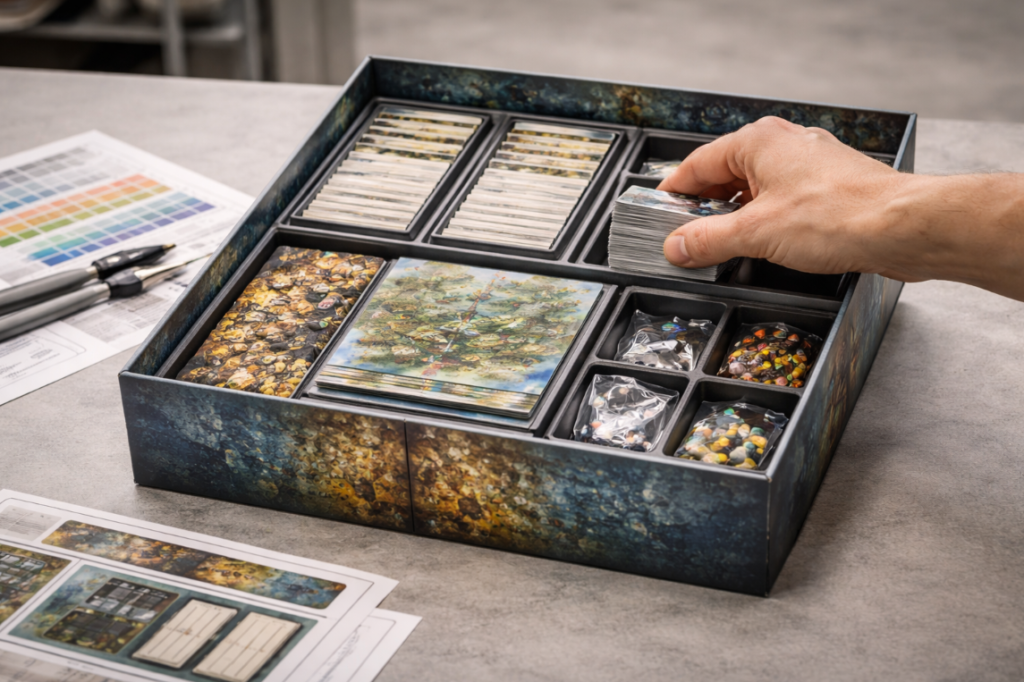
In this context, MPC means Mass Production Copy.
A physical MPC only has real value if it is used as a manufacturing check.
The point of an MPC is to test whether the approved design still works once it becomes a real product with actual material thickness, actual packing order, actual board wrap, actual tray behavior, and actual component interaction.
That matters because many production problems are not visual. They are physical:
This is the kind of issue that is easy to miss if the team only reviews files on screen.
So when buyers ask, what is a Mass Production Copy, the best answer is this:
A physical MPC is a pre-production control step used to check whether the product still works once it becomes real.
That is much more useful than saying it is “a sample befo
Digital Proofing and Physical MPC Solve Different Risks
This is the point that should drive the decision.
Those are not the same category.
If your game is mostly flat print, standard-size cards, a standard box, and a simple packing structure, the main risk often remains at file level. In that case, digital proofing may be enough, and forcing a physical MPC too early may only add time and sample cost.
But once the project carries real fit risk, that logic changes.
At that point, the product can fail even when the files are technically correct.
That is where a physical MPC becomes the more honest control step.
Our internal rule is simple:
Use digital proofing when the danger is still flat. Use a physical MPC when the danger has become three-dimensional.
That is not a textbook phrase, but it is closer to how these projects actually behave.
When Digital Proofing Is Usually Enough
A physical MPC is not automatically required just because the game is custom.
This is one place where buyers sometimes overspend.
Digital proofing is often enough when the structure is straightforward, the packed product is forgiving, and there is no meaningful fit sensitivity between components. A project built around standard cards, a standard box, a simple rulebook, and no complex insert logic can often move efficiently with digital proofing first.
The correct decision sequence is not “always do both.” That advice sounds complete, but it is weak.
The better sequence is:
That is especially true when the files are already stable and the buyer wants to move to production without unnecessary sampling loops.
But there is a limit to this advice. Digital proofing is only enough if the project itself is already settled. If the component list is still changing, the insert is still open, or the packed structure is still drifting, then digital proofing is not really simplifying the job. It is just postponing the instability.
When a Physical MPC Is the Better Decision
A physical MPC becomes much more valuable when the game can fail through fit, tolerance, or packing sequence.
This usually starts happening when the project includes a rigid setup box, wrapped insert, multiple component layers, large folded boards, nested trays, mixed materials packed tightly, or custom plastic miniatures.
These are the projects where a digital proof can look completely clean while the real product still feels wrong.
And “feels wrong” is not a small issue in manufacturing:
This is why a physical MPC is often worth more than another round of on-screen checking when the real risk has already shifted into product behavior.
Not because it looks more serious.
Because it reveals more serious things.
If the game can fail in the physical relationship between parts, a physical MPC is usually the better decision.
Where Buyers Usually Misjudge the Sample Decision
The sample decision normally goes wrong in one of two ways.
Both mistakes cost money, but they waste it differently.
So the real decision question is not:
Should we do an MPC or not?
The better question is:
Has the product reached the point where a physical sample will produce a stable answer?
If the answer is no, the MPC may be premature.
If the answer is yes and the project has real fit risk, skipping it may be false economy.
That is the actual decision boundary.
How Custom Miniatures Change the Proofing Decision
Once custom plastic miniatures are part of the project, the value of a physical MPC usually increases.
Not because miniatures always require extra ceremony, but because they introduce another layer of physical uncertainty: base fit, cavity fit, standing behavior, interference with adjacent parts, and the difference between “technically fits” and “packs comfortably.”
That difference is easy to underestimate on screen.
The same thing can happen with thick punchboard, folded boards, stacked card decks, and multi-level inserts. A product can be mechanically acceptable and still behave badly in real assembly or real packing.
This is why a component-heavy game should not be sampled with the same logic as a mostly flat-print game.
The proofing path should follow the real risk path.
A Better Way to Decide Before Mass Production
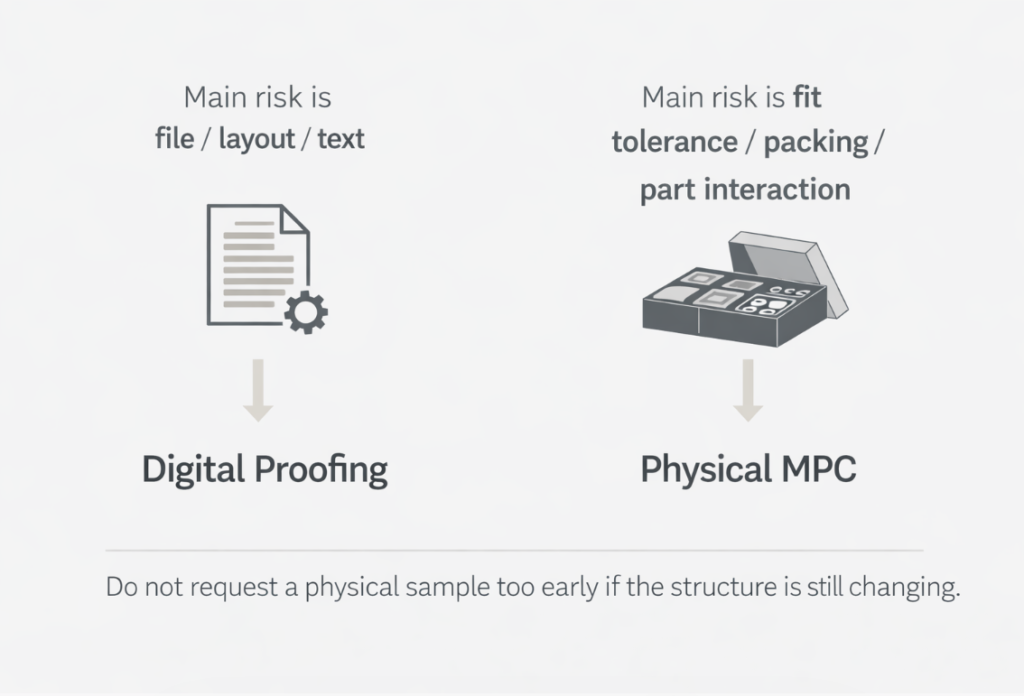
The safest decision sequence before mass production is not complicated, but it does require discipline.
If the remaining risk is mainly artwork, text, dieline alignment, or print file behavior, digital proofing should lead.
If the remaining risk is fit, tolerance, insert logic, or component interaction, a physical MPC becomes the better control step.
That sequence is stronger than broad advice like “premium games should always do physical samples” or “simple games can skip them.” Those statements are too broad to guide a real project.
A better rule is this:
Choose the proofing method based on where the project can still fail. That is how the decision stays useful.
Warning Before You Approve the Wrong Sample Stage
If your game is still changing card counts, insert structure, or major packed components, a physical MPC may not give you a stable answer yet.
If your project is mostly flat print with low fit sensitivity, insisting on a physical MPC too early can add cost without adding much control.
And if your team is requesting a physical sample mainly for emotional reassurance rather than to test a real manufacturing risk, that is usually the wrong reason to request one.
Digital proofing and physical MPC are both useful. But they are useful at different moments, and for different failure points. Mixing those roles is where the sample budget starts to leak.
If you are moving from prototype to mass production and are not sure whether digital proofing is enough for your project, the right starting point is usually to review the component structure first, not to request every sample type by default. A simple flat-print game and a component-heavy boxed game should not use the same proofing logic.