
Why Are Board Game Boxes So Big? Box Size, Shelf Presence, and Shipping Logic
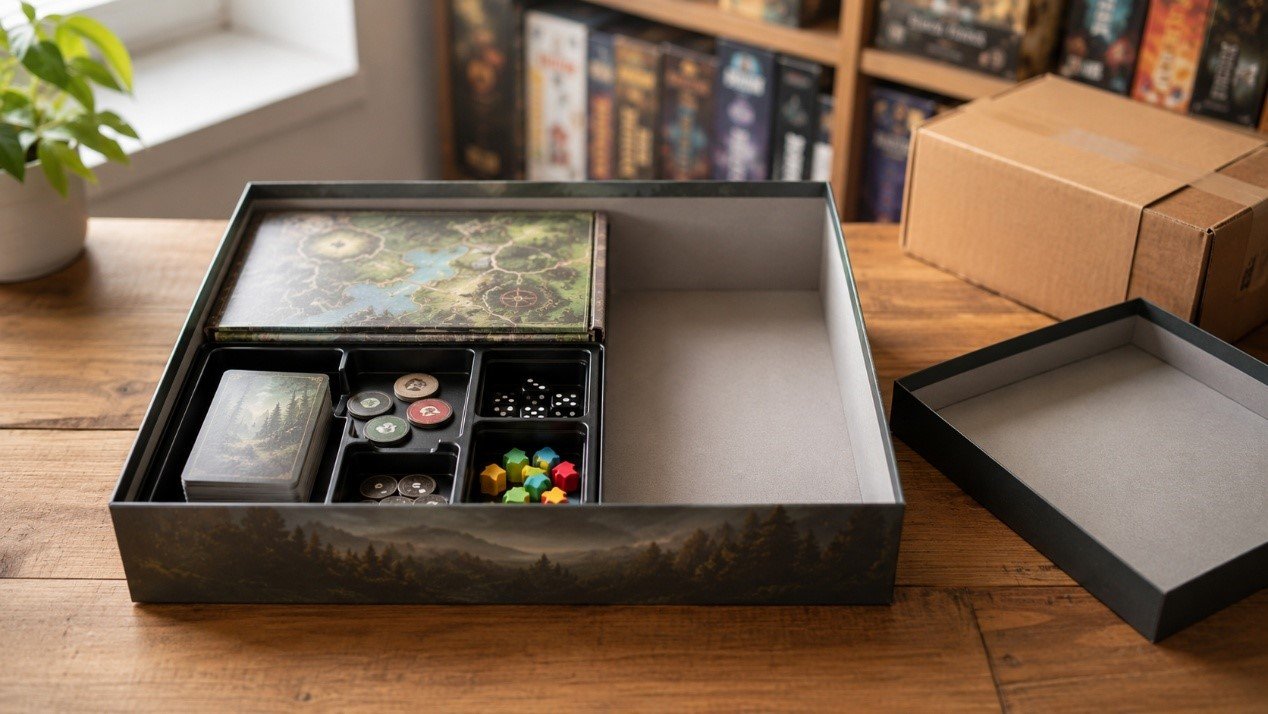 Open board game box showing components, insert space, and unused interior volume to explain why board game boxes are so big
Players complain about oversized board game boxes all the time.
They open the box, remove one deck of cards, a rulebook, a few punchboards, maybe some wooden pieces, and then realize half the inside volume is air. The reaction is predictable:
“Why is this box so big?”
“Is this just for premium pricing?”
“Did the publisher waste space on purpose?”
Sometimes the complaint is fair. Some boxes are simply too large for the component volume. But the real answer is not always “marketing trick.” Board game box sizes are usually shaped by several decisions that happen before players ever see the product: shelf visibility, standard retail formats, component protection, insert design, carton loading, and sometimes future expansion planning.
The problem is that these decisions are rarely visible from the outside.
A player sees empty space.
A publisher sees shelf presence.
A factory sees box structure, packing speed, carton efficiency, and shipping risk.
This article explains why board game boxes are so big, when the extra space is justified, and when it becomes a production mistake.
The “Empty Box” Complaint Is Not Always Wrong
Let’s start with the uncomfortable part: yes, some board game boxes are too big.
If a game contains only 110 cards, a small rulebook, and a few tokens, placing it inside a large square box can feel dishonest. The buyer expects more physical value. When the box opens and the components occupy only a corner, the product feels inflated.
That feeling matters.
Packaging is not only protection. It is part of the perceived product promise. If the outside volume suggests a heavy tabletop experience but the inside feels like a card game, players notice. They may not understand the production reason, but they understand the disappointment.
So the question is not whether big boxes are always wrong.
The better question is:
What job is the box size doing?
If the box is large because it improves shelf display, protects a folded board, fits standard retail storage, allows expansion content, or supports efficient packing, that can be a valid decision.
If the box is large only because “bigger looks more premium,” it becomes risky. That trick works once. It does not work well with experienced hobby players.
Board Game Box Sizes Are Usually Decided Earlier Than Designers Think
Many designers treat box size as a late packaging choice.
That is backwards.
The box size is often locked by the game’s physical system before the final artwork is even ready. The usual decision sequence should be:
Cost control usually fails around step 6 or 7, not at the final shipping quote.
A designer may optimize the number of components but forget the box height. Or they may choose a large board format that forces a larger box even though the rest of the game is small. Once the board fold, card size, and punchboard layout are locked, the box does not have unlimited freedom.
This is why board game box sizes should be discussed before final artwork.
A beautiful cover designed for the wrong box size becomes budget lock-in. Nobody wants to redesign the cover after the campaign page is live, even if the factory later explains that the box is inefficient.
Why the 30 × 30 cm Box Became So Common
A box around 30 × 30 cm is common in modern board games, especially medium-weight family and hobby games.
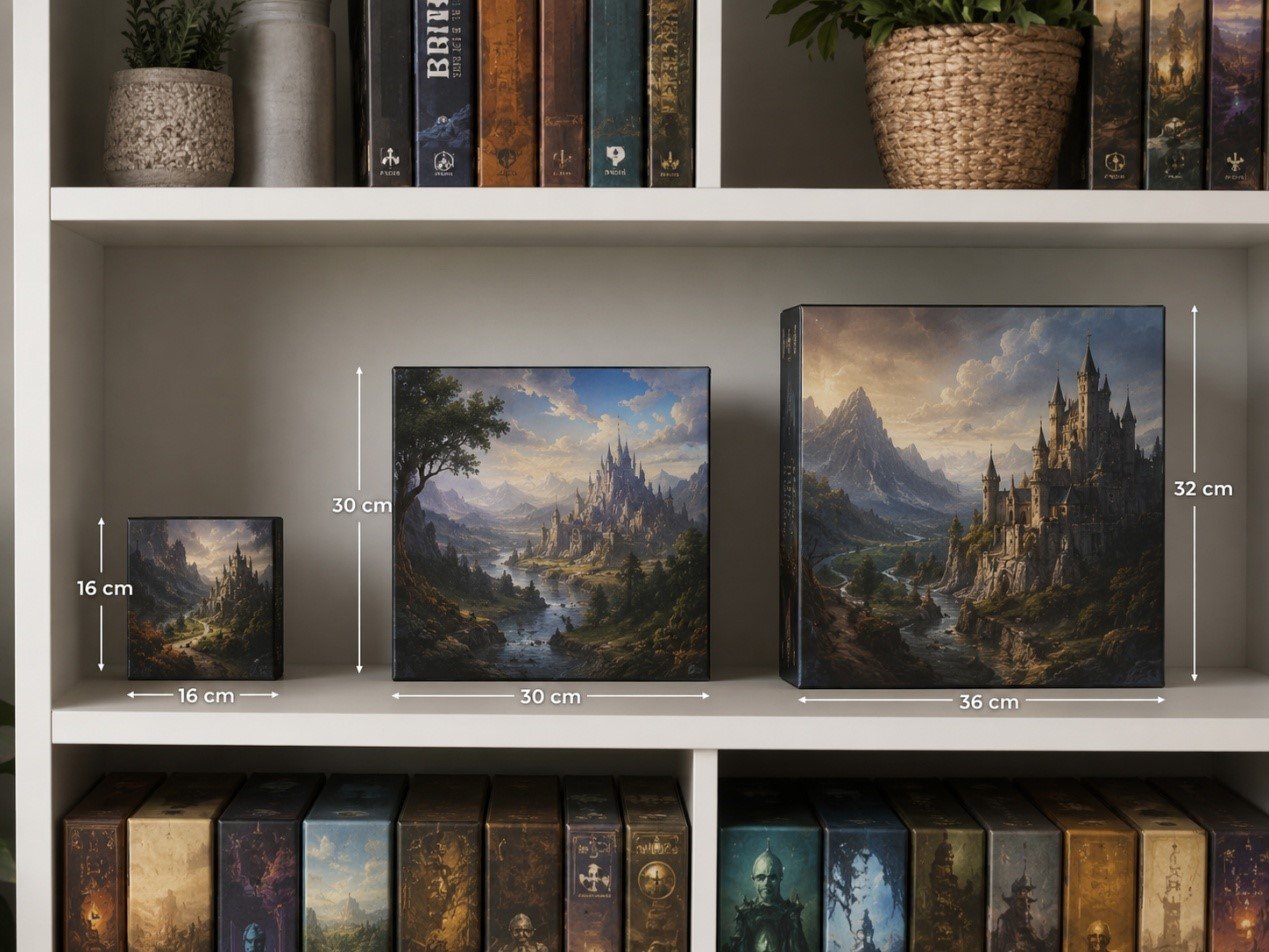
It is not a magic size. It is not a legal international standard. But it became a familiar retail-friendly format because it solves several problems at once.
First, it fits the visual language of many tabletop games. A square box gives enough space for cover art, title readability, and shelf impact. For retail, the front cover is not just decoration. It is the first sales surface.
Second, it works well with folded boards. A game board can fold down into a square or near-square footprint more easily than into a narrow card-game box. If the board is a core part of the game, the box often grows around the folded board, not around the cards.
Third, it is familiar to players’ storage habits. Many hobby gamers store games on cube shelves, bookcases, or board game racks. A box in the 30 cm square family feels normal beside other games. A strange oversized rectangle may create more storage frustration than a standard square box.
Fourth, it helps retailers merchandise the product. A very small box can disappear on a shelf. A large square front gives the game more presence, especially when the publisher is not a famous brand.
That does not mean every game should use a 30 × 30 cm box.
A small card game forced into a square box may look impressive online but disappointing in hand. The size should follow the product promise. If the game experience is compact, portable, and fast, a smaller box may support the brand better than a large one.
Shelf Presence Is Real, But It Can Become Lazy Packaging
Players often suspect big boxes are designed only to justify a higher retail price.
Sometimes they are close.
Shelf presence is a real commercial factor. In a store, a larger box can show artwork better, communicate genre faster, and make the game feel more giftable. For family games, party games, and Kickstarter products, that visual weight can help.
But shelf presence is not a free excuse.
A large box creates expectations. If the inside does not support those expectations, the packaging starts working against the product.
For a publisher, the safer question is not:
“How big can we make the box?”
The better question is:
“What size makes the product feel honest after opening?”
A big box can be justified when it contains a folded board, thick punchboards, trays, miniatures, or enough component variety to fill the space visually.
A big box is harder to justify when the contents are mostly cards and paper.
This is where many indie projects overcorrect. They see successful games in large boxes and copy the outer size without copying the component system inside. The result is not premium. It is empty.
Shipping vs Components: The Hidden Cost of Air
The keyword here is Shipping vs components.
In manufacturing, we do not only price the visible components. We also pay for the air around them.
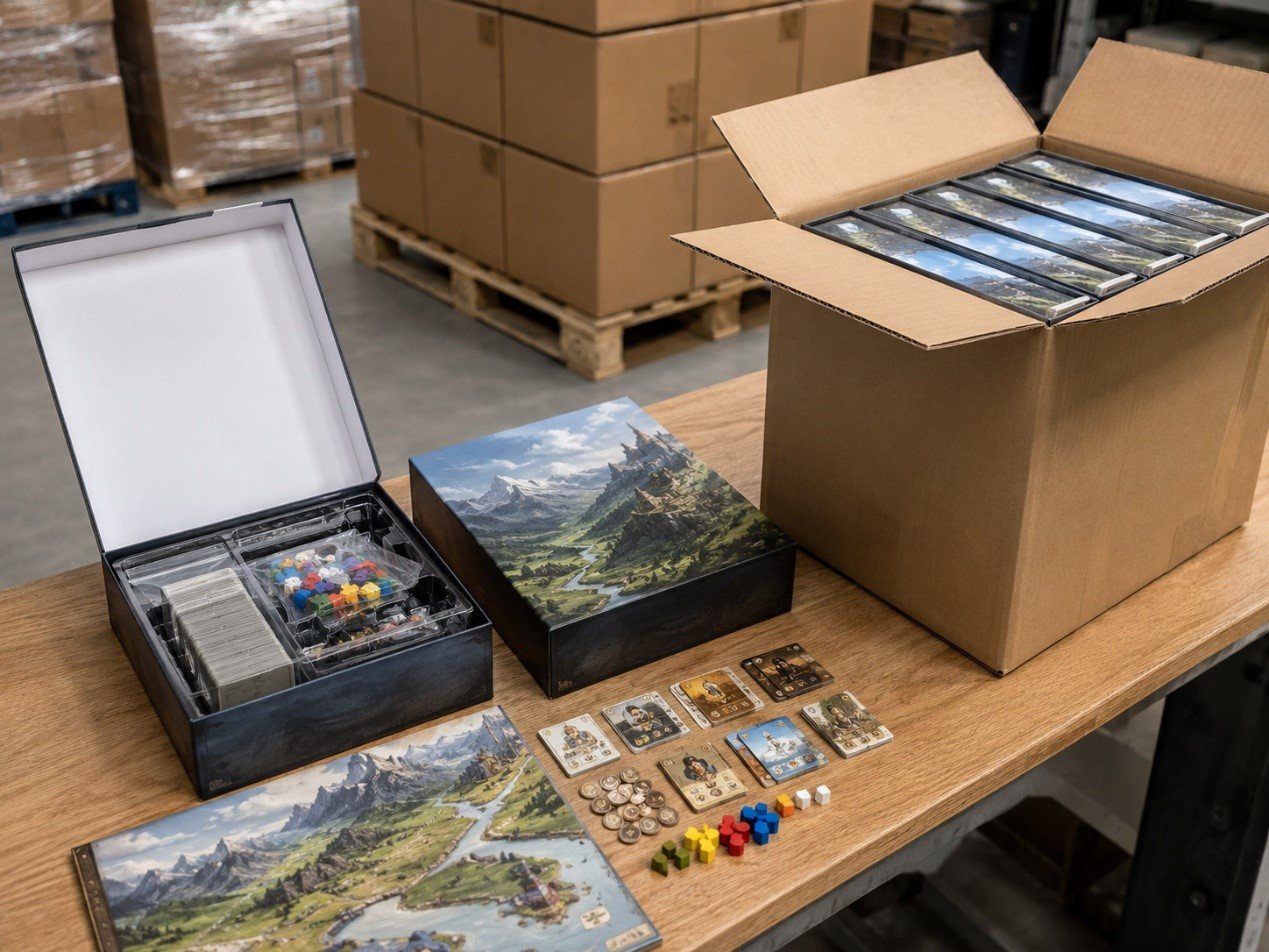
A board game box affects:
A box that is only 10 mm taller than necessary may not look like a big issue on one sample. Multiply that by 3,000 or 10,000 units, and the extra air becomes real shipping cost.
This is why box height is often more dangerous than box width.
A slightly larger footprint may be acceptable if it fits retail shelves and carton layouts. But unnecessary height often creates wasted carton volume fast. It also allows components to move during shipping unless the insert controls them.
Empty space inside the box is not automatically bad. Uncontrolled empty space is bad.
If the box has a tray, cardboard insert, pulp tray, or internal structure that holds components properly, the extra volume may be part of the design. If components rattle around in a large box, that is not premium packaging. That is a shipping problem waiting to happen.
For small publishers, this matters because freight is rarely stable. A box that looked affordable during sample development may become painful once ocean freight, destination handling, warehousing, and fulfillment are added.
The box is not only packaging. It is part of the landed cost.
Why Some Big Boxes Need Extra Space Inside
Not all extra space is waste.
Some board games need space for practical reasons that are not obvious to players.
A folded board may need room so it does not press against card corners. Punchboard sheets may require a wider box even after the tokens are removed. Miniatures may need protective separation. Rulebooks can curl if they are packed too tightly. Cards may need space if players sleeve them later.
Insert design also changes the equation.
A vacuum-formed tray, paperboard insert, molded pulp insert, or plastic blister tray may take up more room than the components alone. But it can also speed packing, improve presentation, and prevent movement during shipment.
This is why comparing “component pile volume” to “box volume” can be misleading.
The real question is:
Does the internal space have a job?
Useful internal space protects, separates, presents, or allows practical storage.
Bad internal space only makes the box look bigger.
That difference matters.
Expansion Space Can Be Smart, But Only If It Is Honest
Some publishers leave room for future expansions.
Leaving expansion space is not automatically a bad idea.
For some campaign games, the base box is expected to become the long-term storage box. Future card packs, extra tokens, small boards, or upgraded components may all need a place to go. If that plan is real, making the base box slightly larger can save players from keeping three small expansion boxes later.
But this only works when the space is designed, not guessed.
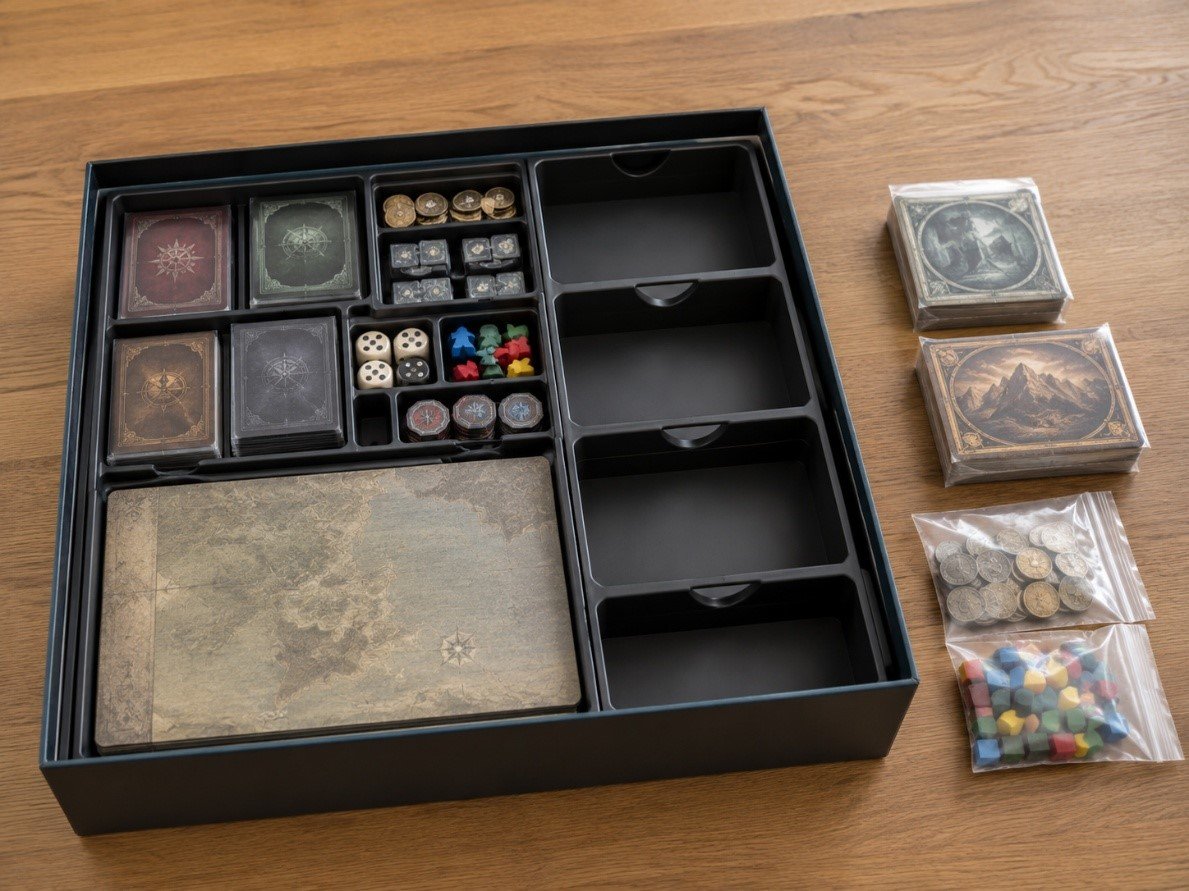
But expansion space is risky if it is not clearly planned.
If the box is oversized because “maybe we will add expansions later,” the base game may feel unfinished. Players are not buying your future roadmap. They are buying the box in front of them.
Expansion space works better when:
It fails when the reserved space is just an open cavity.
A large empty well inside the box does not look like expansion planning. It looks like missing content.
From a factory-side view, expansion space should be designed like a real packing area, not leftover room. The insert should make the base game feel intentional now and still support expansion later.
That is a hard balance. Many boxes do not do it well.
Big Boxes Also Create Retail and Fulfillment Trade-Offs
A larger box can help in retail, but it starts creating pressure once the game moves into fulfillment.
For Kickstarter, DTC, Amazon, or international parcel shipping, the box is no longer just a display surface. Every extra centimeter becomes carton space, warehouse space, and sometimes higher parcel cost. If the larger box does not improve protection, setup, or unboxing value, it is usually not helping the project — it is just shipping air.
But if the box becomes too small, new problems appear.
Components may be harder to pack. The lid may press against the rulebook. The insert may become too tight. Players may struggle to put everything back after punching tokens or sleeving cards.
So the decision is not “small box good, big box bad.”
The better manufacturing question is:
What is the smallest box that still gives the game a clean opening experience, safe component storage, and acceptable carton efficiency?
That is usually the correct target.
Not the biggest box that looks premium.
Not the smallest box that technically fits.
The correct size is often in between, and it is found by physical packing tests, not by visual guesswork.
When a Smaller Box Is the Better Decision
Some games should not be in large boxes.
A compact box is usually better when the game is mainly:
For these games, a large box may damage trust. Players expect the contents to match the outside promise. If the game is light, let the packaging say that confidently.
A small box can also improve online shipping economics. For indie designers selling direct, this may matter more than retail shelf presence.
If the game is mainly sold through Kickstarter, your own webstore, Amazon, or convention tables, copying a retail-size box can be the wrong move.
There may be no store shelf to win. The box has to ship in a parcel, sit in a warehouse, fit on a player’s shelf, and still feel honest when opened. For many direct-sale games, reducing unused box volume does more for the project than making the front cover look bigger.
That is a different design-stage constraint.
When a Larger Box Is the Better Decision
A larger box can be the better decision when the game has a real physical reason.
For example:
In these cases, shrinking the box too aggressively can make the product worse.
Players do not like empty boxes, but they also do not like boxes where nothing fits back after the first play. A box that is efficient on day one but frustrating after punching and sleeving may create a different kind of complaint.
The best box size is not measured only at factory packing stage. It should also survive real player use.
That means the box must work after components are punched, cards are sleeved, bags are opened, and the rulebook has been handled several times.
A box can be technically efficient and still bad for the player.
Factory-Side Advice Before You Lock the Box Size
Before you finalize board game box sizes, check these points in order:
Do not let artwork decide the box size too early.
A cover can be resized. A bad box system is harder to fix after component layout, campaign photos, retail listings, and carton calculations are already built around it.
For quotation, send the factory:
A factory cannot judge box efficiency from cover art alone.
Warning, Limitation, and Not Suitable Scenario
⚠️ Warning: A large board game box is not automatically wasteful. But if the extra space has no job, players will read it as fake value.
A compact box is not automatically smarter either. If players cannot store the game after punching tokens or sleeving cards, the savings were made in the wrong place.
If your game is still changing component count, board size, or expansion plan, do not lock the final box size yet. The box is not the last packaging decision. It is one of the earliest cost decisions.
And if the only reason for choosing a big box is “it looks more premium,” stop there. That may help the first click, but it can hurt the first unboxing.