
Plastic-Free Board Games: A Factory Guide to Replacing Shrink Wrap and PET Trays
💡 Factory Insight
Plastic-free board games do not fail because the idea is wrong. They fail when plastic is removed before its job is replaced.
Plastic-Free Board Games Do Not Start by Removing Every Piece of Plastic
The first mistake is treating every plastic item as the same problem. In a board game, different plastic parts do different jobs.
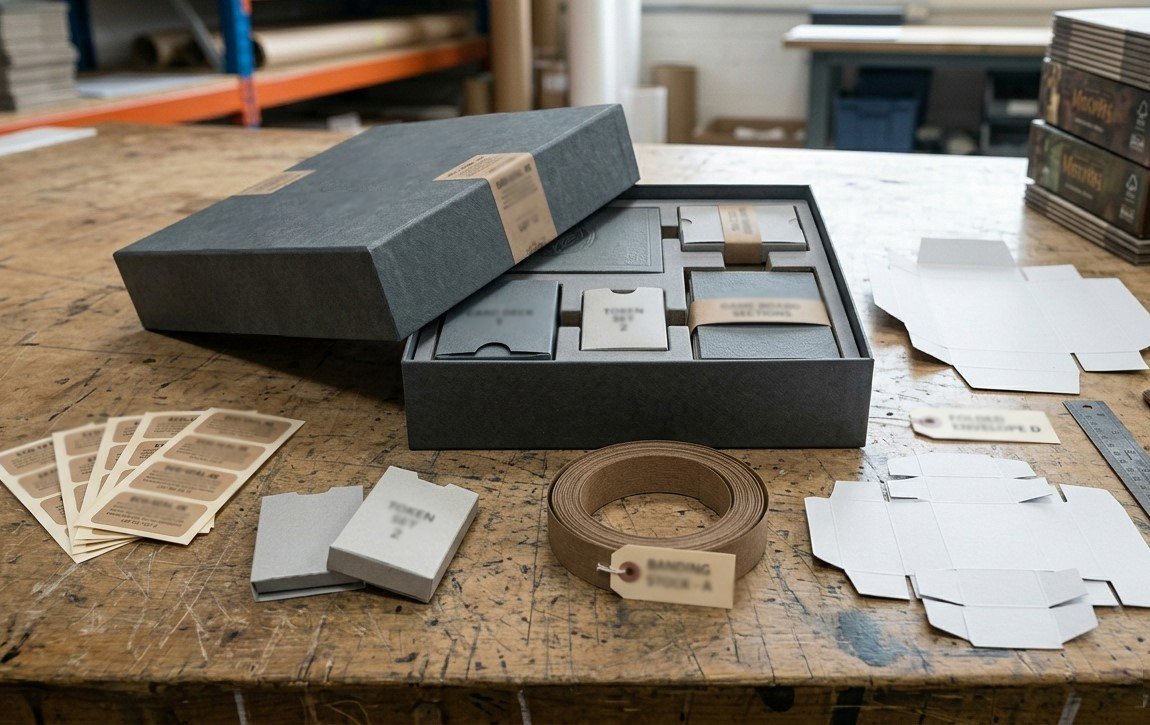
Outer shrink wrap keeps the box closed and shows the unit has not been opened. Card film keeps decks grouped before the first play. Small bags separate dice, meeples, coins, cubes, or tokens. PET trays hold components in fixed cavities. Some bags also help workers count and inspect repeated small parts before final packing.
Once the plastic grouping is removed, the problem usually shows up at the packing table. Dice get mixed with tokens, small card groups lose their order, and painted pieces may rub against each other before the customer even opens the box. The game may look more sustainable in the specification, but the inside of the box feels less controlled.
That is not a better packaging result. Damaged parts, missing components, and messy storage are also waste.
Remove plastic by function, not by material name.
Start with the plastic that is easiest to replace. Then move toward trays and internal grouping only after the component layout is stable.
Start with Outer Shrink Wrap First
Outer shrink wrap is usually the first plastic to review. It is visible to the buyer, easy to explain on a Kickstarter page, and often easier to replace than a tray or internal packing system.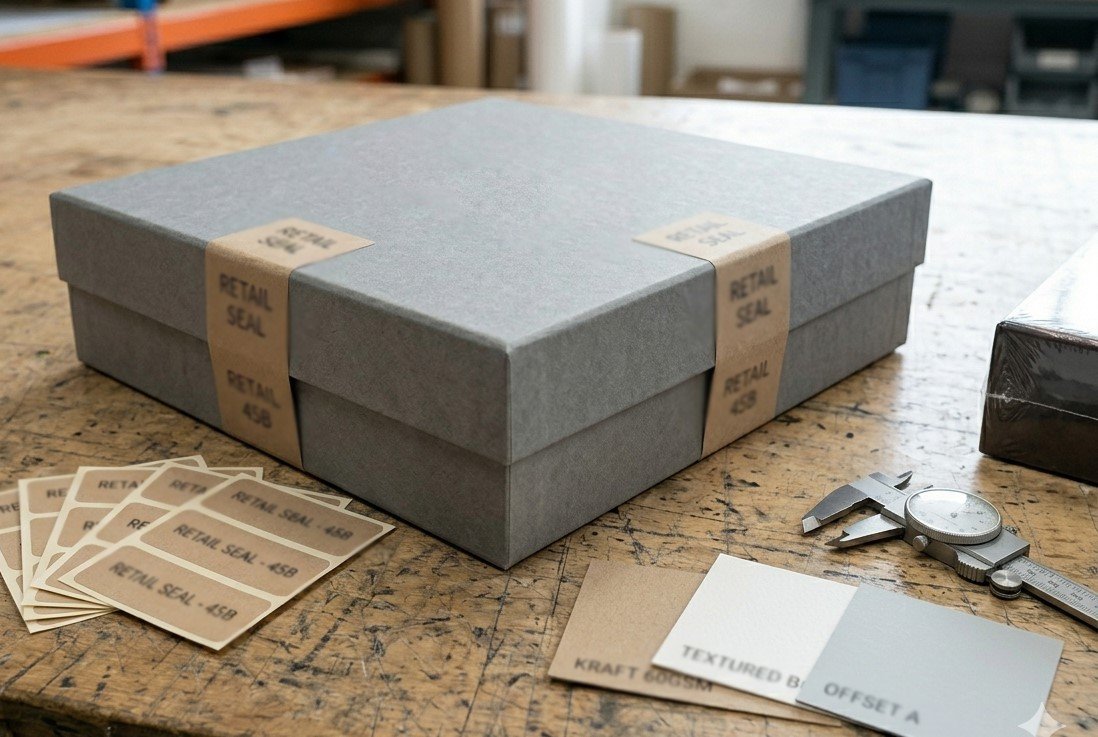 Paper seals replacing shrink wrap on a custom board game box
Common alternatives include:
For many lid-and-base board game boxes, paper seals are the most practical first step. They can show the box is unopened. They reduce visible plastic. They work especially well for Kickstarter, DTC, education, family games, and small retail batches where the sales channel is more controlled.
⚠️ Important: Paper seals do not do the same job as shrink wrap. Shrink wrap gives the box a full-surface hold, even if the lid fit is not perfect. A paper seal works more like a closure point, so the box structure has to do more of the work. It will not protect every corner, stop all rubbing, or hide a loose lid fit.
This matters more when the game uses:
Soft-touch boxes need extra caution. They look good in photos, but dark soft-touch surfaces can show fingerprints, scuff marks, and packing scratches. If the shrink wrap is removed, that surface is exposed earlier.
So the decision is not “paper seal or shrink wrap.” The actual decision is: Can the box structure and surface finish survive without full-surface film protection? If yes, paper seals are a good first move for plastic-free board game packaging. If not, the lid fit or surface finish should be adjusted before the shrink wrap is removed.
Card Decks Need Group Control, Not Just Plastic Removal
Card decks are another obvious place to reduce plastic. But the packing decision depends less on the total card count and more on how the cards are grouped.
A 100-card single deck can usually be controlled with a band or one tuck box. Five small decks are different. Once the player opens the game, loose groups will be mixed quickly. For games with several decks, the packing method should protect the deck order, not just remove the plastic film.
For reduced-plastic card packing, common options include:
A paper band is cheap and simple. It may work for one standard deck, especially around 50–100 cards. But it is not a storage system. After the player opens the game, the band is usually thrown away or becomes loose.
A tuck box costs more, but it has a real function. It can keep the card groups separated, improve storage after play, and reduce the chance that players mix small decks. For multi-deck games, tuck boxes are usually the cleaner plastic-free decision. Not always the cheapest. Cleaner.
For very small card groups, paper bands may slip. A small paper envelope or mini tuck box is often more controlled. For premium Kickstarter games, tuck boxes also make the inside of the box feel more finished than loose card stacks with paper bands.
The point is not to replace plastic with paper at any cost. The point is to keep the deck usable after the first play.
Plastic Bags Are Often a Kitting Tool, Not Just Packaging Waste
Small plastic bags are where many plastic-free plans become unrealistic. A client may see them as unnecessary waste. On the packing line, those bags may be doing a practical job.
They help separate colors. They keep player sets together. They prevent dice and tokens from mixing. They make counting faster. They reduce missing-part claims. They stop some components from rubbing against each other.
If a game has eight player colors, many wooden meeples, dice, coins, and several token groups, removing all small bags without another grouping method creates risk.
Paper alternatives are possible, but they need to be designed into the game. Possible replacements include:
For simple wooden meeples, dice, and punchboard tokens, paper-based grouping can work well. For metal coins, acrylic gems, painted pieces, or sharp-edged parts, the decision needs more caution. Paper grouping may reduce plastic, but it may also allow parts to scratch, rub, or break loose inside the box.
💡 Factory Rule
If the bag was only separating simple components, replace it. If the bag was preventing damage or counting errors, design the replacement first. Do not remove it just because the packaging claim sounds better without it.
Paperboard Inserts Can Replace PET Trays, But Not in Every Game
Paperboard inserts are one of the most common requests in sustainable game production. They are paper-based, printable, foldable, and easier to align with a reduced-plastic or plastic-free retail packaging claim. For many board games, they are also more flexible than a molded tray during early development.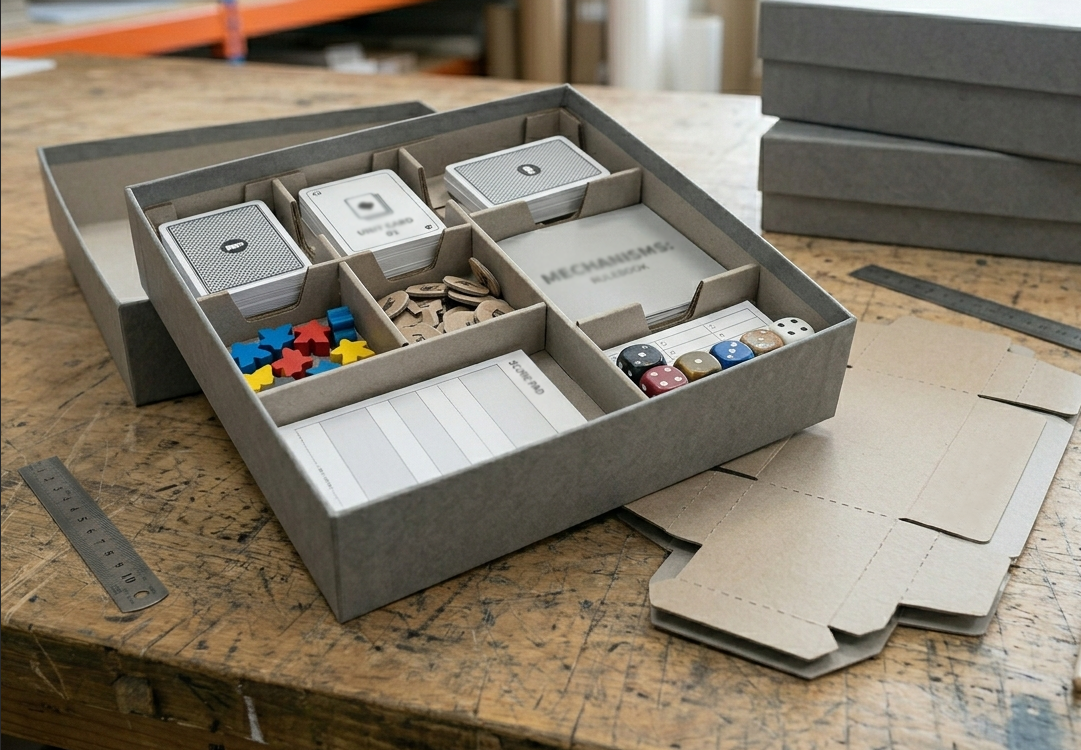 Paperboard insert as an alternative to PET tray for plastic-free board game packaging
But paperboard inserts are not a direct replacement for every PET tray. They work best when components are:
Good fits include: cards, rulebooks, punchboard tokens, dice, wooden cubes, simple meeples, score pads, and flat paper components.
They are weaker when the game includes: painted miniatures, metal coins, acrylic gems, high-gloss painted parts, loose premium components, parts with very different heights, components that need tight cavity control.
A vacuum-formed PET tray can form exact wells around components. A paperboard insert usually needs more forgiving geometry. It can divide sections, lift parts, and organize the box, but it does not grip irregular components in the same way. That does not mean PET is always better. It means the insert should match the component reality.
A paperboard insert is a good plastic-free option when the game is built around cards, boards, tokens, dice, and simple wooden parts. It becomes a weak solution when fragile or heavy parts need precise protection.
⚠️ Warning: If the insert lets parts rub against each other, the eco decision has already failed.
Molded Pulp Is Useful, But It Is Not a Premium Tray by Default
Molded pulp trays can be useful for some plastic-free board game projects. They have a clear environmental story. They can feel suitable for nature-themed games, children’s education games, family games, and products where the visual direction is more natural than luxury. They also provide decent cushioning for some component types.
But molded pulp is not a direct replacement for vacuum-formed PET. The tolerance logic is different. Molded pulp is usually less precise. The surface is rougher. Fine wells, narrow slots, and thin walls are harder to control cleanly. It may not hold small components as tightly as a plastic tray. It may also feel too rough for a collector-style or premium gift product.
Use molded pulp when the components are forgiving and the brand direction supports it. Do not force molded pulp when the game needs:
For many games, a folded paperboard insert is easier to customize than molded pulp. For other games, molded pulp gives better cushioning. The choice depends on component shape, quantity, and the visual position of the game.
The wrong question: Which one is more eco-friendly? The better question: Which one can hold this component set without damage, confusion, or ugly assembly?
Eco-Labels on Plastic-Free Packaging Should Be Specific
Eco-labels on board game boxes should be plain and specific. Do not overclaim.
If the game removes shrink wrap, say that. If cards are packed in tuck boxes, say that. If the insert is paperboard, say that. If only part of the retail packaging is plastic-free, do not stretch the claim.
Useful Box-Side Wording
Risky Wording to Avoid
Those claims are too broad. Even if the retail unit avoids plastic, factory handling, storage, pallet protection, export protection, or fulfillment processes may still use plastic materials. Do not create a claim that the full production chain cannot support.
The safer wording is often “reduced-plastic retail packaging.” Use “plastic-free retail packaging” only when the retail game box itself truly supports that claim. If cards are still shrink-wrapped, tokens are still in plastic bags, or the insert is still PET, that wording becomes hard to defend. This kind of wording is less flashy. It is also easier to verify.
A Practical Plastic-Free Packaging Direction for a Board Game
For many board games, a realistic plastic-free or reduced-plastic retail setup looks like this:
This setup works especially well for card-heavy games, education games, quiz games, family games, and medium-complexity board games with mostly paper and wooden components. It is less suitable for miniature-heavy games, deluxe component games, or collector editions with painted pieces, metal coins, acrylic gems, or many loose premium parts.
That does not mean those games cannot reduce plastic. It means the first step should be smaller: remove outer shrink wrap, replace simple card film, reduce unnecessary small bags, keep protective structures where the components still need them.
A controlled plastic reduction plan is better than a fragile plastic-free claim.
What to Tell Your Manufacturer Before Asking for Plastic-Free Packaging
At the quotation stage, do not just write “plastic-free packaging.” That wording is too broad, and the factory still has to guess which plastic can be removed safely.
Start with the retail box. If shrink wrap is removed, the manufacturer needs to check whether paper seals can actually hold the lid. A tight lid-and-base box may work well with two paper seals. A loose lid will not. In that case, the seal only proves the box was closed; it does not control the box during handling.
For cards, the key point is not only the total card count. It is how many groups must stay separated after the player opens the game. One simple deck can usually use a paper band or a tuck box. Several small decks are different. If they mix easily, small tuck boxes are usually safer than loose bands.
For tokens, dice, meeples, coins, and other small parts, list which items need to stay separated by color, type, or player set. This is where small plastic bags are often doing real work. If those bags are removed, the replacement needs to be designed: paper envelopes, mini tuck boxes, paperboard compartments, or a different insert structure.
For the insert, say what kind of components it needs to hold. A paperboard insert can work well for cards, rulebooks, punchboard, dice, and simple wooden pieces. It is less reliable for painted miniatures, metal coins, acrylic gems, or loose premium parts that can rub or scratch. If molded pulp is being considered, the manufacturer also needs to know whether a rougher, less precise tray finish fits the product style.
Finally, be clear about the wording you want on the box. “No shrink wrap” is easy to verify. “Reduced-plastic retail packaging” is safer if some internal bags remain. “Plastic-free retail packaging” should only be used when the retail game box truly supports that claim.
Deleting every plastic item from the quote is easy. Making the packed box work is the real check.
When Full Plastic-Free Packaging Is Not the First Move
Full plastic-free packaging is not the right first move for every board game. If your game uses painted miniatures, metal coins, acrylic gems, fragile decorative parts, or many small premium components, start by removing outer shrink wrap and replacing simple card wrapping first. Do not force the insert into paper before the component layout is stable.
If the game is still in prototype stage, keep the target practical. Use paper-based structures where easy, reduce obvious plastic, and avoid claims that require perfect retail-unit control.
If the game is moving toward Kickstarter or retail production, decide the packaging claim earlier. The box structure, card grouping, insert design, and eco-label wording should be planned together.
⚠️ Final Warning: Plastic-free packaging is not just a material change. It is a packing-control decision. If removing plastic creates rubbing, mixed components, loose decks, or a damaged unboxing experience, the packaging is not better. It is only greener on paper.