

Eco-Friendly Board Games: How to Lock FSC Materials and Soy-Based Inks Before Artwork Approval
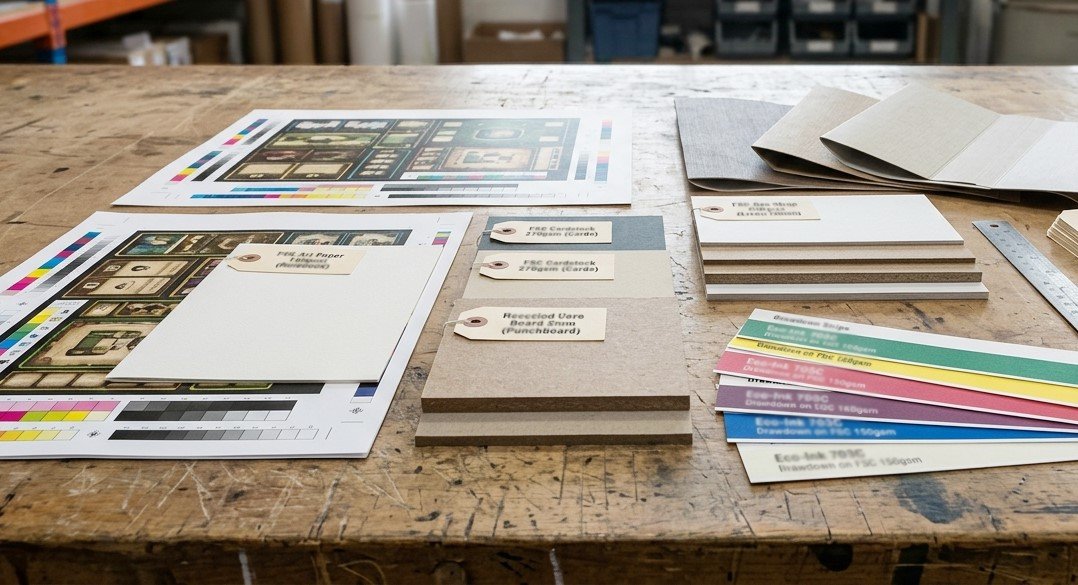
Most eco-friendly board game mistakes start before production. Not during packing. Not during shipping. Usually before the first sample is even made.
A publisher may finish the box artwork, approve the card material, confirm the board thickness, and then ask, “Can we add FSC certification and use eco-friendly ink?”
That is backwards. The box claim should come after the production structure is clear. FSC label space, soy-based ink wording, paper material selection, and coating direction should be decided before the final artwork is released. Otherwise, the manufacturer has to work around decisions that are already locked:
At that point, “make it eco-friendly” becomes a correction, not a design-stage constraint. For a custom board game, the first eco decision should be made around the printed paper structure:
If these questions are answered early, the project can be quoted with fewer assumptions. If they are answered after artwork approval, every change creates friction.
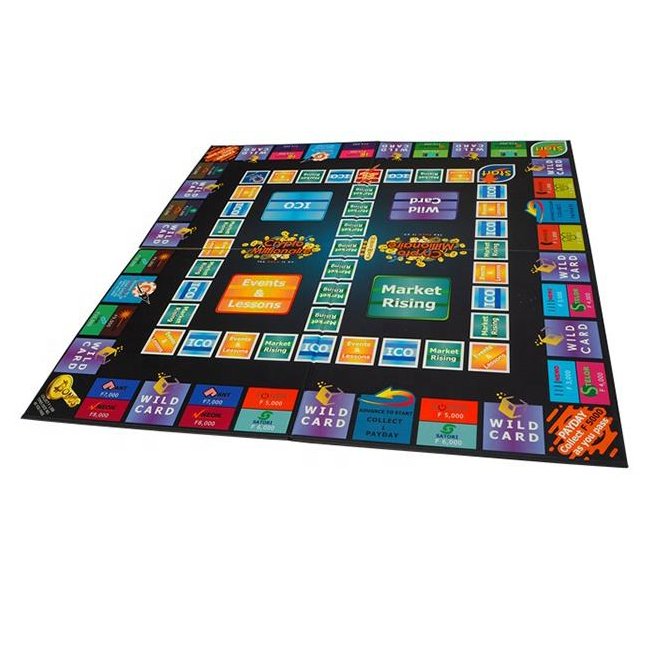
Custom Game Boards
Do Not Start With the Green Icon on the Box
💡 Design-Stage Rule
The box claim should come after the production structure is clear. FSC label space, soy-based ink wording, paper material selection, and coating direction should be decided before the final artwork is released.
FSC Certification Is a Material Decision, Not a Logo Decision
FSC is useful because board games are paper-heavy products. A typical game may include a rigid box, mounted game board, card decks, rulebook, punchboard tokens, paper inserts, tuck boxes, and shipping cartons. Most of the visible product is paper or board. For Kickstarter backers and retail buyers, FSC is easier to understand than a vague statement like “green material.”
But FSC is not just a decorative badge. The FSC label on a finished product signals that materials have met chain-of-custody requirements through the supply chain, and FSC label types such as FSC 100%, FSC Recycled, and FSC Mix have different meanings. FSC-certified companies also need to submit FSC label use to their certifier for approval.
That matters in production. If a customer needs an FSC label on the game box, the supplier cannot simply print the FSC logo because the artwork designer left a blank space. The paper source, certified supplier, label type, and approval process all need to match.
💡 Pro Tip
If FSC labeling is important for your Kickstarter page or retail requirement, tell the manufacturer before sampling. Do not approve a normal paper structure first and ask for FSC labeling after the box design is finished.
Which Board Game Components Should Use FSC Paper First?
Not every component carries the same risk. A clean FSC direction usually starts with the largest and most visible paper parts.
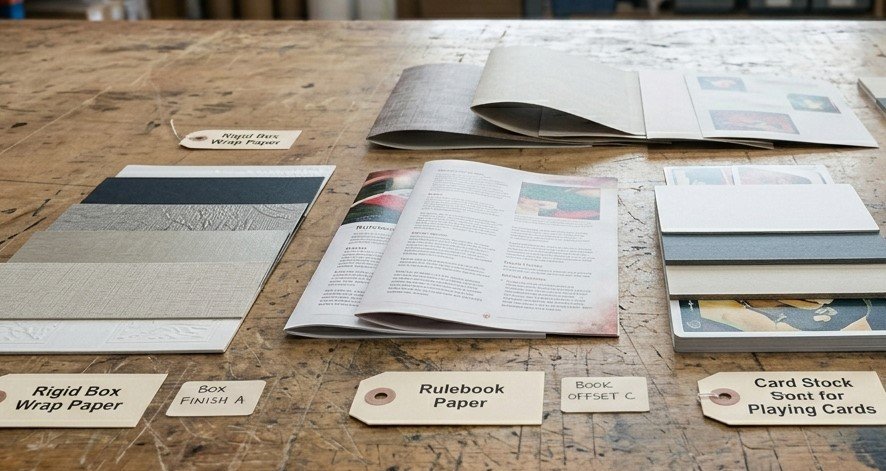
1. Box Wrap Paper
The rigid box is the easiest place for the customer to notice the claim. It is also where the FSC label usually appears. For a lid-and-base box, the wrap paper needs to fold cleanly around corners, bond well with greyboard, and avoid cracking on dark ink coverage. FSC paper is possible, but the exact paper still has to work with the box structure. A paper can be certified and still be unpleasant to wrap. That is not theory. It happens when the surface is too stiff, the grain direction is ignored, or the artwork uses heavy dark coverage around the corners.
2. Rulebook
The rulebook is usually a safe early FSC target. It does not need the same stiffness as cards. It does not need mounted-board flatness. It usually uses common paper weights, such as 100gsm offset paper, 128gsm art paper, or 157gsm art paper depending on the print style. If the project wants to show responsible paper sourcing without adding too much production complexity, the rulebook is one of the easier parts to control.
3. Cards
Cards are more sensitive. Do not choose FSC paper only by certificate status. Cards still need stiffness, opacity, cutting response, coating compatibility, and shuffle feel. For many board games, 300gsm to 330gsm card stock is a normal working range. For heavier card decks or card-driven games, black core or blue core material may be required for opacity and handling. If an FSC option is available inside that material range, good. If not, do not downgrade card performance just to claim sustainability. A card deck that bends too easily, shows through, or chips at the edges will create complaints faster than the FSC claim creates value.
4. Game Board Surface Paper
Mounted boards are not just printed paper. They are paper, greyboard, glue, lamination or varnish, folding line, and wrap control working together. If the board is large, folded, or uses heavy ink coverage, material stability matters more than the label. For game boards, FSC paper should be checked together with:
A 2.0mm greyboard with printed surface paper behaves differently from a 1.5mm board. A quad-fold board behaves differently from a single-panel board. FSC sourcing should fit the structure, not override it.
5. Punchboard
Punchboard is a good candidate for FSC paper-based sourcing, but die-cut response still matters. If the surface paper tears around small tokens, or the greyboard creates too much dust during punching, the material is wrong for the product even if the sourcing claim sounds good. For punchboard tokens, the real test is clean release, edge strength, and print alignment after die cutting.
Soy-Based Inks Are Useful, but They Do Not Replace Surface Protection
Soy-based inks are a practical option for many paper-based board game components. They move away from petroleum-based printing oils and are commonly discussed for offset printing on cards, box wrap paper, boards, rulebooks, and punchboard sheets. The American Soybean Association notes that soy-based ink is accepted as more environmentally friendly than traditional petroleum-based ink, can provide accurate colors, and makes paper easier to recycle, although it can dry more slowly than many inks. EPA material on sheet-fed offset printing also reports lower volatile hydrocarbon emissions when soy-based inks are used.
That makes soy-based inks useful. But they are not a shortcut to “sustainable.”
Soy-based ink does not make a card durable. It does not stop a dark box from scuffing. It does not protect a board surface from repeated folding. It also does not solve printing on PVC, acrylic, or plastic tokens.
For board game production, soy-based inks make the most sense on:
They are not the main answer for PVC cards, plastic miniatures, acrylic gems, or non-absorbent plastic parts. Those components usually need different printing or decoration methods.
The factory-side decision order should be:
Do not start from the ink name.
Coating Choice Can Break the Sustainability Story
This is where many eco-friendly board game plans become inconsistent. A project may request FSC paper and soy-based inks, then apply plastic film lamination to every printed component without thinking about the message. Sometimes that is still the right production choice. Sometimes it weakens the claim. The decision should be made by function.
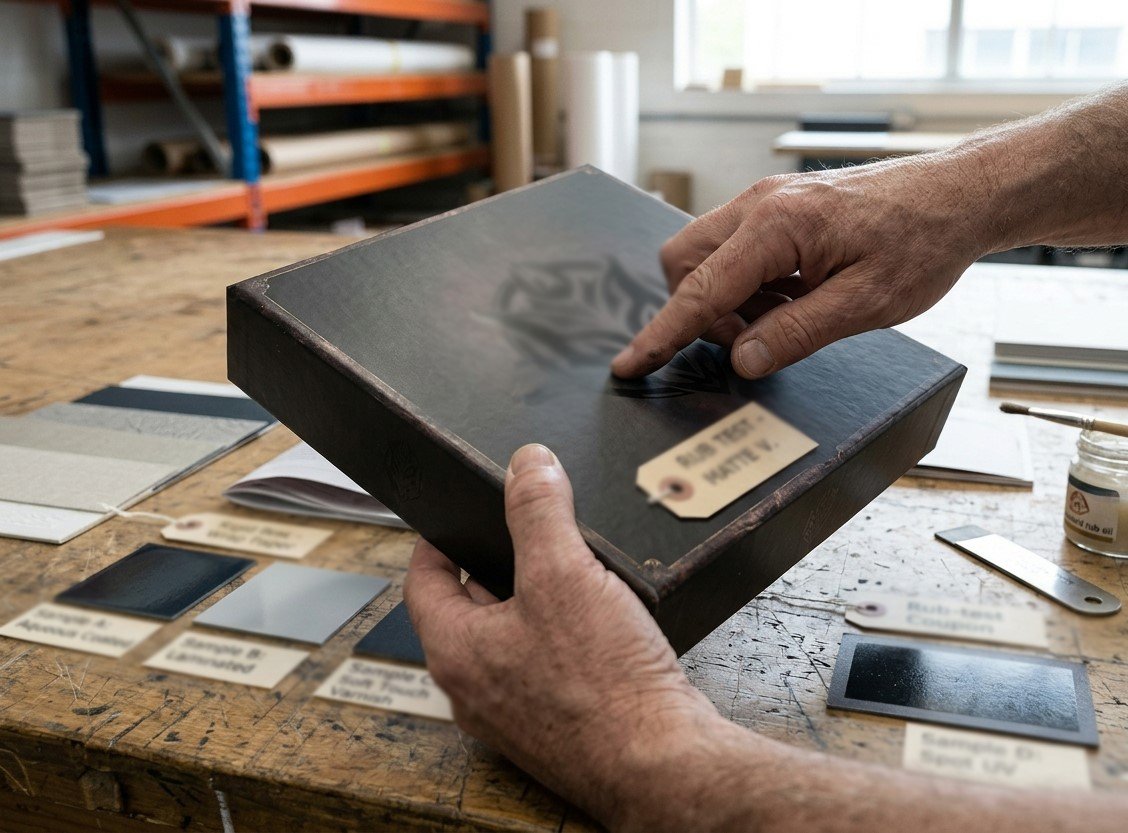
For light-use paper components, matte varnish or aqueous coating may be enough. These coatings can protect the surface without adding the same film feel as lamination.
For card decks, the decision depends on shuffle intensity. A lightly used educational card set does not need the same surface protection as a trading-card-style game or a party game that will be shuffled heavily.
For rigid boxes, the artwork matters. Dark solid colors, black backgrounds, and soft-touch surfaces are more likely to show scuffs, fingerprints, and packing marks. If the box also removes outer shrink wrap, the surface finish needs more attention, not less.
💡 Coating Rule
Use the lightest surface protection that still survives the product’s real handling condition. Not the cheapest. Not the most eco-sounding. The one that survives the project.
For example:
There is no universal answer. But there is a wrong sequence: choosing a sustainability claim first and forcing the coating to match later.
Artwork Should Reserve a Claim Control Area
Environmental claims need a place on the box. This sounds basic, but it is often missed. The back panel of a board game box is usually crowded with:
If FSC label placement or eco-claim wording is required, reserve a small “claim control area” early. Do not put it over a busy illustration. Do not leave it until the box artwork is already approved.
For practical board game packaging, the claim area should be:
This is especially important when working with an FSC certified game manufacturer, because the final label use may need formal approval before printing. The designer does not need to solve everything alone. But the artwork should leave space for manufacturing reality.
What to Tell Your Manufacturer Before Quotation
A manufacturer can give a better eco-friendly board game recommendation if the inquiry includes these details:
This does not need to be perfect at the first inquiry stage. But the manufacturer should know the target direction.
A useful early request might be: “We are developing an eco-friendly board game for Kickstarter. Please quote based on FSC paper components where practical, soy-based inks for paper printing, and a coating choice that avoids unnecessary film but still protects the cards and box surface. We may need FSC label placement on the box, so please advise the artwork requirements before sampling.”
That gives the factory something real to work with.
Factory Note: Do Not Treat FSC and Ink as Afterthoughts
FSC paper and soy-based inks are manageable when they are part of the early production plan. They become messy when added after the normal version is already approved.
If your artwork is finished, paper materials sampled, coating selected, and box layout locked, changing to FSC-certified material or adding a formal FSC label may no longer be a simple revision. It can affect sourcing, approval, print layout, cost, and schedule.
For early-stage projects, keep the sustainability scope practical:
FSC paper-based components where available, soy-based inks for paper printing, and coating selected by real handling requirements.
For late-stage projects, be careful. A stronger environmental claim may require reopening decisions that looked finished. That is not a marketing problem. It is a manufacturing constraint.
Once the paper, ink, and FSC scope are clear, the next step is retail packaging. For many projects, that means reviewing shrink wrap, card wrapping, plastic bags, and insert structure before making a plastic-free claim. Those decisions are covered separately in our plastic-free board game packaging guide.