
Playing Card GSM Guide: What Really Matters Beyond Thickness (Core, Finish, and Shuffle Performance)
Most guides explain card materials as separate topics:
- GSM
- core
- finish
In production, these are not independent variables.
They interact through:
- stack height
- packing density
- friction behavior
- die-cut tolerance
This is where most sourcing mistakes happen.
Not because the information is missing,
but because it is treated in isolation.
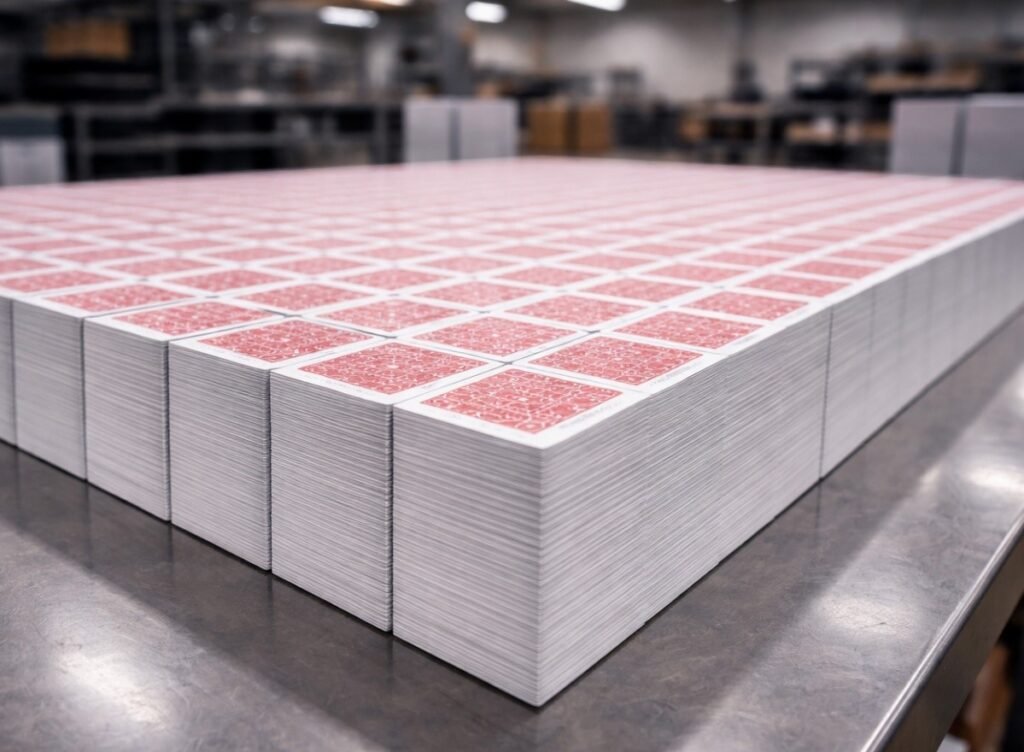
If you are not trying to understand the theory but simply want to decide what to use, refer to our guide on choosing the best card stock for card games, where the specifications are translated into a practical decision framework.

Custom Playing Cards
GSM Is Not Thickness — It Is Stack Behavior
GSM is often treated as a number.
In production, it behaves as accumulation.
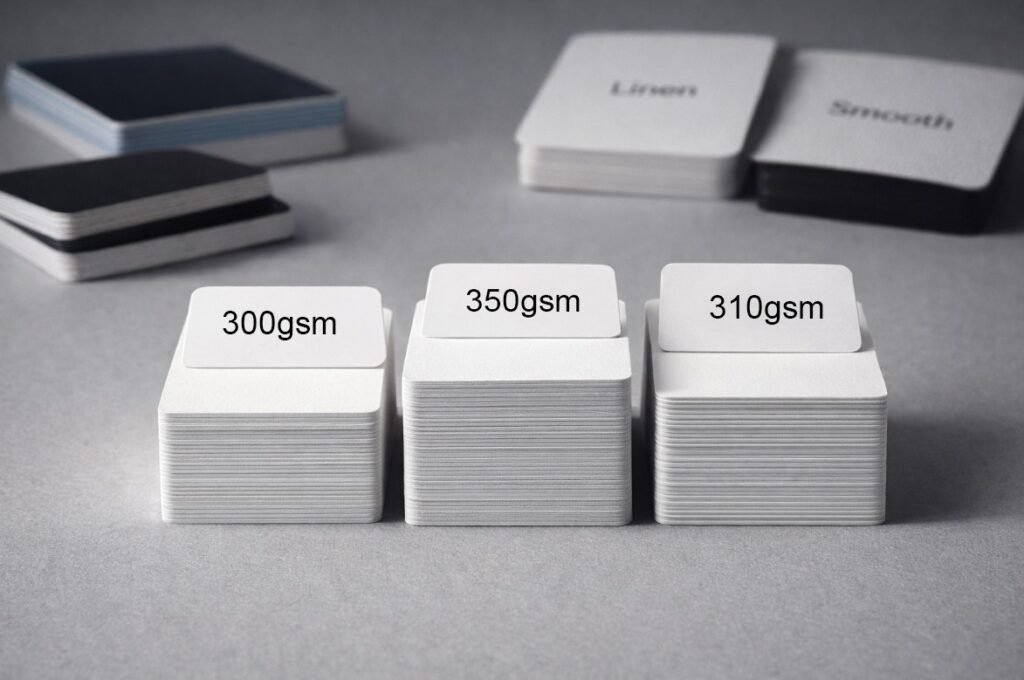
If you are comparing 300gsm vs 350gsm from a decision perspective, our decision guide on the best card stock for card games summarizes where each option actually creates constraints.
What Actually Matters
One card difference is irrelevant.
But across a full deck:
- 72 cards
- 100 cards
- 120 cards
Thickness compounds.
Where Problems Start
At around 80–100 cards:
- small GSM changes begin affecting box fit
- insert tolerance becomes tighter
- packing becomes less stable
This is where “premium thickness” starts creating constraints.
What Typical Guides Miss
Factories do not optimize for single-card feel.
They optimize for:
- consistent stacking
- stable machine feeding
- predictable packing
That is why 300gsm appears repeatedly.
Core Structure: Why Black Core Is a Structural Decision
The topic blue core vs black core cards is often presented as comparison.
In practice, it is closer to risk control.
For the practical buying decision, see our guide to blue core vs black core cards.
What Causes Translucency
Light passes through:
- fiber inconsistencies
- coating variations
- pressure differences during printing
This cannot be solved reliably by increasing GSM.
What Black Core Changes
Black core absorbs light internally.
Not partially — structurally.
Where This Matters
- competitive card games
- high contrast card backs
- retail or tournament lighting
What Is Rarely Mentioned
Black core is less forgiving in printing.
It may:
- slightly affect color brightness
- require tighter ink control
This is why some factories avoid it unless required.
Linen Finish vs Smooth Finish: Friction Is Engineered
The difference between linen finish vs smooth finish is mechanical, not aesthetic.
If your concern is practical shuffle behavior rather than process details, the linen finish vs smooth finish comparison in the main guide is more decision-oriented.

Linen Finish
Created through embossing.
Result:
- reduced contact points
- improved air separation
Effect:
- smoother shuffle
- less sticking
Smooth + Matte Varnish
Created through coating.
Result:
- full surface contact
- consistent friction
Effect:
- slower card movement
- more resistance
What Is Not Standardized
Embossing depth varies by factory.
- too shallow → behaves like smooth
- too deep → affects print clarity
This parameter is rarely specified in quotations.
Durability: Where Cards Actually Fail
Cards do not fail uniformly.
Real Failure Areas
- edges
- coating surface
- layer bonding
What Controls Durability
- coating formulation
- curing process
- die-cut sharpness
What Does Not
GSM alone.
Practical Observation
In repeated use:
- poorly coated 350gsm cards degrade faster
- than properly processed 300gsm linen cards
This is rarely stated in basic guides.
Cost Drivers: Where Budget Actually Moves
Cost does not increase evenly.
It shifts at specific steps.
Where Cost Control Fails
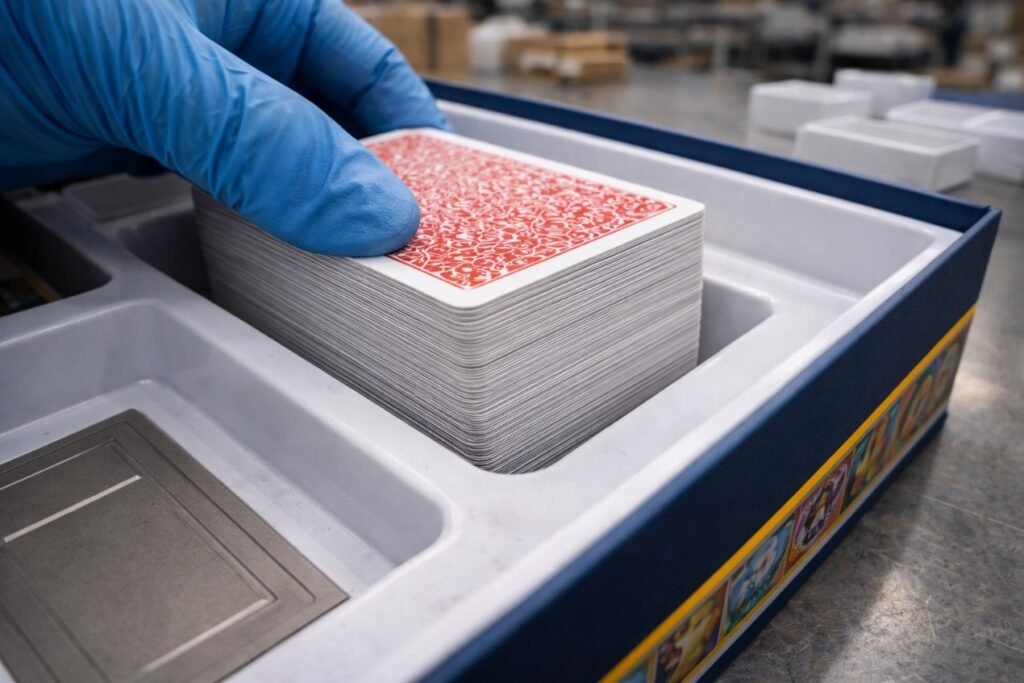
Cost control usually fails at stack height, not at printing.
Sequence:
- card count increases
- GSM increases
- stack height increases
- box size increases
- carton efficiency drops
This is where cost moves.
Direct vs Indirect Costs
- black core → material increase (~10–20%)
- linen → additional processing
- higher GSM → indirect shipping cost increase
Why “Same Spec” Does Not Mean Same Result
Two suppliers quoting the same spec can produce different outcomes.
Reasons
- different paper sources
- different embossing tools
- different die-cut tolerances
What This Means
Specifications reduce uncertainty.
They do not eliminate variation.
Where This Model Breaks
This material logic does not apply well when:
- card count is not fixed
- packaging is undefined
- multiple prototypes are being tested
In these cases, optimizing material too early slows development.
For most projects, these variables only become useful once they are translated into a clear material choice. The full decision framework is outlined in our guide to the best card stock for card games.
Custom Playing Cards
Warning (Not a Conclusion)
If your project requires frequent revisions or SKU changes,
locking GSM and finish too early will create more rework than savings.
Material decisions only work when the surrounding structure is stable.